Is China an environmental savior? Alex Wang says it’s complicated
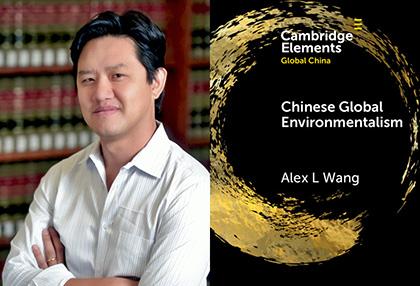
Though China was once viewed as a climate villain, the country now dominates the global supply chains of solar panels, batteries, and electric vehicles. Just this month, Chinese manufacturer BYD overtook Tesla as the world’s biggest maker of EVs. It’s the latest example of how China’s focus on clean technology is setting the pace for the rest of the world as the Trump administration hits the brakes. This reversal may seem relatively new, but it is actually the result of strategic policy decisions made by China over several decades, says UCLA School of Law professor Alex Wang, whose new book, Chinese Global Environmentalism (Cambridge University Press), gets to the heart of the issue. In this Q&A, Wang expands on some of the arguments in the book.
China seeks global recognition as a leader on climate change action even as it remains the largest annual emitter of greenhouse gas emissions. How do you see China trying to strike a balance between those two identities?
China’s pursuit of green development began more than two decades ago, driven by a complex set of pragmatic motives: the need for energy security; the opportunity to lead in fast-growing industries such as solar photovoltaics, wind turbines, batteries, and electric vehicles; widespread domestic pollution that sparked social unrest; and damage to its global reputation as the world’s largest polluter. For anyone concerned with the environment, there are still strong reasons to worry about China. Its emissions and ecological impact remain the largest in the world. At the same time, its clean energy buildout is unprecedented in history, creating the conditions for emissions to begin declining. But the path ahead is long. In the book, I argue that China’s developmental drive toward green growth is ultimately a positive force for the planet. Decarbonization is more likely to succeed when tied to economic self-interest than when driven solely by moral obligation or foreign pressure.
How do you make sense of these seemingly contradictory narratives about China after three decades of working in this space?
China is no more an environmental savior than we in the U.S. are. It’s a nation of 1.4 billion people with rising material demands, while also serving as the world’s factory for ever-growing global consumption. We have to confront the reality that humanity is on track to exceed the planet’s ecological limits. Yet China is like a massive ocean liner slowly changing course — it is beginning to take meaningful steps in several key areas.
What is something surprising that you think readers will learn from your book?
As a lawyer, I focus on norms. In Chinese Global Environmentalism, we see China actively reshaping global norms to better align with its own interests — through diplomacy, economic statecraft, development cooperation, and a green ideology. I argue that this evolution can be beneficial for the planet, even as it carries risks and requires China to engage more carefully with international concerns.
In the U.S., there is a debate over “abundance” and how best to quickly build clean energy, housing, and transportation. What are some of the lessons, and warnings, in China’s ability to get things done, what you label as a “good” environmental authoritarianism?
The U.S. environmental law framework was designed to curb the worst excesses of mid-20th-century industrial growth. It was remarkably effective, leading to vast improvements in public health and environmental quality in the U.S. and beyond. China illustrates a different model: addressing development’s harms by deploying clean energy and infrastructure at scale and speed. The U.S. can learn from this, while still upholding values of transparency, participation, and accountability. We need our process, but we also need to recognize when it’s time to move forward and get things built. This is easier said than done, but it will involve allowing process but also setting time limits on litigation and deliberation, as California has already begun to do in some instances.
As you visit other law schools to talk about the book, what do you hope law students and academic colleagues will take away from the book or ask you about?
My hope is to build a better understanding of China — one that helps us engage constructively as a global community in working toward shared environmental goals. There are many people here in the U.S. working on China policy issues who have limited direct experience with the country. I want to inform the public debates so we have a more accurate assessment of the risks and opportunities at play.
Alex Wang will discuss Chinese Global Environmentalism at UCLA School of Law on March 4. RSVP for the in-person event.