A second chance: How UCLA Law’s Resentencing Practicum helped one man go free
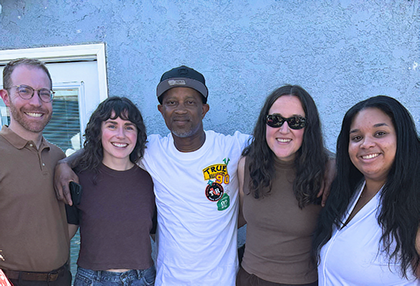
To everyone who was there, the special gathering on a sunny Sunday in March was a joyous and warm affair – and an event that they never fully expected to happen.
Students and staff members of UCLA School of Law’s Resentencing Practicum were in the backyard of a Los Angeles home, eating, drinking, and sharing hugs and high-fives as vital figures in the extended community of Joseph Turner. Thanks to their hard work and partnership with federal public defenders, Turner had been freed from prison after more than 25 years.
“It felt surreal,” says student Destinee Dickson ’26 in the days after Turner’s welcome-home party, which followed years of judicial denials and other legal disappointments. “There was so much uncertainty throughout the entire process. When I joined the practicum, there was no guarantee that we would be successful. Even after we filed the motion, it still felt like a long shot, especially with a pending Supreme Court decision on compassionate release at the time. So when the judge granted his release, it felt like everything paused for a moment. It was overwhelming in the best way. It reminded me why this work matters.”
A gem of UCLA Law’s trailblazing Experiential Program, the Resentencing Practicum allows students to advocate for incarcerated clients who are seeking sentence reductions. They litigate in federal court for clients who are facing medical or family emergencies, and they file cutting-edge motions for clients – including Turner – who are serving lengthy prison terms due to unjust or outdated sentencing laws. The practicum also features a seminar where students grapple with policy issues that arise in their fieldwork.
Altogether, says Josh Weiss, a former federal public defender who teaches the practicum, students learn investigation, collaboration with incarcerated clients and their families, and extensive brief writing. In Turner’s case, those skills were essential to bringing about his release.
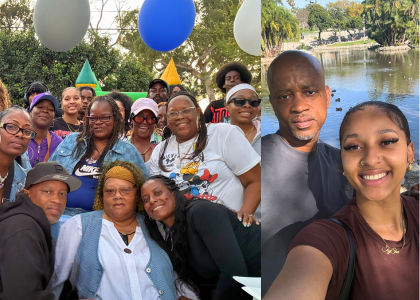
“I couldn’t be happier for Mr. Turner and his family or prouder of the students who put together the motion on his behalf,” says Weiss, who is a Binder Clinical Teaching Fellow at UCLA Law. “This result was the product of many people’s hard work, including the students, our colleagues at the Federal Public Defender’s Office, and, most of all, Mr. Turner, who spent many years getting ready for this moment. In obtaining relief for Mr. Turner, we also drew upon the work of a national network of public defenders, clinicians, and incarcerated people who have built a record of success in related cases.”
Weiss stresses the importance of his students’ collaboration with people in the Federal Public Defender’s Office in L.A.: Lisa LaBarre, the trial chief; Drew Havens, a deputy federal public defender; Brittany Klein, a paralegal; and Inna Verdiyan, the clinical supervisor of the federal public defender’s social services unit.
Working closely with the federal public defenders, the students conducted extensive factual investigation and legal research and ultimately drafted an expansive motion for compassionate release, which deputy federal public defender Havens filed in federal court in December 2025.
Their motion presented the key facts in the case. Turner’s childhood, they wrote, “was characterized by poverty, abuse, and neglect.” He was 23 years old when he was sentenced to almost 37 years in federal prison for a pair of armed bank robberies in which he did not physically harm anyone. Far longer than the duration of the average federal punishment even for murder, the sentence was driven by mandatory sentencing laws that Congress had greatly reduced in the years since. By 2025, Turner had served 25 years – “over 130% of the sentence the law now considers just,” their motion argued.
With invaluable help from Turner’s family, especially his adult daughter, Jay’Sha, they painted a picture of a man who had turned his life around. During his incarceration – and after he was almost killed when another prisoner stabbed him – Turner got sober, taught himself to read and write, earned his GED, obtained several rehabilitative and vocational certificates, and earned so much trust that he was appointed an orderly of his unit. Prison staff, they wrote, described him as a “model inmate” and a “great leader,” and he had officially been re-classified “as a low risk for recidivism.”
“Looking back on my life as a younger man, I’ve made some really bad decisions,” Turner wrote in a letter to Senior U.S. District Judge Terry Hatter that his legal team submitted with their motion. “I’ve created victims and crimes that I really regret. No one should be fearful of just going to shop for groceries or to go inside of a bank on a casual day to withdraw funds. The bad thing about creating victims is that you can’t uncreate them and the spill-over effect hurts everybody. My heart and soul goes out to the people that were made victims by my decisions. I hope that they will find forgiveness in their hearts as I have found redemption in mine. I apologize to all the victims, including my family.”
Turner said that, after his release, he planned to keep his family’s restaurant going because his mother was in declining health. He also hoped to continue building a connection with Jay’Sha, who earned her bachelor’s degree in 2025 but never knew her dad outside of prison.
“While I still don't really know my father,” she wrote in another letter that accompanied the motion, “life is moving so fast and I desperately want my dad to be a part of it. I want to show him where my first job was and where my first paid art mural is. I want to watch stupid love reality shows with him, cook with him and hopefully cook his first meal as my cooking skills have improved! I just want him here, so we can build a true father and daughter relationship.”
In late February, Judge Hatter granted the motion and ordered Turner to be released.
“While Mr. Turner is an exceptional person in many ways, his case is not an outlier,” Weiss, the practicum’s director, says. “It is instead a reminder of the many other similarly situated people who have been incarcerated since they were young adults and are now more than ready to come home. I hope this case is just the beginning of the work we are able to do in the Resentencing Practicum, which joins a national movement of clinics and practitioners seeking second chances for incarcerated people.”
That community spirit is a main reason why Weiss took on the practicum and is excited to tackle the next challenge. It’s a mindset that resonated with his students.
“The resentencing practicum had everything I was looking for in a clinical experience: the opportunity to work closely with a client and their family members and gain legal research and writing experience, all under the close guidance of a professor,” says Cathy Balfe ’26, who emphasizes that writing a persuasive motion included significant storytelling. “Mr. Turner is truly an incredible man, and we knew it was our responsibility to showcase that to the judge. This involved gathering letters from Mr. Turner’s family, friends, and supervisors and highlighting his many achievements.”
“This was the most meaningful experience I’ve had in law school. Getting to know Mr. Turner and helping tell his story was a real privilege,” says Tori Funk ’26. She will be working for the alternate public defender of Los Angeles County after she graduates in May and hopes to do plaintiff-side prison litigation and post-conviction work in the longer term. “The course shaped how I’m thinking about my future. So much of law school focuses on the front end of the criminal legal system, but this class pushed me to think more seriously about post-conviction work and the kind of impact it can have.”
Those subtle shifts in perspective and purpose were common among the students.
“I came to law school with a strong interest in public service and civil rights, and experiences like this have only reinforced that commitment,” Dickson says. “Going forward, it’s going to shape how I approach every case. It reinforced the importance of thorough advocacy, storytelling, and really seeing your client as a whole person. It showed me what it actually means to be a lawyer, not just understanding the law, but using it to change someone’s life.”