‘Backtalker’: Kimberlé Crenshaw shares insights from her new memoir
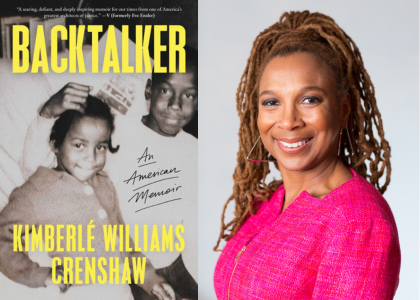
Members of the UCLA School of Law community gathered on April 16 to celebrate the publication of Distinguished Professor Kimberlé Crenshaw’s new book, Backtalker (Simon & Schuster, 2026). In the memoir, Crenshaw tells a personal story of her journey from Canton, Ohio, to UCLA Law, where she coined the term “intersectionality” and has served on the faculty for 40 years, to prominence as a leading Critical Race Theory scholar and civil rights advocate.
At the event, Crenshaw spoke with her longtime colleague Cheryl Harris, herself an eminent UCLA Law professor and authority in Critical Race Theory and civil rights. Here are some of the insights that Crenshaw shared during their conversation.
On what motivated her to include her personal stories in her book
“I’ve been called a public intellectual because I fashioned some words you may have heard of, like intersectionality and critical race theory. But if your vision of an intellectual brings to mind the thinker’s pose, one with chin in hand, who ponders abstract ideas, and, with a lightbulb suddenly flashing overhead, writes down her epiphany – that’s not me, at all. My thinking starts from the bottom up, from interactions with people and experiences across my entire life that have made me feel some type of way. It’s a feeling that tells me to pay attention, to ask some questions, and to struggle to put into words something that needs to be said. That’s what these stories are.”
On the narrative tradition in which Backtalker resides
“I’ve been trying to think of it as ‘critical race memoir.’ I think it pulls from the tradition of Black memoirs – I was deeply influenced by Angela Davis and George Jackson, and the broad groups of folks who shaped our thinking. I think what we’re doing now is a sub-genre of that genre. So, you have traditional memoir, and it’s a personal thing, a story of development and getting to know yourself. Then, you have ours that is a story about us in relationship to history and structures and inequality. I think the critical race memoir … attends to law’s facilitation of these experiences, addresses those who don’t see how law constructs race, and then insulates the thing that it is constructing. It’s trying to create language for people to understand, that law isn’t a sort of neutral referee. Law is there from the beginning, and it shapes what race is.”
On the legacy of her mother’s and grandparents’ efforts against discrimination
“I was shaped from the very early moments of my childhood by my mother’s determination not to hide the reality in which I was born. … It was deeply infused in me that this was the history out of which we come. That is the movie theater. I saw it. It wasn’t in a faded black-and-white picture. It was right there on Market Street. This is the root beer stand that used to try to serve our family in paper cups, and then when they had to serve them in the mugs, they would set them aside. So, my mom made it so concrete that I didn’t really feel like I was choosing – it felt natural to me to continue to challenge some of these things. … It is my inheritance.”