Scientific efforts to curb climate change are moving fast. One UCLA Law project tackles their legal impact.
For decades, the global response to climate change has focused on two strategies: reducing greenhouse gas emissions and adapting to environmental changes already underway. But as warming accelerates and its consequences intensify, scientists and policymakers – including many members of the UCLA School of Law community – have been considering radical new interventions, such as stratospheric aerosol injection, which would release reflective particles into the upper atmosphere to reflect incoming sunlight back into space.
At UCLA Law, the Earth System Interventions Law and Policy Project (ESI Project) is helping to answer thorny legal questions around such efforts. Who should decide whether to alter the planet’s temperature? How should governments assess potential harms? What accountability mechanisms would be needed in case someone claims that an intervention has benefited some countries but harmed others? What new legal authorities or policies are needed to ensure that if these are done, they are done competently, carefully, and fairly?
“Decades of inaction to cut emissions and adapt have left us behind the eight ball, where bad things are happening faster than it’s possible to control events through cutting emissions or adaptation alone,” says ESI Project leader Edward (Ted) Parson, the Dan and Rae Emmett Professor of Environmental Law and faculty director of the Emmett Institute on Climate Change and the Environment.
“The project is not about making judgments about what we should do,” he adds. “It’s mainly about taking seriously the prospect that people are going to want to do these interventions because things are going to get really bad. It requires new approaches to coordination, control, risk assessment, management, and governance.”
Data-led partnerships around the world
Housed at the Emmett Institute, the ESI Project is the only effort of its kind at an American law school. It examines the legal, policy, and governance challenges that are associated with large-scale environmental interventions, and it builds on an earlier effort, the Geoengineering Governance Project, which Parson launched at UCLA Law in 2017. Beyond endorsing or rejecting any particular intervention, it helps governments evaluate potential options in regard to their use, efficacy, and regulation.
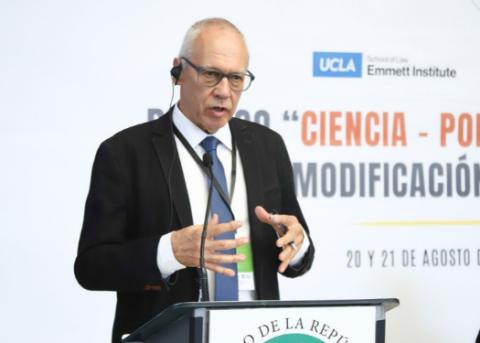
Parson’s ESI Project work spans the globe. It has involved developing partnerships with nearly 100 policymakers from 19 Latin American countries, including engaging in meetings in the senates of Mexico and Chile and in the Parliament of Latin America and the Caribbean in Panama City, Panama. Also ongoing are particularly rich and sustained interactions with institutions in the United Kingdom, Canada, and other Arctic Circle countries. And efforts are expanding to other nations in Europe and Asia, with a focus on the polar regions. Consultations give policymakers opportunities to examine the science, discuss potential consequences, and consider how governments might responsibly oversee efforts.
The project also addresses an imbalance in the international debate: Wealthier countries have historically had greater resources for scientific research and policy analysis than poorer nations do, even though climate interventions could benefit populations worldwide.
Nicolas Esguerra, who directs the ESI Project, says the goal is not simply to deliver information to countries. The team also seeks to build local expertise and create opportunities for policymakers to contribute their own perspectives, ensuring that decisions reflect different national circumstances and priorities.
“Public bodies, such as governments and intergovernmental institutions, are being challenged to address matters as the conversation grows,” Esguerra says. “They’re challenging topics to discuss, and many countries have been slow to recognize their importance.”
The ESI Project, he notes, helps policymakers understand the legal and policy implications of technologies that they may eventually need to consider. Esguerra emphasizes that public institutions must be prepared to address these challenges, regardless of their views on the technologies themselves. While other programs are mainly seeking to advance scientific research into interventions and develop and assess associated technologies, the project helps translate these findings for the worlds of law, public policy, and international relations. This work is particularly important because emerging technologies can develop faster than established policy processes can respond.
Crafting concrete and practical solutions
The effort is yielding results. Following a briefing from the ESI Project on sunlight-reflection approaches, the Parliament of Latin America and the Caribbean passed a resolution calling for the subject to be incorporated into its framework law on climate change.
Parson says that there is a significant debate around environmental interventions because some authorities are suspicious about them. He argues that governments still need to understand how these responses to climate change might work, what their limitations would be, and how they could be controlled if climate threats made them attractive.
The Emmett Institute is developing other opportunities that are focused on the governance of earth system interventions. A forthcoming summer institute will bring together graduate students and early-career professionals to explore interventions’ legal and policy challenges. The aim is to build a community of new leaders in the field – researchers, lawyers, and policymakers who are equipped to address questions that traverse disciplinary and national boundaries.
Parson says that policymakers in Latin America have shown considerable interest in understanding the options and their limitations. He sees universities as valuable partners in helping public institutions navigate unfamiliar challenges. By encouraging informed debate and helping institutions confront difficult questions before a climate crisis forces them to act hastily, the project hopes to improve the decisions that governments may one day have to make.
“Our aim is to think concretely and practically about legal, policy, and institutional responses that might help,” he says. “That might help these interventions get better understood, enable their risks to be more fairly assessed, and nurture a capacity to control them justly and prudently.”