UCLA Law experts shed light on the abortion pill case that is making news
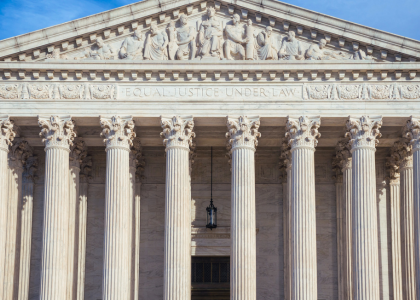
The latest major development in abortion law has brought global headlines – and swift action by members of UCLA School of Law’s Center on Reproductive Health, Law, and Policy (CRHLP). On May 1, the U.S. Court of Appeals for the Fifth Circuit issued a decision in Louisiana v. FDA that effectively halted patients from obtaining through the mail or a pharmacy the abortion and miscarriage drug mifepristone. Then, on May 4, the U.S. Supreme Court issued a one-week administrative stay. Members of CRHLP partnered with several outside organizations to craft and submit an amicus brief on behalf of 360 reproductive health researchers, arguing that the Supreme Court should reverse the Fifth Circuit’s ruling based on the overwhelming evidence of mifepristone’s safety and effectiveness.
CRHLP’s Amanda Barrow, Cathren Cohen, Melissa Goodman, and Diana Kasdan are working on the case. Here, Goodman, CRHLP’s executive director, summarizes their brief’s expansive argument, weighs in on the stakes here, and previews what comes next.
Why is Louisiana v. FDA important?
The outcome of this case will impact whether everyone in this country can continue to get the most common and effective abortion medication by mail or pharmacy, or if they will be forced to travel, sometimes hundreds of miles, to pick up mifepristone in person at a clinic, medical office, or hospital. An in-person dispensing requirement would mean the Supreme Court is ignoring sound science that mifepristone is safe and the FDA’s well-supported determination that an in-person requirement was medically unnecessary and too burdensome for patients. The ruling is also important to the FDA and drug law beyond abortion. To our knowledge, no court has ever ordered the FDA to reimpose on a drug a safety rule the agency has thoroughly studied and deemed unnecessary. If the Supreme Court overrides the FDA determination in this way, it will have tremendous impacts for drug manufacturers, pharmacies, and the business of drug making.
How does this case fit within the overall conversation and legal landscape of abortion law?
If the Supreme Court reimposes an in-person dispensing requirement for mifepristone, it will be the biggest legal blow to abortion access since the Supreme Court’s decision in Dobbs v. Jackson Women’s Health Organization, which overruled Roe v. Wade and ended the federal constitutional right to abortion in 2022. Now, medication abortions account for almost two-thirds of all abortions in the U.S., and telehealth is used in 27% of abortions in the country. Telehealth has been a critical access point for people who face difficulty accessing care, such as people living in rural areas, people with limited resources, survivors of intimate partner violence, people with disabilities, and underserved Black and brown communities. Mail and pharmacy access is also the easiest method of access for people in states that severely restrict or ban abortion.
What happens next?
On or before May 11, the Supreme Court will likely clarify whether it will extend the stay for the remainder of the proceedings. After that, it could be a while, as proceedings continue, maybe for years, before a final decision is reached — as we have seen in other related cases. If the U.S. Supreme Court does not fully stay and prevent the Fifth Circuit’s order from taking effect until it is able to consider this case on the merits, it would upend how abortion and miscarriage care are currently delivered across the country.