UCLA Law’s innovative Levy public interest fellowship enters its ninth year of inspiration
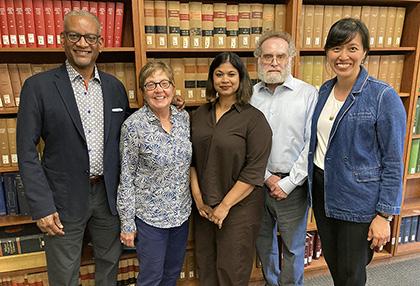
“A lawyer translates moral urgency into leverage,” Vincent Warren, executive director of the Center for Constitutional Rights, told a packed auditorium of UCLA School of Law students in March. Warren, one of the leading civil rights advocates in the country, was there as the Spring 2026 Margaret Levy Public Interest Fellow. He delivered his keynote address, “Leveraging Law, Reinforcing Resistance and Catching Courage,” before the rapt crowd.
“Law is one of the few languages institutions of power are forced to answer to,” he told his audience of future lawyers of conscience. “It can slow violence. It can expose truth. And sometimes, [it can] lock in gains so they’re harder to roll back.”
A signature presentation of UCLA Law’s renowned David J. Epstein Program in Public Interest Law and Policy, the Levy Fellowship has, since 2018, welcomed many of the most eminent advocates in the field. Twice each year, one new fellow comes to the law school for meetings with students and faculty members, office hours that can launch ongoing mentorship connections, probing round-table discussions, and a lecture on the importance of their work.
Past fellows include Vanita Gupta, who has served as the associate attorney general in the U.S. Department of Justice and head of the Leadership Conference on Civil and Human Rights, and Dale Ho, who directed the ACLU’s Voting Rights Project and is now a judge on the U.S. District Court for the Southern District of New York.
At UCLA Law, they have found a community brimming with enthusiasm: Each year, as many as 1,300 prospective students apply to the law school’s program to specialize in public interest law, which has only 25 spots for 1Ls. The fellowship thus enhances UCLA Law’s status as a hub of advocacy and scholarship in the field and is a magnet for the country’s top practitioners, who join in carrying forward the law school’s founding mission of service and access to justice.
“This fellowship seemed like a good way to inspire law students to see other people who have become successful as public interest lawyers and what they can accomplish,” says Levy ’75, whose gift launched and sustains the fellowship.
A mediator and former partner at Manatt, Phelps & Phillips, Levy credits her time as a UCLA Law student for opening her eyes to public interest law, including a key experience that she gained in the summer between her first and second years of law school, working in Washington, D.C., for the legendary consumer advocate Ralph Nader. During her years as an attorney in private practice, Levy continued her commitment to pro bono work and public interest organizations.
“There’s always the need for public interest lawyers,” Levy says. “It’s pervasive, it’s everywhere.”
Students and practitioners enjoy a mutual benefit from the program that Levy launched. Warren, for one, echoes the feelings that several participants have expressed during their fellowships. “It’s really wonderful to be [in this later] stage of my career … and get a different perspective,” he says. “When you see your work and your organization through the students, that’s been very gratifying. The students are just full of dynamism and full of questions, and they seem to be very hungry to get out there and do the work.”
Grace Meng, UCLA Law’s assistant dean of public interest law programs and executive director of the Epstein Program, zeroes in on how students approach the fellows – at once concerned about how they can join in as advocates during a particularly fraught American moment and how they can successfully harness their instincts to make a difference.
“There is a real critical mass of energy here,” Meng says. “So fellows aren’t just coming here to say, ‘Let me share my expertise.’ They’re saying, ‘Let me tell you about my career path. Things don’t always work out the way you think they will.’ I would have loved to have heard that as a law student – just to know that there are so many ways to have the impact that you want to have.”
Student Grace Han ’28 got that encouragement firsthand when she met with former acting U.S. labor secretary Julie Su during Su’s Levy Fellowship in November 2025. It was, Han says, a highlight of her UCLA Law experience. “Su’s commitment to justice renewed my own as an aspiring civil rights lawyer,” Han says. “Her career as a pioneer of novel legal strategies inspired my excitement about the skills I am gaining as a public interest law student, and her sincere kindness empowered me as a young woman of color.”
This effort takes place at a time when public interest lawyers are reevaluating their work and the best ways in which they can create change, says Sunita Patel, a UCLA Law professor and the former faculty director of the Epstein Program. “What do public interest lawyers do right now? What do we do to shift our strategies and our thinking around the kinds of litigation, the kinds of legal services, the kind of policy work we can do in a moment when our democracy is in crisis?” She emphasizes that the partnership between law students, faculty members, and practitioners extends far beyond the classroom, as the Levy Fellowship underscores.
This month, the Levy Fellowship enters its ninth year when Jessica Rutter ’13 visits. It’s something of a full-circle moment, considering that Rutter – a workers’ rights champion who is the manager of the AFL-CIO Labor and Immigration Policy Lab and was the former acting general counsel of the National Labor Relations Board – graduated from UCLA Law and the Epstein Program little more than a decade ago. Her Nov. 9 talk will be titled, “An Injury to One Is an Injury to All: Solidarity in Law and Practice.”
Next semester, Skye Perryman, the head of Democracy Forward, will be Spring 2027 fellow.
“UCLA Law has always been on the cutting edge,” Levy says. “It was ahead of the curve in clinical education, and inspiring people to go into public interest careers is a real strength of ours – and something that attracts students from all over.”