In UCLA Law’s new Housing Justice Clinic, students help vulnerable tenants help themselves
Even before he enrolled at UCLA School of Law, Eli Sills ’26 had a passion for housing justice. He volunteered with LAFLA, the Legal Aid Foundation of Los Angeles, where he worked with tenants’ rights organizations to protect residents from eviction by unscrupulous landlords. There, he saw how many of the city’s most economically vulnerable residents benefit from rent stabilization laws but still can be forced from their homes by landlords who hope they don’t know their rights and won’t fight back.
So when the law school’s Housing Justice Clinic launched in 2026, Sills was one of the first students to sign up.
The newest addition to UCLA Law’s renowned clinical and experiential education program, the Housing Justice Clinic gives students hands-on experience in putting a stop to questionable evictions. Critical to their efforts is movement lawyering – harnessing grassroots social movements to mold political, economic, and systemic power. Students spend roughly 18 hours weekly on their cases, and they attend a seminar taught by clinic director Matt Nickell, a housing and civil rights attorney formerly with the U.S. Department of Justice, where they study housing law and the broader history of housing justice in Los Angeles. Experienced lawyers also visit the seminars, giving students the chance to learn from people who have worked in the field. It’s an education that they can then apply in real time during their work in the communities where people are at risk of losing their homes.
“A key feature of our clinic is that it gives students significant ownership over the cases,” Nickell says. “They’re not just doing a piece of a case, and they’re not just helping with a pleading. They’re appearing in court, arguing, and doing trials if necessary. Students also learn how individual cases fit into the broader housing picture. It’s an invaluable opportunity to experience what it’s like to do public interest lawyering work.”
“Housing Justice is the reason why I came to law school,” says Sills, who graduated last spring and is continuing his tenant-rights work for Brooklyn Legal Services in New York. He adds that the clinic centers on three fundamental ideas: dignity, stability and community. “When I learned of the clinic, I jumped at the opportunity. It was exactly what I'd been looking to do.”
At work on the front lines
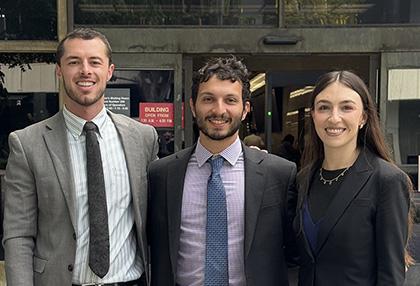
In the Housing Justice Clinic, Sills and his fellow clinic students represented more than a dozen tenants in neighborhoods across Los Angeles, including areas experiencing gentrification. Tenants can be accused of false lease violations, such as fictionalized noise violations or misuse of a garage, for example. Sills and classmates Rose Becker ’26 and Neill McComb ’26 were the clinic’s inaugural participants. Many of the tenants they represented were low-income Spanish speakers who had lived in their homes for decades. Eviction could mean homelessness or force them to leave Los Angeles altogether. The students got a front-row seat to their challenges. “You can learn about the housing crisis, and you can learn about tenant law and property law more abstractly,” Sills says. “But it really doesn't compare at all to the experience of actually doing that work, actually engaging with tenants in that real space.”
The students consulted with clients by phone or at tenants’ union meetings, and they appeared in court on their behalf. The students’ goal was clear: keep the tenants in their homes and communities. They succeeded every time, winning favorable outcomes through motions for summary judgment and demurrers, thereby saving their clients from unlawful evictions.
In one case, apartment residents showed up to court wearing matching tenants’ union T-shirts, an example of what movement-oriented legal work could accomplish. “They created solidarity, and this was their fight,” Sills says. “We were just the legal support for them.”
Peter Horton is the clinic’s staff attorney. He emphasizes how much the students built their expertise during just one intensive semester. At the beginning of their experience, the students were learning how to move from identifying a legal issue to deciding what would actually help a client.
“By the end, they were taking real ownership of their cases,” Horton says. “They were interviewing clients more thoughtfully, recognizing that legal and strategic questions rarely have one tidy answer, and making recommendations that accounted for both the law and what their clients wanted. That growth came from having meaningful responsibility for real people’s problems, with room to reflect and try again.”
Real-life experience creates real-world impact
A legal victory, it turns out, can often signal the beginning of a larger fight. A landlord may try to evict residents again, but clinic counsel – and resident solidarity – can allow them to further organize and develop their own leverage. It's good preparation for a public-interest career, Horton says, because, beyond knowing the law, public interest legal careers require quick judgment, teamwork, and clear and honest communication.
Becker joined the clinic with her own glimpse of housing and the law. Before law school, she worked on environmental cases involving people displaced from their homes. The experiences showed her how losing a home can affect a family, particularly a low-income family. As law school progressed, she decided that she’d use her legal acumen for the highest good. “I was really starting to feel like all of my classwork was very disconnected from what I wanted to do in the law, which was helping people,” she says.
She and her clinic classmates spent time observing eviction court, and that’s where Becker observed an enormous imbalance. Almost all tenants in Los Angeles did not have lawyers, while almost all landlords did. The consequences were apparent in courtroom after courtroom. Tenants might have legitimate defenses because their apartments were uninhabitable, because they had paid their rent, because a landlord had improperly raised the rent, or because required repairs had not been made. But they contended with esoteric and complex housing and municipal codes that are difficult even for many native English speakers to parse, and few knew how to invoke their legal protections.
“So many of the times, the tenants could have won their cases and stayed in their homes, but they just didn't know any better,” Becker says. “There were multiple times when I felt angry.”
So Becker leaned in. As certified law students, she and her classmates were permitted to perform much of the work of an attorney, under the supervision of licensed attorneys – in this case, Nickell and Horton. They took a deposition, conducted discovery, and drafted motions. They also appeared in court and argued before judges.
In one case, they represented two households from a larger tenant association with dozens of people, many of them families from the Mexican state of Oaxaca, who were contesting eviction from their Mar Vista apartment building. While the tenants were afraid, Becker also saw a resolve that spurred collective action. Residents who had lived together for 20 to 30 years formed the tenant association to support each other and fight their corporate landlord. With the support of the UCLA Law students, the tenants attended court proceedings, won their cases, and forced the landlord to send a new one-year notice before it could attempt new eviction cases.
The experience was particularly gratifying for Becker, who plans to do plaintiff-side work in cases involving housing and environmental harms. “I really just wanted to be in an area of law in which I feel like I'm on the right side of history,” she says.
Responding to systemic changes in housing
For McComb, the issues confronting tenants in Los Angeles were never abstract. As a renter himself, he understands the challenges that can accompany something as fundamental as having a place to live. For years, he rented while navigating the financial pressures of school loans. “I know that it's a big and pressing issue for a lot of people all over L.A., and all over the country,” he says.
Before law school, McComb worked as a paralegal at an immigration law firm in San Diego. He entered the job hoping to help people with family reunification and other immigration matters. Instead, much of his work involved wealthy clients. The experience, he says, was disillusioning. McComb came to understand a basic reality of private legal practice: Lawyers generally serve the people who can afford their services. As someone who looks forward to doing pro bono work in his legal career, he found the clinic to be a tremendous opportunity.
“I thought that this would be a good chance to do something where it was really helping individuals who otherwise didn't have access to help,” McComb says. “People who might feel like they're locked out of the justice system because they can't afford to pay the high rates.”
The landlords whom McComb encountered in the clinic weren’t necessarily stereotypical slumlords. Instead, he saw a more sophisticated system, one in which ownership could be obscured behind layers of limited liability companies looking to turn a maximum profit from their properties. “We had cases at the clinic where LLCs were set up for specific buildings,” he says. “And in those kinds of cases it can make it hard in an eviction lawsuit to get at all the information of the parent landlord company.”
McComb observed how the Los Angeles housing market creates powerful incentives for landlords to replace lower-rent housing with more lucrative properties. In a city where housing is scarce and expensive, he says, some owners can make substantially more money by redeveloping buildings and replacing them with smaller, higher-end apartments aimed at tenants who can pay considerably more.
“I don't think that landlords are bad people,” McComb says. “But the incentives are just so strong for them to do these things.”
Cultivating such a nuanced perspective and helping tenants help themselves are just two ways in which Nickell and his colleagues are reconceiving what a law school clinic can be: as a vehicle for social change that doesn't presume lawyers should be the ones leading the movement.
“The goal is not just to win these individual cases,” Nickell says. “We want to enable tenants to find some long-term ability to stay in their building and stop a corporate landlord from pushing them out. Winning in court is a great thing, but you need to find some other longer-term solution.”