Tradition of service: UCLA Law’s pro bono program makes a mark in the community
At UCLA School of Law’s annual convocation ceremony on Aug. 21, Dean Michael Waterstone welcomed the newest entering class of students with a plea to prioritize public service.
“You should not wait to help someone with your legal education until you graduate,” he said, emphasizing the law school’s core founding values of excellence in education and access to justice. “One of the great things about law school, and our law school in particular, is you have all kinds of opportunities to do this while you are still a student.”
For the past five years, those opportunities have included the robust Judge Rand Schrader Pro Bono Program. Already renowned for its impact across Southern California, the program launched in 2021 to create a formal structure within which to carry on UCLA Law’s rich history of student leadership in volunteer legal work. Students apply their growing skills and live out the law school’s abiding ethos of service through a variety of avenues, including student-run projects; collaborative efforts with UCLA Law’s programs, institutes, centers, and clinics; and direct partnerships with organizations and law firms in Los Angeles and elsewhere.
The statistics alone are impressive: each year, UCLA Law students provide more than 10,000 hours of pro bono service by partnering with over 85 organizations on more than 130 projects. But the on-the-ground impact well exceeds the bounds of calculation, and the beneficiaries of this mass effort regularly include immigrants and refugees, tenants and the unhoused, low-wage workers, the LGBTQ community, children with disabilities, veterans, UCLA students experiencing food insecurity, animals, and the environment.
For many of the people who earn a degree at the law school, this volunteer work is a significant part of their UCLA Law experience. For just one example, at the convocation ceremony in August, Waterstone introduced the current president of the law school’s Student Bar Association, Shikya Harrison ’27, by emphasizing her pro bono engagement: a financial and tax literacy curriculum that she designed for individuals reentering society after incarceration.
Erin Han serves as the director of the Schrader Pro Bono program.
“Pro bono is designed to be flexible and compatible with a busy law school schedule, so it is accessible to all students, whether they want to get involved from day one or jump in as they have time. They gain perspective that grounds them during the stressors of law school, all while building their skills and competency as future attorneys. And it allows them to engage in the causes that matter to them,” Han says.
“UCLA Law’s commitment to pro bono also allows us to do our part in bridging the justice gap by expanding capacity for legal aid providers, who are often strapped for support and resources. Our program continues to grow every year through a combination of sustained partnerships and our ability to respond to emerging needs.”
Students steer clients through pivotal life events
One significant opportunity that new and returning students will be able to seize during their time at UCLA Law is the Alternative Spring Break program into which Han invests significant time and resources every March.
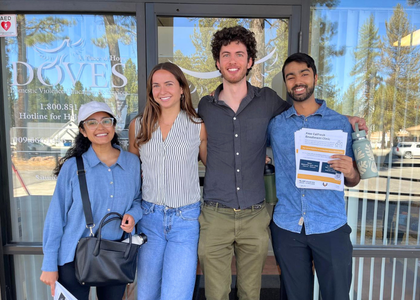
That’s how she and a group of students found themselves on the Justice Caravan, a three-day road trip of sorts, from Ontario, California, to Big Bear Lake to Palm Springs to Indio, where they teamed with Inland Counties Legal Services.
Their purpose was to bring legal services to underserved areas that have considerably lower attorney-to-resident ratios than elsewhere in California. This included working with families to prepare for adverse life events like incarceration, detention/deportation, hospitalization, incapacitation, or death by making plans for assets and care of children. Along the way, the students gave community presentations on estate planning and legal family planning, such as caregiver affidavits for senior citizens and families who are at risk of a parent’s detention or deportation.
Jannet Riveros Gomez LL.M. ’26 was one of those student volunteers. “This experience was eye-opening. I had the opportunity to listen to impactful stories from our clients and re-evaluate decisions I hadn’t considered before,” she says. “UCLA Law is great because of these experiences. It is a place where you can pursue a specialization with top-tier professors while also helping the community at the same time.”
She adds that the service was particularly personal for her. “During my childhood, my family heavily depended on these kinds of initiatives back in Mexico. I was able to access education, scholarships, government programs, et cetera, thanks to the students and associations who took the time to visit my small town,” she says. “I am who I am now because of it, and it is only natural to want to give back and hope that someone’s trajectory is positively influenced by my dedication to community work and service.”
Pro bono volunteers help out close to home
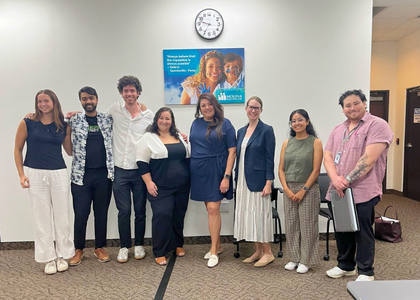
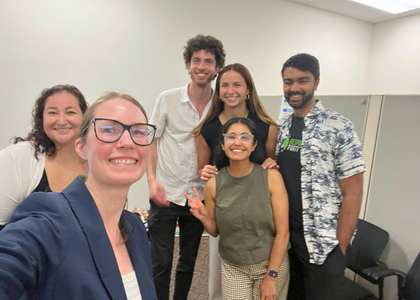
At the same time last spring, elsewhere in Southern California, other students participated in a collaboration that Han had arranged to confront the housing crisis.
“As we build the program,” she says, “we have prioritized involvement that is organically embedded within long term community relationships, with a focus on starting close to home and building outward. Each of our projects has been thoughtfully developed with the goal of creating sustainable partnerships that will continue year after year, building lasting connections between UCLA Law and the communities we wish to serve.”
In 2025, Han helped launch the Stay Housed LA partnership following that year’s devastating wildfires. She did so with an eye on creating a pipeline of students who are interested in working in the fields of housing and eviction defense after law school, whether as legal aid attorneys or through continuing pro bono work.
As part of that project, Matthew Ryan ’28 helped people who had an active eviction case or were in danger of getting one. He observed attorney consultations for people struggling with various housing issues housing, helped people use an online tool to answer eviction complaints and thus avoid default judgments, and watched eviction court proceedings where he got a close-up view of how attorneys from various organizations help tenants arrive at favorable settlements. His interest stemmed from things that he did earlier in his career.
“I worked as a case manager for people who were chronically homeless in the past, and they were always facing issues with their landlords,” he says. “Often, it was an eviction that had led to their initial homelessness, and they were often in danger of another eviction. When I came to law school, I was looking for ways to help that population, and I knew that helping people stay housed could be important and rewarding work. I was really looking for the chance to explore a different area of law and see how I felt. I was looking for a way to spend spring break that helped me stay grounded during my 1L year – instead of just focusing on the very insular world of the classroom – and let me remember why I had come to law school in the first place.”
Hayden Fuchino ’27 also found deep meaning in the Stay Housed LA work, particularly as a lifelong Angeleno who hopes to use his law degree to give back to the community.
“One part of the experience that jumped out at me was how many UCLA Law alumni we met across the housing law world, who were all very impressive, hard-working advocates for the tenants they represented,” he says. “Another amazing part was how non-legal it was. For example, when a tenant negotiates with a landlord, their main considerations may be non-legal in nature, instead being related to things that might be going on in their lives. Though the law is an important backdrop, I learned that we must consider these non-legal aspects of a client's situation when adhering to our duty to represent their best interests.”
Soon enough, more people there and around California will experience for themselves the positive impact of UCLA Law’s students – and they will see clearly that the law school’s celebrated tradition of service continues.