A look inside UCLA Law’s robust centers of scholarship and advocacy, which have expanded the law school’s influence on the most important issues of the day.
“The fact that we’re among the youngest major law schools in the country means that we have the freedom to build new ways of training lawyers.”
As those programs reach their quarter-century, at a moment that happens to fall around the law school’s 75th year, their influence on UCLA Law’s identity is clear. The launches of CRS and the Williams Institute— and, a few years later, the Emmett Institute on Climate Change and the Environment — marked inflection points for UCLA Law. The school had been creating world-class lawyers for decades, but the turn of the 21st century brought about a bold shift in thinking about what else a leading law school should offer.
Thanks to the immense contributions of alumni donors and other philanthropic partners in the com- munity, more centers of scholarship emerged before long, all of them building on the model of engagement and scholarship that CRS, Williams, and Emmett had established. Now numbering more than two dozen, the centers encompass a panoply of disciplines. Each was established with a mission to drive change through academic rigor, specialized training, and issue advocacy— and each made an immediate impact while boosting the school’s reputation and galvanizing its intellectual core.
Today, these centers are at the heart of the UCLA Law experience, amplifying the research of faculty members and top experts in an array of fields, informing policymakers in the United States and around the world, and offering students unparalleled experiential educational opportunities. The collective scope of these projects underscores a scholarly dynamism that has existed at UCLA Law since day one, along with a nimbleness that has allowed the school to enhance
its founding mission of public service by repeatedly adapting to a changing world.
“The fact that we’re among the youngest major law schools in the country means that we have the freedom to build new ways of training lawyers, learning lessons from what has come before,” said Cara Horowitz ’01, executive director of the Emmett Institute.
A legacy of leadership
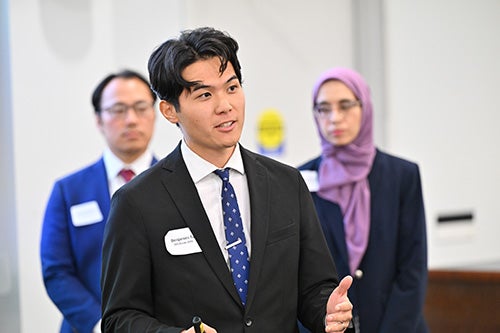
At a time when environmental regulations are under threat, Emmett Institute students work to protect vulnerable communities from pollution. Meanwhile, researchers are delving into the legal underpinnings of energy policy, geoengineering, and environmental governance in China, to name a few initiatives.
“California has been at the forefront of environmental protection and climate change innovation forever,” Horowitz said. “This makes the institute an important place to think creatively about what communities should be doing to advance environmental protections. There are opportunities to push the envelope in California that I don’t think exist elsewhere.”
This perspective carries throughout UCLA Law's programs, centers, and institutes.
The Lowell Milken Institute for Business Law and Policy, the longtime home of UCLA Law’s nationally renowned business and tax law faculty, regularly hosts summits where practicing lawyers come together to share insights on key matters in business law. It also sponsors the annual Lowell Milken Institute–Sandler Prize for New Entrepreneurs competition, providing a significant boost to students with actionable business plans. Meanwhile, the newer Lowell Milken Center for Philanthropy and Nonprofits delves into the study of one of the most pertinent emerging areas, as baby boomers retire and “the Great Wealth Transfer” continues.
Milken ’73 said that his motivation was “to provide students with a broad range of opportunities beyond just their academic training. I also wanted to provide the faculty with opportunities for greater visibility for their research and work, and to engage the broader community— both legal and nonlegal— in issues where UCLA Law could play a leadership role.”
The Ziffren Institute for Media, Entertainment, Technology and Sports Law is another key hub where scholars and practitioners work with students and outside partners to foster a new generation of lawyers adept at contending with contemporary matters.

This includes work in emerging technology; name, image, and likeness issues in sports; and patents. The institute also helps produce the annual UCLA
Entertainment Symposium, the preeminent summit of entertainment lawyers, now in its 49th year.
Ken Ziffren ’65 founded the institute, which built on the law school’s existing programming and expansive reputation as the nation’s No. 1 school for entertainment law. “The whole idea of it appealed to me,” he said. “The law school, I think, is famous, or notable, for its programs. And my interest was in both giving back and at the same time giving students the opportunity to come into the media and entertainment sector better prepared than if the institute didn’t exist.”
Philanthropic visions have driven other centers to immense success.
The Promise Institute for Human Rights was inaugurated to boost UCLA Law’s changemaking scholarship on an array of issues, from migrant rights to accountability for violations to environmental harms. The Promise Institute Europe, meanwhile, places students on the front lines of global policymaking through semesters spent working and learning in The Hague.

The Resnick Center for Food Law and Policy is a pioneer in global scholarship and advocacy. It partners with the United Nations and other important organizations to create guidelines on food governance. It produces a podcast featuring interviews with leading food law experts. And it takes on issues that are not often addressed in law schools, allowing students to play a leading role in its cutting-edge movement toward improved health and sustainability.
The Center for Immigration Law and Policy has led advocacy for migrants, DACA recipients, and other people involved in the American immigration system, and it has notably ramped up efforts as regulations change seemingly by the day and uncertainty abounds.
The Native Nations Law and Policy Center makes a meaningful mark as a place that promotes ground- breaking scholarship, enables community-driven projects, and builds a pipeline for the most promising advocates and academics in the Indian law space. A significant amount of the center’s work happens on the ground through the Tribal Legal Development Clinic, which engages in quality-of-life and other justice issues.
And the David J. Epstein Program in Public Interest Law and Policy is the home of UCLA Law’s legendary and fundamental work in public interest law. Each year, the program turns out graduates who continue to wage many of the most important fights for fair- ness— the kind of legal work that has characterized the law school since 1949.
As Horowitz said, “California is a state where the politics still allow for innovative solutions to tough problems. This means that our students can work on real-world solutions to tough problems in our own backyard. It’s incredibly motivating and rewarding to see our work make a difference in the world.”
Promoting progress
For most of its first quarter-century, CRS has stood as a signature endeavor of UCLA Law. It was founded in 2000, four years after California voters passed Proposition 209 to prohibit state governmental institutions from considering race, sex, or ethnicity in public education. “Prior to that, UCLA was one of the most diverse law schools in the country, but diversity dropped dramatically as lots of students of color didn’t want to apply, thinking it was not a welcoming environment,” said Jasleen Kohli, the program’s executive director.
CRS was the first effort at any law school to incorporate critical race theory into legal scholarship and teaching. From the start, it has been the home of many of the nation’s leading scholars in critical race theory. The program’s singular mission: to train new generations of legal advocates and scholars who are committed to racial justice. Students who specialize in CRS move on to jobs in local, state, and federal government, as well as public interest work in areas such as environmental justice, workers’ rights, and housing.
“As the years have gone by, our reputation has really grown,” said Kohli, who added that a third of 1L students come to UCLA Law intending to pursue a CRS specialization. “I’ve had students tell me that this is the only law school they applied to because of the Critical Race Studies program. We’ve attracted so many faculty and students who are invested in racial justice and in understanding how to use the law to create real, transformative change.”
Their success serves as a symbol of the impact that the law school’s programs, centers, and institutes create: While the challenges are complex, UCLA Law is now, more than ever, a wellspring of solutions.
UCLA Law is grateful to funders who support our institutes, centers, and programs.
Read more in the 75th Anniversary edition of the UCLA Law magazine.
Celebrating 75 Years of UCLA Law
Join the dean of UCLA School of Law, Michael Waterstone, UCLA Chancellor Julio Frenk, and distinguished faculty, students, and alumni as we celebrate 75 years of UCLA Law. This video tribute honors our history of legal innovation and vision for shaping tomorrow's legal landscape. From groundbreaking scholarship to producing leaders who have transformed the practice of law, UCLA Law continues its tradition of excellence while looking boldly toward the future.
“Gary Schwartz, a mentor, was brilliant and quirky, a voracious reader with a keen legal mind. He profoundly shaped tort doctrine through his scholarship and through his work as a reporter on the first part of the mammoth Restatement (Third) of Torts for the American Law Institute.”
Richard Hasen on Gary Schwartz
Arthur Greenberg and Joseph Tilem, members of UCLA Law’s very first class, look back on their time in law school and extraordinary careers.
A law school at its start
Tilem, now 98, was a UCLA undergrad when he heard that a law school was opening. He walked across campus and found someone taking the names of those wanting to be considered for admission. “I put my name down and later was pleased to learn I was accepted,” he said.
Greenberg wanted to go to law school at Stanford, where he had spent his undergraduate freshman year before transferring to UCLA, but his parents wanted him to stay close to home. Although his family lived near USC, Greenberg chose UCLA Law.
Watch "A Conversation with UCLA Law's Inaugural Class" and join Dean Michael Waterstone as he sits down with Arthur Greenberg and Joseph Tilem, alumni from UCLA Law's historic first graduating class of 1952. In this conversation, Arthur and Joe both share their memories of early campus life, reflect on their distinguished careers, and discuss how their UCLA Law education shaped their professional journeys.
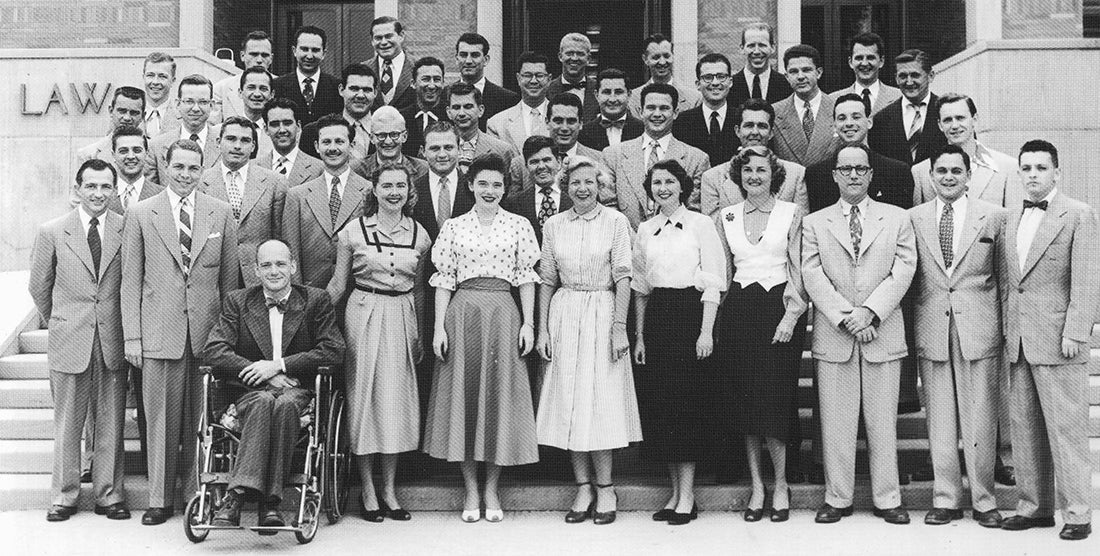
Both men — two of the last living members of UCLA Law’s very first class — had vivid memories of the school’s early days. “For two years, we had classes in barracks — like the ones I slept in the army — behind Royce Hall,” Greenberg recalled.
Tilem chimed in: “Yeah, there was a room where we could spend spare time, and a few of us would occasionally play cards there, with nickels, dimes, and quarters. But it all came to a halt when Dean Coffman came through, giving a tour to deans from other law schools. We were chastised, and the next day, an edict went out: ‘No card playing.’”
The two remembered the school’s first dean, L. Dale Coffman, as “running a tight ship.” He was “tough, not particularly friendly,” Greenberg said.
In a class of 49 men and five women, the top two students were female. It was, Tilem noted, “the great irony.”
Classes met six days a week at 8 a.m. The men agreed that there was no time for a social life; they were “glued to the books.” They took notes in class “furiously” and typed them up at night. “You’d summarize the lecture into 10 lines on a tissue paper that was gummed on one side, and stick it into a notebook,” Tilem said.
The construction of a building was a major milestone for the new school. Both men remember watching it go up “brick by brick.” When it opened, “it was kind of shocking to walk into it,” Tilem said. “Some of the doors didn’t open properly. There were a lot of little things that still needed work. It had an enormous library, and I got a job there, putting books on the shelves for $1 an hour.”
“Don’t focus too narrowly on one thing, because something is going to come in from left field. It’ll change your life. It did mine.”
Their careers take flight
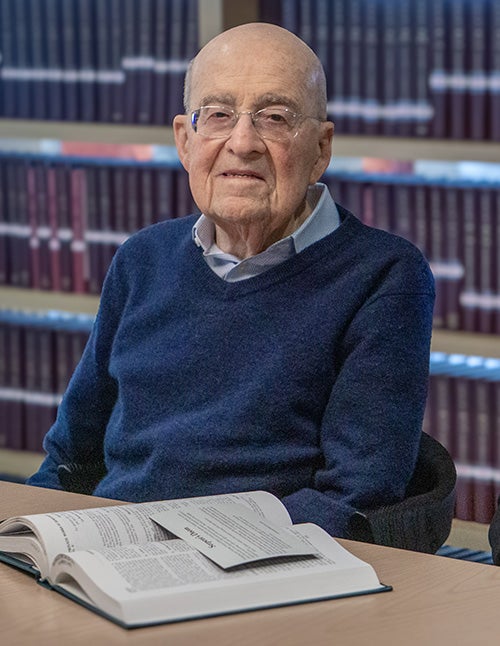
After graduating, Greenberg joined a firm in down- town Los Angeles at a salary of $400 a month. His partners were specialized, focused only on certain types of cases, so he tried to handle everything else — “whatever walked through the door.”
In questioning prospective jurors for his first case, he knew he wasn’t supposed to ask a woman if she was married. “So I said, ‘Mrs. Smith, is there a Mr. Smith?’ She answered, ‘Yes, there are many.’”
In 1959, he joined attorneys Philip Glusker and Irving Hill in forming Greenberg Glusker above a Safeway store on Wilshire Boulevard. Hill, the most experienced of the three, charged $30 an hour; Glusker and Greenberg, $25. Today, the firm— now in Century City — charges $1,000 an hour.
As for Tilem, in his second year of law school, he was hired as a law clerk at a firm on South Beverly Drive, for 90 cents an hour. “I really just filled the paper machine and cleaned up in the office,” he said. “When I passed the bar, they raised me to a dollar an hour.”

But his fortunes changed when he got a call from one of the firm’s clients, Alfred Bloomingdale, owner of Diner’s Club, which created the world’s first multipurpose credit card. Bloomingdale invited Tilem to work for him for $600 a month. “I felt it might be disloyal to leave the firm with a client, so I called my father for advice. But I couldn’t forgo the salary, and I was at Diner’s Club from 1954 to 1960.”
Then, when Hilton Hotels started a credit card company, Barron Hilton hired Tilem as vice president. In that role, he traveled to South America, Europe, and the Middle East, trying to get banks to accept the Hilton card.
Next, Tilem started his own law firm, which grew to 11 members. He started another new chapter when he was elected mayor of Beverly Hills. He recalled, “Being mayor was like taking a postgraduate college education in dealing with street lighting, union negotiations, what kind of trees you’re allowed to plant in a city, and a whole range of human activities that you would never encounter in any other way except when you’re in the hot seat at city hall.”
Tilem and Greenberg reconnected occasionally over the years. Notably, they crossed paths when Greenberg Glusker handled the savings and loan crisis in L.A., which Greenberg remembered as a “very bitter, tough experience.” Tilem, who at the time was on the board of a failing savings bank, remembers being deposed by Greenberg. “I was scared,” he admitted. “It’s very different when you’re being deposed rather than taking the deposition.”
UCLA Law’s lasting impact
“Arthur and I went in very different directions,” Tilem said, “but the nucleus of our life experience has been based on what we did in law school. Sometimes, years later, a case you had in school applies to what you’re doing.”
He said UCLA Law taught him the importance of working together by partnering him with a classmate to study for the bar exam. “That taught me the need for talking with your colleagues,” he said. “As a result, later in my law practice, I had no problem walking into my partner’s office to discuss a case.”
Asked what advice he’d give to graduating students today, Tilem said: “Keep your options open. So much of it is serendipity. You never can tell when opportunity is going to arise. Don’t focus too narrowly on one thing, because something is going to come in from left field. It’ll change your life. It did mine.”
Greenberg advised: “Be careful in choosing where to practice law. Some firms are better than others in how they treat people. That’s a serious issue. But the law practice to me was exciting, interesting, profitable, and happy.”
Read more in the 75th Anniversary edition of the UCLA Law magazine.
Celebrating 75 Years of UCLA Law
Join the dean of UCLA School of Law, Michael Waterstone, UCLA Chancellor Julio Frenk, and distinguished faculty, students, and alumni as we celebrate 75 years of UCLA Law. This video tribute honors our history of legal innovation and vision for shaping tomorrow's legal landscape. From groundbreaking scholarship to producing leaders who have transformed the practice of law, UCLA Law continues its tradition of excellence while looking boldly toward the future.