Naming ‘Global Racism’ as an opportunity for humanity: A book Q&A with Anna Spain Bradley
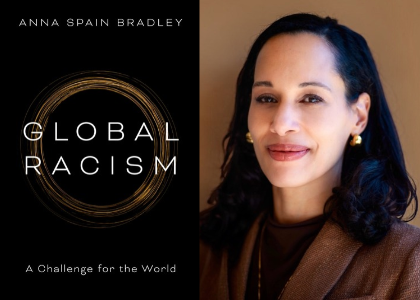
For two decades, UCLA School of Law professor Anna Spain Bradley has sought to promote peace and human rights through international law as a scholar, attorney, and leader. In 2024, she was appointed by President Biden to the World Bank-ICSID Panel of Conciliators. In 2021, the United Nations appointed her as a Legal Expert to the United Nations Ad Hoc Committee focused on preventing racist and xenophobic discrimination. From 2020 to 2023, she served as UCLA’s Vice Chancellor for Equity, Diversity and Inclusion. Through these experiences, she became concerned that approaches to combatting racism were missing something.
That query led Spain Bradley to write Global Racism: A Challenge for the World (Oxford University Press, 2026). The book names global racism as an uncharted form of global oppression and takes readers on a journey through history, law, and modern-day accounts to understand why. It also advances a call to action, reimagining the fight against racism as a fight for our shared humanity. She writes, “The most striking lesson Global Racism reveals isn’t about challenge of hatred or that which divides us. It is the persistence of our humanity, found in those rare yet sustaining moments of human solidarity when the world commits to naming and combating harms together. We’ve done it before and we can do it again.”
Spain Bradley holds the MacArthur Foundation Chair in International Justice and Human Rights at UCLA Law. Here, she talks about the inspiration for this book and what gives her optimism.
What motivated you to write this book?
The book starts in 1943 with the birth of my father during World War II in Jim Crow Florida, where my grandfather was serving in a segregated Army unit. A few years later, the United Nations was formed and, in 1948, nations agreed to the Universal Declaration of Human Rights that established the inherent dignity of all human beings. But inherent dignity was far from the reality for my dad growing up, and for so many people around the world, because of racism. In 2016, the day after the U.S. presidential election, my dad recalled his past days fighting for civil rights and tapped me on the shoulder, saying, “Anna, it is your turn now.”
I started writing this book the following day. Along the way, it was informed by lessons learned from my time as Legal Expert to the United Nations on racial discrimination and as UCLA’s Vice Chancellor for Equity, Diversity and Inclusion. Nations and people around the world don’t agree on what racism is or what it is not. This book shares the story of my search to find out why. My Dad passed away two years ago, and this book is dedicated to his memory.
What is global racism?
In this book, I name global racism as a yet-unmapped global form of racism that is operating within the human ecosystem and through world order. In Chapter 6, readers will find the Ten Tenants of Global Racism, outlining the contours of this phenomenon that, I argue, is older and more global than we’ve ever acknowledged. The book also draws lessons from history to illustrate why global racism is a threat to peace and to humanity.
Why did you choose to tackle such a massive topic? Was it daunting?
I am a big-picture thinker, and my life story is a global one. I studied ecosystems and environmental science in college. I’ve lived or worked in every continent except Australia and Antarctica. I’ve been a law professor and legal scholar of international law and human rights for almost 20 years. I’ve also worked as an international lawyer and diplomat. Big topics are sort of what I do.
That said, writing this book was daunting. It took me five years and built upon another five years where I wrote the article “Human Rights Racism” (Harvard Human Rights Journal, 2019), introducing the argument that international law should define racism as a violation of human rights, not just certain acts of discrimination on the basis of race. It was on the strength of this article that Oxford University Press approached me about a book project in 2020. Then, George Floyd Jr. was murdered and the national and global discourse about racism rapidly changed. I also became UCLA’s vice chancellor, and writing the book was put on hold. When I came back to it, I had learned a lot more about racism and combatting it as a leader, and I knew I needed to craft a book that general readers could connect to, all over the world.
What did you learn along the way?
One of the most important lessons I learned with this book was how to lean in to being a writer, not just a legal scholar who is writing. I had to face certain fears about being wrong in order to be courageous and tackle risky yet vital topics. The book covers painful and often controversial ground. I wrote about Hitler’s dangerous ideologies in Mein Kampf and their resurgence in the world today. I wrote about China’s treatment of Uighurs and the Rwandan genocide and the plight of Roma children in segregated schools in Europe. I wrote about white supremacy and world leaders who espouse such views. Learning about global racism is tough. These are the themes the first half of the book covers. The second half of the book gets to reasons for hope and optimism. There are many of them, so keep reading!
I relied on the examples of other great scholars turned authors who write about sweeping themes for general audiences as inspiration, including my UCLA colleague Jared Diamond, who wrote an endorsement for my book and really understood what I was trying to take one with the project. One of the points I am making in Global Racism is that this isn’t just a harm that affects certain people in certain places, it is a danger to us all. I call global racism the “thief of humanity” and take readers through the lens of history, law and modern-day examples to explain why.
What are the central issues that you identify and your proposals for confronting them?
One of the book’s key themes is about understanding racism globally. In the book, I call this a “paradoxical local-global phenomenon.” Racism is like the weather; it manifests locally in various forms around the world. You know what the weather is where you live when you go outside. Global racism is like the broader climate driving local weather events. It’s connected but often in invisible ways that are harder to map. I theorize that global racism is also embedded in the human ecosystem, making it ubiquitous and possible anywhere and everywhere people are, including online.
A second theme is this: The book Global Racism is a call to action for people and nations. The book offers four pillars that guide this work, starting with resisting ideologies of racial superiority and the world leaders that espouse them. The journey ahead requires understanding global racism not just as one story, but as many. The book journeys through centuries and travels to places like Albania, Australia, China, Denmark, Guam, Japan, the United States, and Uruguay to bring these stories to the reader.
What do you hope that law students take away from this book?
The time to stand up for our shared humanity is now. This is work we must do together in pursuit of the shared value of humanitas, which Cicero expressed as “human nature, civilization, and kindness.” Law helps ground these values, which we today name as freedom, peace, and dignity, but people must do the work, together. Why? Because the future of the human species depends on our ability to act as one.
What gives you reason for optimism?
When I was 15, I became a mediator and worked with NAACP and the mayor on public dialogues to address racism and violence that was creating rifts in our small Ohio town. Those days changed my life. Why? Because I grew up with very racist people in a community where the KKK was active and I was called the N-word more times than I could count. Some parents of my friends – and even a five-year-old I babysat – truly believed they were inherently superior because of the white race they had taken up as their core identity. This dangerous white supremacist thinking is once again spreading in America and in the world.
But I also saw some of those very same people change over the course of the dialogues. Yes, they were wedded to their racial superiority, but not when it cost them family, friends, and the community. The allure of belonging to the community was stronger than the allure of racial superiority. The moral of the story: People at every age and stage can change, if they choose to. I hope this book helps give people a narrative for why we should try.
Read more from Spain Bradley in this essay on global racism that she published in The Guardian.