Sanitation as a human right: UCLA Law students help make the case at the U.N.
Around the globe, nearly 3.4 billion people lack access to sanitation services that are essential to the health and welfare of populations in large cities and rural communities alike, according to the United Nations.
UCLA School of Law students are playing a critical role in promoting that plight to international leaders and policymakers, contributing research to “Making the Human Right to Sanitation a Reality for All,” a report published by Pedro Arrojo-Agudo, the U.N. Special Rapporteur on the human rights to safe drinking water and sanitation. Arrojo-Agudo presented findings this month to the U.N.’s Human Rights Council in Geneva, Switzerland.
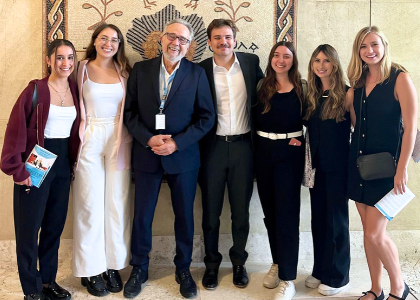
Throughout the last academic year, 11 UCLA Law students helped in the effort as part of the Judge Rand Schrader Pro Bono Program and The Promise Institute for Human Rights (Europe), which organizes and oversees projects that connect UCLA Law students with international partners. Kate Mackintosh, executive director of The Promise Institute (Europe), oversees the institute’s expansive work, including its pro bono endeavors. These projects give students in Los Angeles a unique opportunity to remotely support the work of human rights experts in Europe.
For the sanitation report, students researched sanitation rights by studying national constitutions around the world, cataloging which countries define the right in legislation and policy. They also analyzed how sanitation as a human right has been discussed in academia, civil society and the United Nations ecosystem. While the U.N. recognizes sanitation as a human right, most nations don’t recognize it in their constitutions.
“The report urges all states to write the right to sanitation into their national law, and to prioritize ensuring access to all forms of sanitation for everyone, without discrimination,” says Amanda Brown, who is a legal advisor for The Promise Institute (Europe) and coordinated the project. “For an issue like sanitation, a report like this can be an important reference point, simply because there isn’t much else out there consolidating the global picture.”
“Pro bono work gives you a sense of what the law looks like when it touches real lives in real time,” says Kateryna Onyshchenko LL.M. ’26. “You learn things in a pro bono project that no casebook can teach you: how to work in a team under time pressure and how to communicate complex findings to people with no legal background. You might influence how the international community addresses modern challenges or become part of a solution to someone’s problem – all while you are still in law school.”
In addition to the sanitation study, another cohort of 13 UCLA Law students have helped Arrojo-Agudo conduct research on the weaponization of water in conflict. And a new project underway this semester pairs students with Astrid Puentes Riaño, the U.N. Special Rapporteur on the human right to a healthy environment, to research rollbacks of environmental protections.
Their efforts are consequential. “Special Rapporteurs are unpaid independent experts with very small teams, and due to U.N. budget cuts, they now have even less support,” Brown says. “By providing their specialized research support pro bono, UCLA Law students can make a big difference in helping courts, human rights institutions, and civil society shape the direction of future standard-setting.”
Joining the pro bono team allowed Colombian lawyer and Fulbright scholar Maria Paula Herrera Duque LL.M. ’26 to build on work that she started in her homeland, where she has been active in pro bono efforts supporting sustainable development. With the institute, Duque conducted research on the weaponization of water in countries with water scarcity.
“Some of the countries we researched are the most vulnerable to climate change, and the combined effects of conflict, water scarcity, and desertification continue to threaten food security, public health, women rights, and economic stability,” Duque says. “Climate change acts as a risk multiplier, exacerbating existing vulnerabilities and intensifying humanitarian crises.”
Alexandra Quintana ’26 joined the UCLA Law effort after volunteering for water nonprofit BLUE Missions in high school. The organization leads service projects to Latin America to provide clean water to residents. She later led high school students on service trips to the Dominican Republic to help provide sustainable access to clean drinking water and sanitation.
“Pro bono work has been the throughline that connects my values to my legal training,” Quintana says. “I wanted to be involved in this project because it sits at the intersection of international humanitarian law, human rights law, and accountability, relying on rigorous legal analysis to push back against the weaponization of water and support stronger protections for civilians.”
On a broader level, Lamya Nawar Rahman LL.M. ’26 emphasizes the significant meaning of the effort. “Pro bono work is not an obligation,” she says, “but an opportunity to reconnect with the reasons you came to law school in the first place.”