Rick Hasen leads publication of a major new restatement on the law of torts remedies
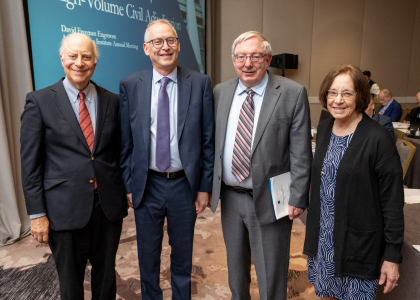
UCLA School of Law professor Rick Hasen has been uncommonly busy lately. At a time when his agenda has been full of successful projects and honors, Hasen traveled to Philadelphia for the annual meeting of the American Law Institute. There, on May 18, members voted to approve the Restatement of the Law Third, Torts: Remedies, for which Hasen served as a lead reporter.
“Restatements are statute-like statements of the law, along with comments and extensive notes,” Hasen says. “Courts rely heavily on restatements, especially when there is no law on point in a jurisdiction. That’s in part because the review process for restatements is so rigorous; each draft goes through four levels of review and requires the agreement of judges, lawyers, and professors across disciplines and the ideological spectrum. The Restatement of Torts has been among ALI’s most cited projects, and it gets periodically updated. Thirty years ago, ALI decided to do a third edition of it. It was a huge undertaking that was broken into pieces.”
Hasen and co-reporter Douglas Laycock, an emeritus professor at the University of Texas and University of Virginia, spent seven years – assisted by a group of judges, lawyers, and law professors who served as advisers – crafting the remedies piece of this significant legal undertaking. “The project has advanced our understanding of how civil remedies work, not only in tort but across the law,” Hasen says. “It has been a great collaborative project, and courts have already started relying on our work. It is nice to work on a project that I am confident will have lasting impact on the legal field.”
Laycock and Hasen are the authors of the leading casebook in the field, Modern American Remedies (Sixth Edition, Aspen, 2025). “This project reflects a significant evolution in how remedies are treated within the restatement framework,” Laycock said in an ALI announcement of the restatement’s approval. “For the first time, remedies are addressed in a dedicated volume, allowing for more detailed analysis and clearer articulation of the governing principles. We have sought to present the law in a way that is analytically precise and useful to courts and practitioners.”
Hasen is a 1991 graduate of UCLA Law, the Gary T. Schwartz Distinguished Professor of Law, and one of the country’s foremost authorities in election law and democracy. He directs the Safeguarding Democracy Project. This was the latest accomplishment in a spring where he has earned a Guggenheim fellowship, been cited in a U.S. Supreme Court opinion, served as a go-to media expert on the full scope of voting rights matters, and helped oversee a pioneering survey of top lawyers and judges about their perceptions of the rule of law as it stands today.
On his trip home from the East Coast, Hasen shared this inside look into why this project was important, as much for himself as it is for American law.
How did you come to work on this project?
Back in 1997, I was teaching in Chicago, and we desperately wanted to get back to California to be with family. I was offered a coverage visit at Loyola Law School, Los Angeles, and asked if I would teach Remedies, 8:10-10:10 p.m., two nights a week. I gladly accepted, despite being a morning person and despite never having taken Remedies. I had no idea what I was getting into. I picked up the third edition of Modern American Remedies by Doug Laycock, who is a giant in the field. It was the strongest casebook I knew in any field, and it had a teacher’s manual that provided a detailed and logical road map for understanding Remedies. Over the years as I came to master remedies, I peppered Doug with questions. Eventually, he asked me to come on as a co-author, and so I’ve been steeped in remedies ever since. It’s kind of a second line of my scholarly interest aside from election law.
Why is remedies an important subject?
It’s a course I love teaching because students come in with very little expectation that it will be good; they know it’s a bar course. I exceed their very low expectations! Remedies serves as a capstone, bridging torts, contracts, property, constitutional law, public law, and private law. Lots of students write me after graduation telling me how useful the course is. I tell students it is the class your future clients want you to take.
What makes this particular restatement so groundbreaking?
One of the things I’m most proud of is the restatement’s position against the use of race and sex data in computing damages when a child faces a serious injury that prevents the child from working later as an adult. These children have no work history, and so states allow parties to introduce evidence of average wages. In many states, those averages may be adjusted by race or sex; so a Black girl could be awarded lower overall damages than a white boy. The rules just reinforce existing discrimination and disparities. The restatement says the standard should be that of the average person, regardless of race or sex. I very much hope our arguments will carry the day on this issue with courts in the future.
It was gratifying when the Hawaii Supreme Court recently adopted the Third Restatement’s approach to punitive damages. I hope that as time goes on, our work will help courts create uniform rules that treat defendants and plaintiffs fairly and with respect.
Can you describe your personal connection to this work?
One of the early reporters on the project was UCLA Law’s Gary Schwartz, the leading torts scholar of his generation. He also served on my dissertation committee when I earned a Ph.D. in political science at UCLA. Gary died tragically early, at age 61 – the same age that I was when I was named the Gary T. Schwartz endowed chair in law, which was such an honor for me.