‘Smog and Sunshine’: Ann Carlson discusses her new book about the air in L.A.
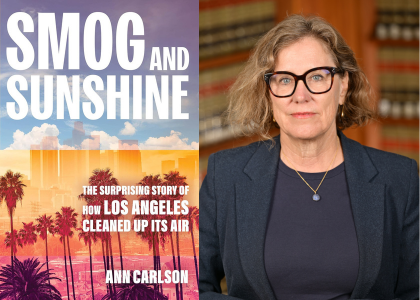
Los Angeles is famous for both sunshine and smog. It turns out that the two are related: Ozone pollution is caused by the interaction of sunlight and the chemicals that come out of vehicle tailpipes and factory smokestacks. But when Ann Carlson’s family moved to Southern California, nobody knew what caused smog, and there were no laws to prevent it. “I lived through the smoggiest decades of Los Angeles,” she says, “and I’m always struck by how few people understand just how bad the air was and what we’ve accomplished to clean it up.”
In her new book, Smog and Sunshine: The Surprising Story of How Los Angeles Cleaned Up Its Air (University of California Press, 2026), Carlson – the Shirley Shapiro Professor of Environmental Law at UCLA and faculty director of the Emmett Institute on Climate Change and the Environment – explores the hazy history and offers a brighter outlook.
Why did you want to tell this story?
Several years ago, I went on a hike in Glacier National Park to raise money for the Emmett Institute. The hike coincided with the worst wildfires in Montana history. When we got there, the skies were covered with smoke, and we were being rained on with ash. The woman leading us on the hike, who was from Montana, leaned over to me and said, “This must remind you of home.” And I just couldn’t believe that she thought our air quality in Los Angeles was so bad that it resembled the air quality in Montana during the worst wildfires in history. She was only one of many people who continue to perceive Los Angeles air quality as a cesspool, and that’s just not true anymore. It’s true that we still have air pollution problems, but the contrast between then and now is so extraordinary, and what we’ve accomplished in cleaning up our air is such an important story to tell.
How far have we come in recent years?
In 1960, the year I was born, there were 286 days that violated ozone standards. On many days in the ’60s and ’70s, you could not see more than three miles — that was more than half the year. The entire view of the mountains was occluded. Let’s talk about lead pollution, which came from leaded gasoline and came out of the tailpipe of vehicles and polluted the atmosphere. In Southern California, lead concentrations were 50 times higher than they are today. Or take carbon monoxide. In 1964, Los Angeles violated the carbon monoxide standards that California had set on 366 days — it was a leap year. We don’t violate the carbon monoxide standard anymore. We don’t violate the lead standard anymore. We violate the ozone standard many fewer days at much lower levels. We used to have smog alerts. They were a regular part of my childhood. We’d have smog alerts on more than half of the days of the year. We haven’t had a single smog alert since 2003.
How did we make it happen?
The story of how Southern California cleaned up its air is centrally a story about government. The reality is that without government, we would not have cleaned up our air to the degree we have today. For lots of reasons, the private sector doesn’t have a big incentive to do something about air pollution unless everybody is compelled to do something about air pollution. It’s just too easy to conclude that, Even if I try to stop my products from polluting, other companies will just continue to pollute. It took government, with incredible public support and pressure, to do something especially about automobiles, which were the biggest smog source for many years in Southern California. It was government that stepped in — first at the local level, then at the state level, and ultimately at the federal level, to push the automobile industry to clean up their vehicles and to push other industries to stop spewing pollutants into the air in order to get us where we are today.
How does this history relate to the current political context, in which the federal government is attacking California’s ability to set clean air standards?
California was key because, under the federal Clean Air Act, California has a unique exemption that allows for stricter regulation of emissions from cars and trucks — no other state can do that, and California has used that power to force the development of technology that makes our vehicles 99.9% cleaner than they were in 1970. It’s been an extraordinary success story. But it’s also the power that California has used to regulate greenhouse gases from cars and trucks, and it’s that power that the Trump administration has been trying to eviscerate with the assistance of Congress, which passed legislation under a very obscure statute that took California’s permission to issue strong standards for cars and trucks away from the state. So right now, California can’t use that power. We can’t regulate tailpipe emissions — greenhouse gas emissions or even tailpipe emissions that cause conventional smog. It’s California’s most powerful authority and if we can’t use it, it really slows us down.
So where do we go from here?
It doesn’t leave California without any authority to do anything. In fact, the state can regulate all sorts of other pollution sources, like chemical plants and oil refineries, including for greenhouse gases. California can use creative powers, like providing tax incentives to encourage the purchase of electric vehicles and to encourage truckers to buy clean trucks, or to continue to clean up the ports, which are the biggest source of remaining pollution in Southern California. So the state can do a lot, but we’re slowed down right now.
Watch an extended version of this interview with Carlson on YouTube, and read longer versions of this Q&A in the UCLA Newsroom and Legal Planet.
-
J.D Environmental Law