Please join us for a timely event that examines U.S. abortion restrictions in contrast to global trends toward greater abortion protections. Panelists will look to other countries as well as international human rights norms for clarity – and discuss how to bring international standards to bear in the fight for abortion rights at home.
Speakers
- Elise Keppler
- Executive Director, Global Justice Center
- Lara Stemple
- Assistant Dean, Faculty Affiliate of UCLA Law's Center for Reproductive Health, Law, and Policy
- Irum Taqi
- Director of Global Policy, Guttmacher Institute
- Grace Meng - Moderator
- Executive Director, UCLA Law's David J. Epstein Program in Public Interest Law & Policy
- Executive Director, UCLA Law's David J. Epstein Program in Public Interest Law & Policy
Wednesday, September 18, 2024
12:15 PM Pacific Time
In-Person at UCLA Law in Room 1430 and Virtually on Zoom
Shield Laws for Reproductive and Gender-Affirming Health Care: A State Law Guide
After the Supreme Court overturned Roe v. Wade in June 2022 and eliminated the federal constitutional right to abortion, many states enacted bans and further restrictions on abortion.
- Arizona
- California
- Colorado
- Connecticut
- Delaware
- Hawaii
- Illinois
- Maine
- Maryland
- Massachusetts
- Michigan
- Minnesota
- Nevada
- New Jersey
- New Mexico
- New York
- North Carolina
- Oregon
- Pennsylvania
- Rhode Island
- Vermont
- Virginia
- Washington
- Washington, DC
To learn about the legal actions in which shield laws have been or are likely to be used to protect people providing, receiving, and supporting reproductive and gender-affirming health care, visit our resource on Shield Law Challenges.
For legal scholarship addressing issues arising from the conflict between states that have penalized reproductive and gender-affirming health care and states that have protected that care through shield laws, visit our resource on Shield Law Scholarship.
Shield Laws by Categories of Protection
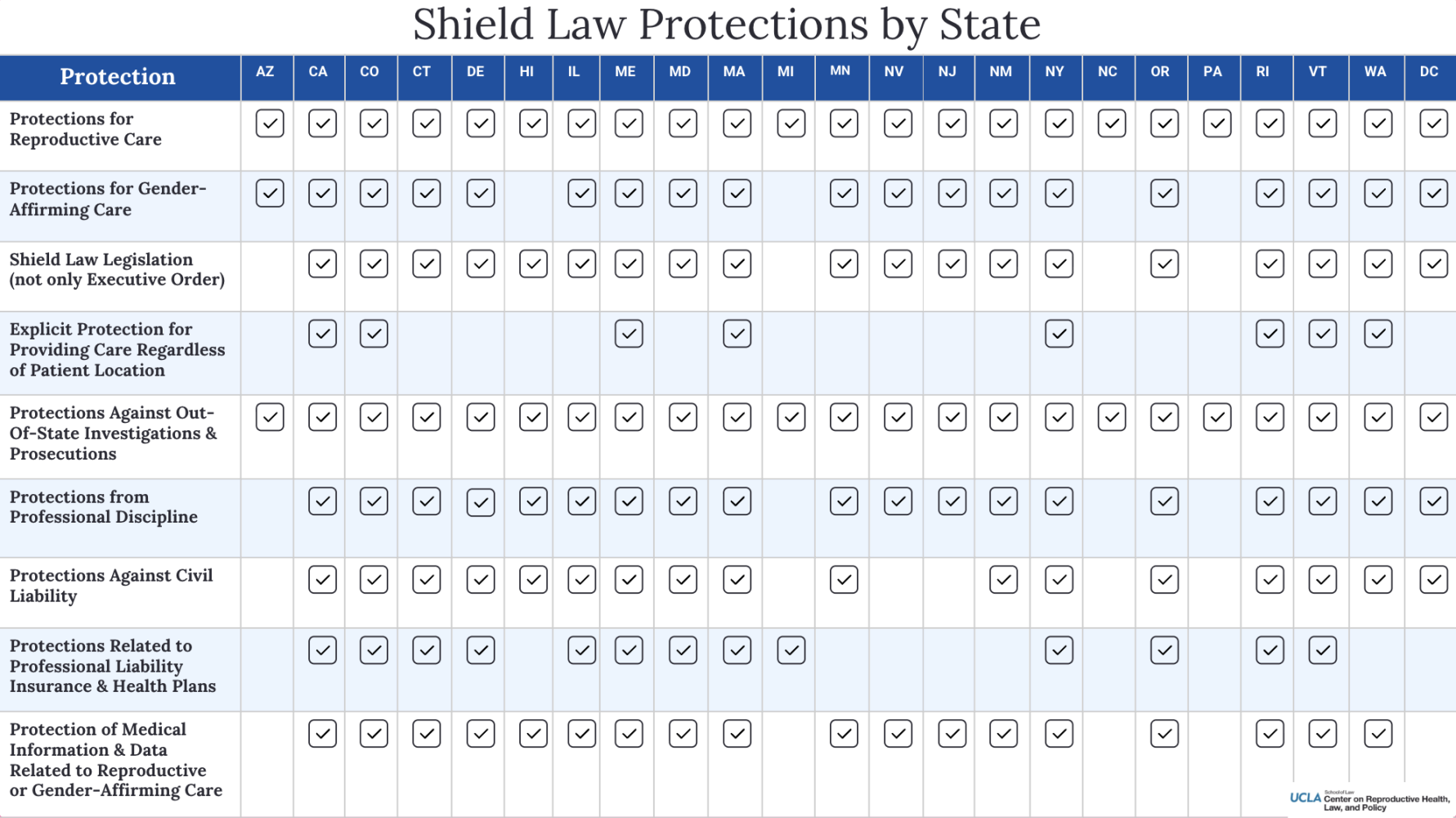
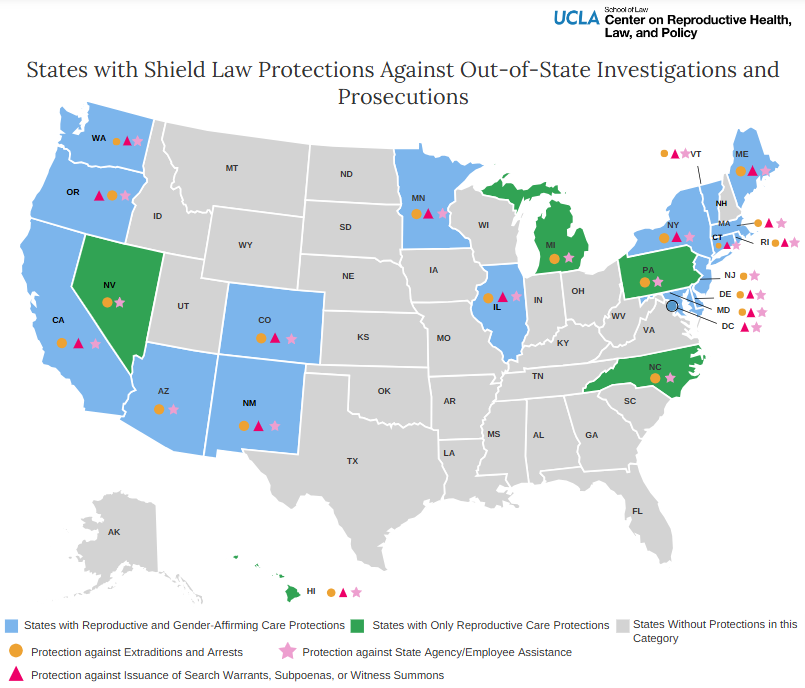
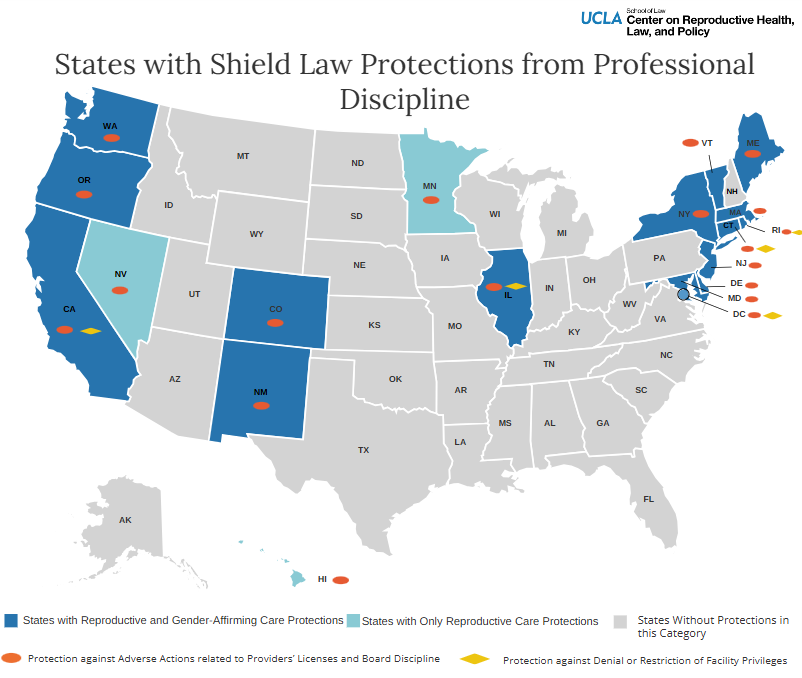
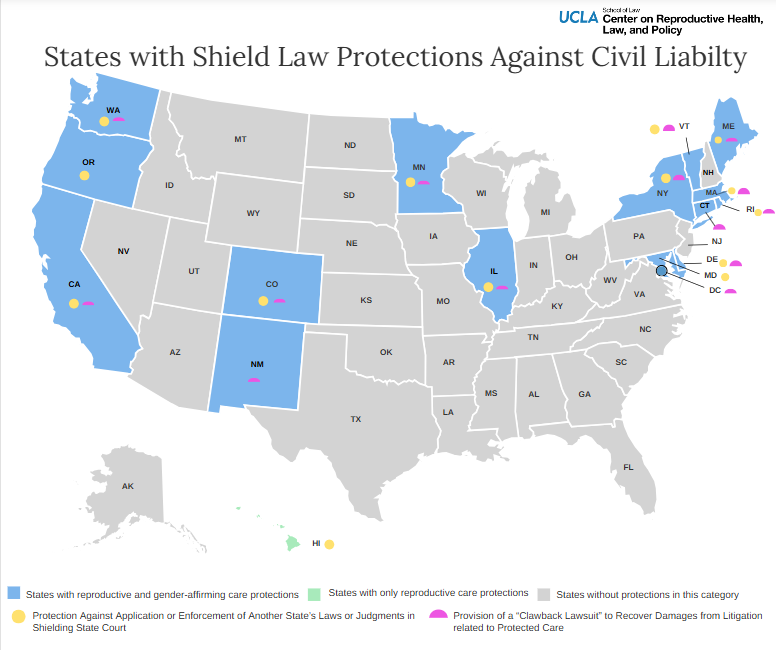
The protections offered by each state’s shield laws vary. Shield laws may include: (1) Protections Against Out-of-State Investigations and Prosecutions (including specific protections against extradition, arrests, search warrants, subpoenas, witness summons, and state agency assistance in out-of-state investigations or prosecutions), (2) Protections Against Professional Discipline (including specific protections against adverse actions related to providers’ licenses, board discipline, and denial or restriction of facility privileges), (3) Protections Against Civil Liability (including specific protections against application or enforcement of another state’s laws or judgments in the shielding state’s courts, and availability of a “clawback” action to recover damages from litigation in another state as a result of providing, receiving, or assisting in the provision of certain health care), (4) Protections Related to Professional Liability Insurance and Health Plans (including specific protections against an insurer’s refusal to issue insurance, increase in premiums, or denial of coverage based solely on providing protected care and protections for contracts with health plans and insurers), and (5) Protection of Medical Information and Other Data Related to Reproductive or Gender-Affirming Care (including specific protections against disclosure of medical information, location data, providers’ personal information, and data held by businesses providing electronic communications or reproductive health apps). 4 states only offer certain protections by executive order rather than by legislation. The legislatively-enacted shield laws in 8 states explicitly protect provision of care regardless of patient location, which includes telehealth provision.
The chart and maps below show the types of protections offered in each shield law state.
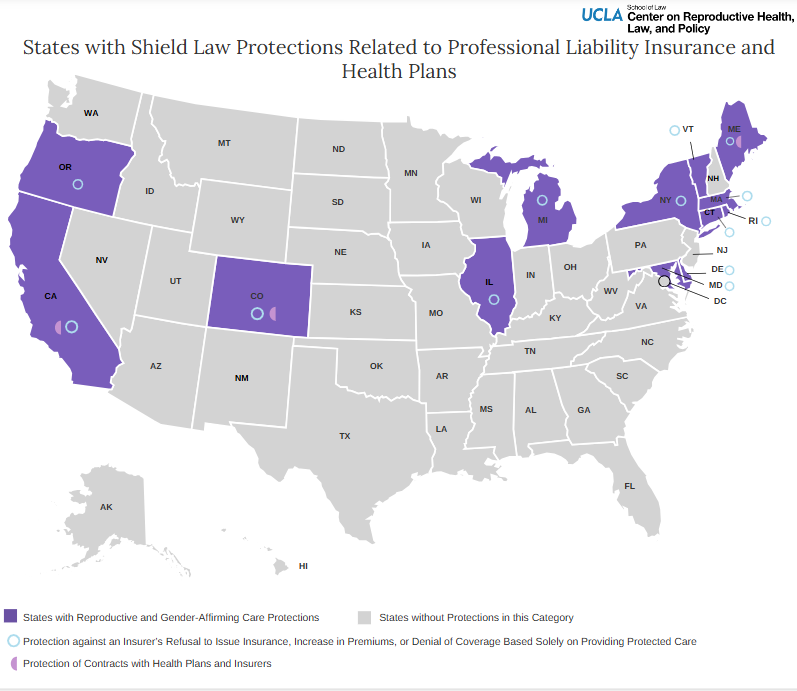
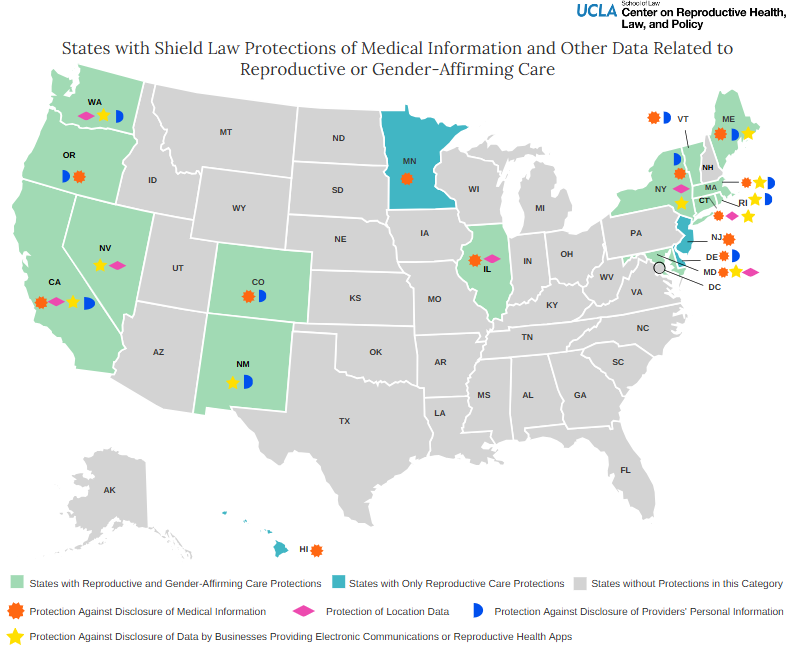
This State Law Guide is designed to provide a foundation on each state’s shield laws related to reproductive and gender-affirming health care. To receive pro bono legal assistance on questions related to the shield laws or other reproductive rights or justice issues, email larj@law.ucla.edu.
For general questions regarding the Center on Reproductive Health, Law, and Policy, email crhlp@law.ucla.edu.
The Williams Institute's 2024 NYC Fall Salon will take place on Thursday, September 12 from 6:00-8:30 PM at the Meta office in Hudson Yards.
We invite you to join our discussion on the current state of LGBTQ+ law and policy and what’s at stake in the upcoming November election and beyond.For tickets to our 2024 NYC Fall Salon, please visit: https://bit.ly/NYCFallSalon24RSVP ends on September 4, 2024.
For more information, please contact Williamsdev@law.ucla.edu.
On Friday June 28 at 1:30 PM PT, join the Center on Reproductive Health, Law, and Policy, legal scholars, impacted providers, abortion researchers, and advocates to discuss the practical effects of FDA v. Alliance for Hippocratic Medicine, concerning access to mifepristone, and Moyle v. United States, concerning whether EMTALA supersedes Idaho’s abortion ban. We will discuss how these cases impact access to abortion across the country.
Speakers currently include (subject to minor changes):
Moderator: Melissa Goodman JD, Executive Director at the Center on Reproductive Health, Law, and Policy
- Cary Franklin JD, McDonald/Wright Chair of Law & Faculty Director of the Center on Reproductive Health, Law, and Policy
- Ushma Upadhyay, PhD, MPH, Professor, Dept. of Obstetrics, Gynecology, and Reproductive Sciences UCSF & Co-Director, UCGHI Center for Gender and Health Justice, Advancing New Standards in Reproductive Health (ANSIRH)
- Kylie Cooper, MD, Maternal-Fetal Medicine Specialist, Mayo Clinic
- Caitlin Gustafson, MD Physician, Co-President, Idaho Coalition for Safe Healthcare