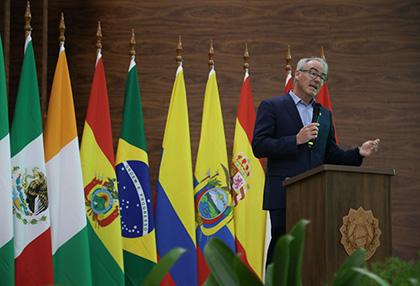
World diplomats are descending on the Amazonian city of Belém this month for COP30, the annual United Nations climate conference, at a critical juncture in the fight against global warming. Joining them are UCLA researchers with an outsized and powerful presence thanks to the organization they lead called the Governors’ Climate and Forests Task Force.
The GCF Task Force, a unique project that came to UCLA School of Law in 2022, is a subnational alliance of governors from around the world who work together on policies to protect forests.
Staff and faculty of the UCLA Emmett Institute filed an amicus brief in the U.S. Court of Appeals for the Ninth Circuit defending the right of air pollution regulators to set important standards under the Clean Air Act to protect public health. The case is Rinnai America Corp.et al. v. South Coast Air Quality Management District, and it involves a challenge to South Coast AQMD's recent efforts to reduce nitrogen oxides (NOx) pollution by accelerating the transition to zero-NOx-emissions models for certain water heaters and boilers.
-
J.D Environmental Law
Announcing the UCLA Emmett Institute’s STOP Methane Project, a user-friendly ranking of super-polluting methane emissions across multiple sectors.
Methane accounts for about one-third of global warming. And because methane only stays in the atmosphere for a short time, cutting that potent greenhouse gas provides a critical opportunity to reduce near-term climate change.
When climate-fueled disasters strike, local news coverage helps educate residents about the causes and informs public opinion about policy responses. This was true in early January 2025 when Los Angeles was devastated by the Eaton and Palisades fires.
So, how did local news coverage frame these disasters? This survey of more than 600 stories and videos by The Los Angeles Times found that about 14% of that news content made mention of “climate change” or “global warming.”
Join us on November 3 at UCLA School of Law for a special evening with Yurok attorney and Native American civil rights activist Amy Bowers Cordalis. Just days after the release of her new book The Water Remembers, Amy will share her story of fighting for the Klamath River and affirming Yurok sovereignty.
🗓 November 3 | UCLA School of Law
📍 RSVP NOW: bit.ly/UCLAwaterremembers
⚠️ Please note: This event will not be livestreamed. Lunch will be provided for RSVP'd guests only
.png)
Up in the Air: Climate Policy Without the Endangerment Finding
Date: Monday, September 29, 2025
Time: 12:15 - 1:15 PM PST
Register here: https://ucla.zoom.us/webinar/register/WN_AkzVVRX3R-2bXGkAmQRN6Q
UCLA students only: Viewing in room 2483, there will be food availiable on a first-come, first serve basis.
In late July, the Trump administration proposed to revoke the “endangerment finding” — a determination by the Environmental Protection Agency that carbon dioxide and other greenhouse endanger public health and welfare under the Clean Air Act. Removing such a foundational piece of U.S. climate policy is aggressive, based on a drastic revision of the underlying science supporting the original finding of endangerment.
In this discussion, leading experts will cover the administration's possible motivations and legal justifications, as well as the pushback from the scientific community, and what lies ahead in the process. We'll also look at the options for states looking to regulate climate pollution.
Could the fight over the endangerment finding end up at the Supreme Court? What will it mean for the EPA's work in the short- and long-term? And what are some of the surprising unintended consequences for state policy? Submit your questions for our panel below.
Panelists:
Ann Carlson, Shirley Shapiro Professor of Environmental Law and founding Faculty Director of the Emmett Institute on Climate Change and the Environment at UCLA School of Law; former Acting Administrator of NHTSA
Joseph Goffman, Former Asst. Administrator, Office of Air and Radiation at US EPA
Karen McKinnon, Associate Professor, UCLA, Statistics & Data Science, Atmospheric and Oceanic Sciences, Institute of the Environment & Sustainability
Moderated by:
Cara Horowitz, Executive Director, the UCLA Emmett Institute
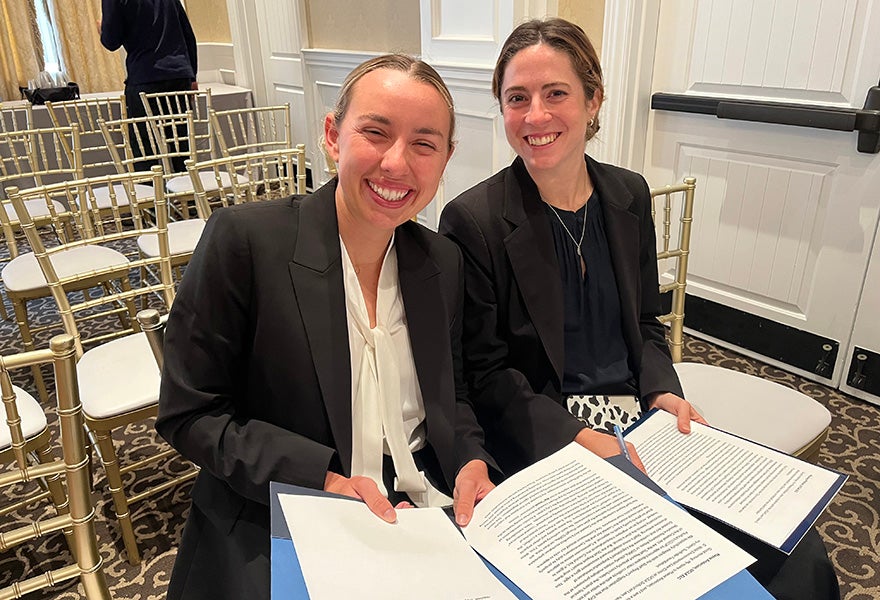
The hall was standing room only when Maeve Anderson ’26 and Ana Mackay Peltzer ’26 stepp
-
J.D Environmental Law
-
LL.M. Program