Walking the line: Intensive course teaches students to navigate U.S.-Mexico border law
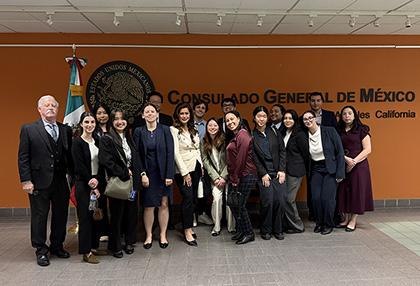
On the morning of January 13, a group of UCLA School of Law students enjoyed a rare opportunity to visit the Mexican consulate in Los Angeles. There, they observed lawyers who were hard at work on many of the most pressing immigration matters. They also received a special briefing regarding Mexico’s responses to the current ICE arrests, including the role of habeas corpus petitions at immigrant detention centers, and about ongoing economic relations between the two countries.
“It was especially impactful,” says Roy Molina ’27. “Seeing consular attorneys and staff operate on the front lines, collaborating with attorneys in different fields across borders, highlighted the differences of the region and made me realize that the complex reality of the border is what makes it such a meaningful and compelling legal space.”
Molina and his classmates were there for the final exercise of UCLA Law’s Law of the U.S.-Mexico Border class, a field trip that enhanced their studies and, in several cases, inspired a deep personal connection.
“I took the class essentially because I am from El Paso, Texas, my family is from Ciudad Juárez, Mexico, and I come from a family shaped by the Bracero Program” – the mid-20th century temporary-labor effort that brought Mexican workers to U.S. farms and railroads – “and cross-border Mexican business,” Molina says. “The legal distinctions that we studied in the class, between the border as a line and as a zone, helped me better understand my lived realities growing up and gave me a deeper appreciation for the region and community that raised me.”
Offered every two or three years to a limited number of students, the class is part of the law school’s intensive two-week January Term – or “J-term” – which affords upper-level J.D. students like Molina, as well as students in UCLA Law’s Master of Legal Studies and LL.M. programs, a chance to engage in a seminar-style course that zeroes in on a nuanced area of the law at the heart of a professor’s expertise. J-term classes have examined the business and law of esports, cannabis law and policy, and religious liberty, among many other topics. Selection for a J-term course can be competitive, and students take only one class for the duration of the annual session, which happens before regular coursework resumes in the middle of the month.
The border class tracks the scholarship of Peter Reich, a UCLA Law continuing lecturer and noted scholar of the U.S.-Mexico border, particularly the region’s legal history and natural resources law. His book The Law of the United States-Mexico Border: A Casebook (Carolina Academic Press, 2017) serves as a guide for the students as they learn about the border from a geographic perspective and study issues including the boundary, border detentions, immigrants’ rights, family law, real estate, financial and trade transactions, torts, crimes, environmental law, and Mexican law in the United States. They also play an interactive stakeholder game, where they take on the roles of government agencies, farmworker unions, agribusiness, migrants, environmental nonprofits, and the tech sector.
“Meeting during the focused J-term, the class provides a rare opportunity for students to learn through case analysis, experiential simulation, and direct access to diplomats, all framed by the geography of this fascinating region,” says Reich, who earned the UCLA Distinguished Teaching Award, the university’s highest honor for excellence in the classroom, in 2024. Reich teaches several courses notably tailored for M.L.S. and LL.M. students, who come to the law school with rich backgrounds in other professions or countries.
Several of them found his U.S.-Mexico border course to be particularly pertinent.
M.L.S. student Julia Barajas is a reporter for Southern California Public Radio, where she covers higher education and, increasingly, immigration. “In the past, I’ve had the chance to cover transnational issues, Latin America remains my first love, and I hope to resume covering this region in the future,” she says. “I knew that the course would help me take on this work.”
One helpful lesson, she says, had to do with a 2010 case from the California Supreme Court, Martinez v. Regents of the University of California, regarding the tuition that undocumented immigrants pay at state colleges and universities. “This was extremely useful because I am currently reporting on the federal push to eliminate in-state tuition for undocumented college students, something undocumented Californians have relied on for decades.”
A working journalist who is getting an M.L.S. degree so that she can learn about the law without becoming a lawyer, Barajas also appreciated the simulation exercise because it gave her a clearer view of legal practice. “It was an invaluable experience,” she says. “My goal is to become well-versed in the law so I can provide accurate, concise information to the public.”
Her classmate Hansol Kim LL.M. ’26, meanwhile, is already a practicing lawyer – in South Korea. Kim is a military lawyer and commissioned officer in the Republic of Korea Army and has served in units responsible for operations near the demilitarized zone between her home country and North Korea. The course about the U.S.-Mexico border thus created stark contrasts.
“Korea’s border context is very different from the U.S.-Mexico border – there’s little day-to-day cross-border exchange on land – so I wanted to learn how a long-standing, active border shapes legal rules and real-world disputes,” she says. “What made the class especially valuable was seeing how ‘the border’ shows up across many fields at once – constitutional law, immigration, property, torts, finance, environmental issues, and more – and how U.S. common-law reasoning interacts with a civil-law system like Mexico’s, and like Korea’s.”
Kim also appreciated the role-playing project that she and her classmates participated in during the J-term course. “I’ve worked on treaty-related legal advice and supported negotiation work between Korea and the U.S., and the simulation gave me a structured way to think about negotiation strategy, interests, and how to adapt when unexpected facts arise – skills I expect to use again in practice. I’m very grateful for the experience.”