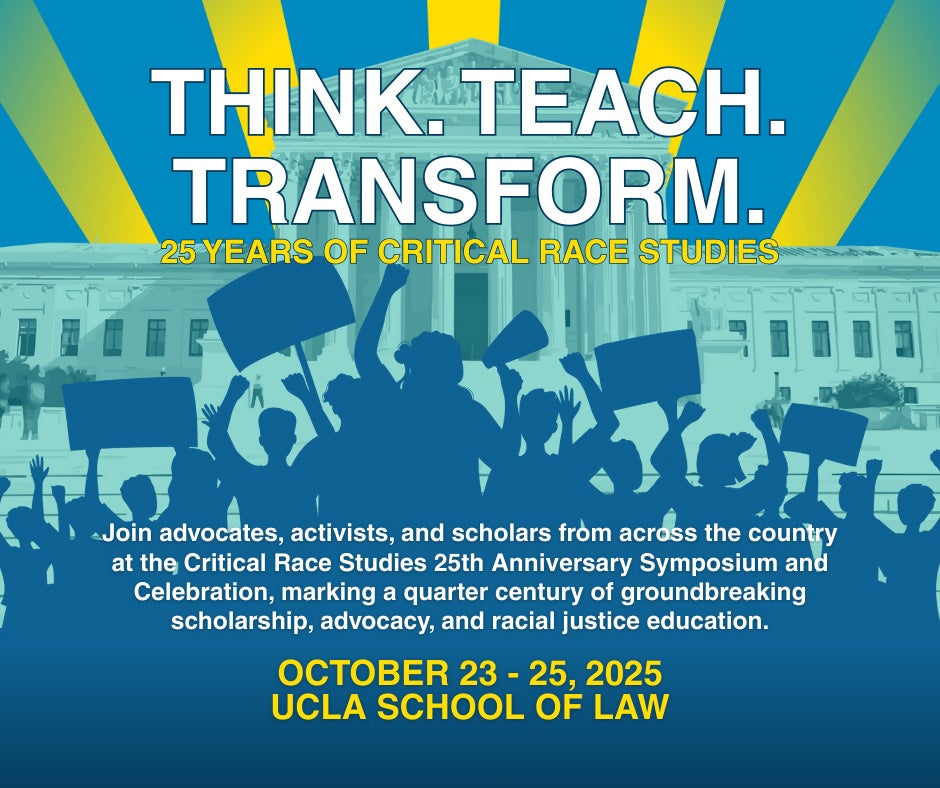
Think. Teach. Transform. Critical Race Studies 25th Anniversary Symposium and Celebration
Thank you for joining us October 23–25, 2025, as we celebrated the 25th anniversary of the Critical Race Studies Program at UCLA School of Law. For three days, scholars, students, advocates, and community members came together to honor CRS’s trailblazing legacy and to envision the future of racial and social justice in this urgent political moment. Below you’ll find links to symposium recordings, photos, and our community Kudoboard, along with continuing opportunities to stay connected with CRS.
Playlist of all panel recordings
Symposium Program
Download the full symposium program, including plenary sessions, panels, speaker information, and convening details.
Our Sponsors
We are deeply grateful to the partners whose generosity made the 25th Anniversary Symposium possible.
-
Legacy Leaders ($10,000+ level or equivalent in-kind support)
- Williams Institute
- Emmett Institute on Climate Change and the Environment
- Nicole Gambino
Movement Builders ($5,000 level)
- Corey, Luzaich, de Ghetaldi & Riddle LLP
Justice Advocate ($2,500 level)
- Law Offices of Angel J. Horacek, PC
Critical Collaborators ($1,000 level)
- David J. Epstein Program in Public Interest Law & Policy
- Victor Narro and Laureen Lazarovici
- Ziffren Institute for Media, Entertainment, Technology & Sports Law
Community Allies ($500 level)
- Center for Immigration Law and Policy
- International and Comparative Law Program
- L’Tanya M. Butler
Symposium Recordings
-
MAIN PANELS
See also Concurrent Sessions below Main Panels.
October 23, 2025
Plenary: From Theory to Program: The Establishment of Critical Race Studies
Welcome
- LaToya Baldwin Clark, Professor of Law and Faculty Director, Critical Race Studies, UCLA School of Law
Plenary: From Theory to Program: The Establishment of Critical Race Studies
Critical Race Theory emerged in the late 1980s as a revolutionary response to the limitations of traditional civil rights approaches. Legal scholars like Derrick Bell recognized that landmark 1960s civil rights legislation had failed to produce structural transformation, necessitating new theoretical frameworks for understanding persistent racial inequality. The movement crystallized through student activism at Harvard Law School in 1981, when Kimberlé Crenshaw organized an alternative race and law course following Bell’s departure, challenging both inadequate legal frameworks and institutional failures to address racial justice comprehensively.
UCLA’s Critical Race Studies program, established in 2000 by faculty including Crenshaw, Cheryl Harris, Laura Gómez, Devon Carbado, Mitu Gulati, and Jerry Kang, became the first law school program dedicated to Critical Race Theory. Its founding responded directly to California’s Proposition 209 (1996), which devastated the law school’s diversity—exemplified by one incoming class of 320 students that included only one African American male. Both foundational moments reflected sophisticated understandings of law’s dual role in enabling racial progress while maintaining hierarchical structures. This panel will highlight how the program’s establishment represented both a scholarly response to retrenchment and a commitment to training lawyers equipped with analytical tools for combating contemporary racial subordination.
- E. Tendayi Achiume, Professor of Law, Stanford Law School
- Cheryl I. Harris, Rosalinde and Arthur Gilbert Professor in Civil Rights and Civil Liberties, UCLA School of Law
- Emmanuel Mauleón, Associate Professor of Law, University of Minnesota Law School, UCLA Law JD ‘18
- K-Sue Park, Professor of Law, UCLA School of Law
- Moderator: LaToya Baldwin Clark, Professor of Law and Faculty Director, Critical Race Studies, UCLA School of Law
October 24, 2025
Plenary : Think Bold, New Ideas, and Dean Waterstone’s Remarks
Welcome
- Jasleen Kohli, Executive Director, Critical Race Studies, UCLA School of Law
Plenary: Think Bold, New Ideas
This panel assembles leading scholars whose work exemplifies Critical Race Theory’s evolution beyond its foundational frameworks. While honoring CRT’s origins, our panelists expand theoretical conversations through diverse methodological approaches: historical analysis of racial categories and comparative formations, sociological examination of Latino/Latina identity within racial hierarchies, international human rights and Third World legal perspectives, and empirical research on implicit bias intersecting race, gender, and sexuality.
The discussion will explore how interdisciplinary methodologies have enriched CRT’s analytical toolkit while generating productive theoretical tensions. How does historical methodology—straddling empirical social science and interpretive humanities—reshape understanding of racial formation? How does evidence of implicit bias complement or challenge CRT’s structural critique? What transformations occur when CRT travels transnationally, encountering different racial formations and legal systems? How do intersectional analyses of race, gender, sexuality, and class both fulfill and complicate CRT’s original vision?
By embracing both CRT’s expanding intellectual influence and its generative internal debates, this panel charts future directions for critical race scholarship across legal and interdisciplinary contexts, demonstrating the theory’s continued relevance and methodological sophistication.
- Aslı Ü. Bâli, Howard M. Holtzmann Professor of Law, Yale Law School
- Laura E. Gómez, Lee & Leon Karelitz Chair in Evidence & Procedure, The University of New Mexico School of Law and Rachel F. Moran Endowed Chair in Law Emerita, UCLA School of Law
- Ariela Gross, Distinguished Professor of Law and History, UCLA School of Law
- Russell K. Robinson, Walter Perry Johnson Professor of Law and Faculty Director, Center on Race, Sexuality, and Culture, UC Berkeley School of Law
- Moderator: Jerry Kang, Ralph and Shirley Shapiro Distinguished Professor of Law, UCLA School of Law; Distinguished Professor of Asian American Studies (by courtesy); Inaugural Korea Times – Hankook Ilbo Endowed Chair (2010-20); Founding Vice Chancellor for Equity, Diversity and Inclusion (2015-20), UCLA
Dean’s Remarks
- Michael Waterstone, Dean and Professor of Law, UCLA School of Law
Plenary: Teach Future Leaders and Scholars
Educational institutions serve as critical sites for shaping future leaders and fostering critical consciousness. Recent political developments, including systematic attacks on diversity, equity, and inclusion initiatives and the weaponization of anti-CRT rhetoric, have created unprecedented challenges for race-conscious pedagogy. These efforts continue reverberating across educational contexts, fueling censorship, silencing conversations about systemic inequality, and restricting institutional access. However, a Critical Race Studies lens offers potent strategies for resistance and institutional reimagination.
This panel brings together scholars and educators examining how legal education— and educational practice broadly—can foster critical consciousness while equipping future leaders to challenge oppressive systems and envision more equitable futures. Panelists will share concrete strategies for embedding CRS principles within curriculum, mentorship programs, and institutional reform initiatives, while addressing real-world barriers posed by political, legal, and institutional backlash. From community-engaged learning methodologies to radical reconceptualization of classroom dynamics, this conversation highlights teaching as both a site of resistance and a foundation for systemic transformation.
Together, participants will reflect on pedagogical approaches that cultivate responsibility, resilience, and imagination in emerging scholars and practitioners. This discussion invites students, faculty, and allies to collectively consider how educational practice can serve as both a foundation for collective liberation and a safeguard against civil rights retrenchment.
- Jonathan Feingold, Professor of Law, Boston University School of Law, UCLA Law JD ‘12
- Hiroshi Motomura, Susan Westerberg Prager Distinguished Professor of Law and Faculty Co-Director, Center for Immigration Law and Policy, UCLA School of Law
- Addie Rolnick, Yuhaaviatam of San Manuel Nation Professor of Law, Faculty Director, Indian Nations Gaming & Governance Program and Associate Director, Program on Race, Gender and Policing, University of Nevada, Las Vegas, William S. Boyd School of Law, UCLA Law JD ‘04
- Anna Spain Bradley, Professor of Law and Faculty Director, The Promise Institute for Human Rights at UCLA (with locations in Los Angeles and in Europe), UCLA School of Law
- Moderator: Fanna Gamal, Assistant Professor of Law, UCLA School of Law
Plenary: Transform Racial Justice Advocacy
This panel convenes distinguished alums, advocates, and scholars to examine innovative approaches for implementing critical race studies in professional practice. Panelists will analyze emerging and persistent challenges in translating theoretical frameworks into actionable strategies and highlight effective approaches to race-centered litigation, policy development, and movement-building initiatives. This discussion will illuminate how legal advocates are reimagining racial justice work in response to rising anti-CRT sentiment and increasing authoritarian tendencies within contemporary American political culture.
Panelists will address multifaceted challenges and evidence-based solutions operating at local, state, and national levels, offering concrete pathways for advancing social justice within the current political climate. The conversation will examine how practitioners navigate institutional and real-world constraints, exploring successful case studies and strategic innovations that demonstrate CRT’s practical applications. By connecting theoretical foundations with experience, this panel bridges academic scholarship and advocacy practice.
The discussion will emphasize collaborative approaches to systemic change, examining how legal professionals, community organizers, and policy advocates can leverage critical race theory insights to challenge structural inequities effectively. Speakers will demonstrate how CRT principles inform strategic decision-making, coalition-building, and long-term movement sustainability, providing attendees with actionable frameworks for translating critical race scholarship into meaningful social transformation across diverse professional contexts.- Ahilan Arulanantham, Professor from Practice and Faculty Co-Director, Center for Immigration Law & Policy, UCLA School of Law
- Kimberlé W. Crenshaw, Distinguished Professor of Law and Promise Institute Chair in Human Rights, UCLA School of Law
- Sandy Hudson, Writer, Producer, and Activist, Founder, Black Lives Matter-Canada, Co- Founder, Black Legal Action Centre, and Co-Owner, Above the Palace, UCLA Law JD ‘22
- Caleb Jackson, Judiciary Counsel, U.S. Senate, UCLA Law JD ‘18
- Saúl Sarabia, Founder and Director, Solidarity Consulting and Academic Coordinator, UCLA Institute for Research on Labor and Employment, UCLA Law JD ‘96
- Moderator: Sunita Patel, Professor of Law, Faculty Director, David J. Epstein Program in Public Interest Law and Policy, and Faculty Director, Veterans Legal Clinic, UCLA School of Law
CONCURRENT SESSIONS
See also Main Panels above Concurrent Sessions.
October 24, 2025
Algorithms, Authorship, and Empire: Critical Race Perspectives on Technology and Control
This panel interrogates how emerging technologies and intellectual property law reproduce racial hierarchies. Presenters analyze how structural bias in generative AI perpetuates racial inequality, how settler colonialism and global “chip wars” shape the cultural and geopolitical stakes of AI in Oceania, and how copyright law’s fixation on authorship has historically denied marginalized communities recognition for their creative labor. Drawing on Critical Race Theory, decolonial scholarship, and feminist critiques, the panel reveals how technological and legal regimes—often framed as neutral or progressive—can reinforce subjugating systems. Collectively, these papers offer accountable and justice-oriented alternatives to the ways knowledge, creativity, and data are owned and controlled in the era of generative AI.
- Chris Chambers Goodman, Professor of Law, Pepperdine Caruso School of Law, Critical Race Theory and Generative Artificial Intelligence: Understanding & Transforming Structural Bias in Subjugating Systems
- Dr. Melemaikalani Moniz, Postdoctoral Researcher, Abundant Intelligences, Toward A Decolonial Framework for Artificial Intelligence
- John Tehranian, Paul W. Wildman Chair and Professor of Law, Southwestern Law School, (C)aptured: Copyright Law’s Authorship Doctrine, the Body Politic and the Politics of the Body
- Moderator: Jerry Kang, Ralph and Shirley Shapiro Distinguished Professor of Law, UCLA School of Law
Citizenship, Territory, and the Constitutional Life of White Supremacy
This panel examines how constitutional law and legal structures have been central to producing and preserving racial hierarchy across different contexts and eras. These papers explore how caste supremacy aligned with whiteness in early naturalization law; parallels between fugitive slave laws and the contemporary rendition of migrants; the Insular Cases and white supremacy in U.S. territorial governance; and racial hierarchy in Redeemer constitutions and in the English-language requirement for naturalization. Together, these analyses reveal how legal frameworks have not merely reflected racial hierarchies but have actively constructed and reconstituted them across temporal and geographic boundaries.
- Sumit Baudh, Professor of Law, Jindal Global Law School, O.P. Jindal Global University, UCLA Law SJD ‘16, Citizenship and Equal Protection Laws in the U.S. and India: A South Asian Dalit Critique of Thind (1923)
- Emma Brush, Assistant Professor of Law, Jurisprudence and Social Thought, Amherst College, The Fugitivity the Law Creates
- Gabriel “Jack” Chin, Edward L. Barrett Jr. Distinguished Professor of Law, UC Davis School of Law and Paul Finkelman, Professor of Law, University of Toledo College of Law, White Supremacy in the Territories Marc E. Jácome, Immigration Attorney, Chicago Immigration Advocates, UCLA Law JD ‘19, White Naturalization: A Critique of the English Language Requirement in United States Naturalization Law
- Moderator & Panelist: Brian Highsmith, Assistant Professor of Law, UCLA School of Law, The Constitutional Entrenchment of Racial Hierarchy: Lessons from the “Redeemer” Constitutions
Families and the Construction of Racial Experience
As an area of scholarly and pedagogical interest, family law concerns adult intimate partnerships and parent-child relationships. Most of the laws and cases that comprise the current family law canon are race-neutral, leading to a centering of the white family in legal analysis. Family law in its current form is only conceptually coherent, however, if the experiences of non-white people are shunted into fields such as criminal, welfare, or immigration law. The family remains a site where racial meaning is created, and the law continues to play an active role in shaping those meanings, regulating who can partner together and reproduce. Family has also been a powerful metaphor for belonging in this country and thus a stage on which anxieties about citizenship have continued to play out, as evidenced by recent efforts to curtail birthright citizenship. Because marriage was, and continues to be, a sexual and economic relationship, the regulation of family inherently involves the policing of sexuality and gender roles: the study of race and family relationships is necessarily intersectional.
The papers in this panel all study the dialogical relationship between race and gender, as mediated through family relationships. They study how family choices and the laws available to certain families produce racial experiences, and how race affects family members along the lines of gender and sexuality. And they interrogate how individuals’ family formation choices reflect political calculations to maximize access to white privilege. These papers ultimately reveal underappreciated mechanisms by which the law perpetuates white supremacy.
- Robert Chang, Professor of Law and Sylvia Mendez Presidential Chair for Civil Rights, UC Irvine School of Law
- Rose Cuison-Villazor, Professor of Law and Chancellor’s Social Justice Scholar, Rutgers Law School
- Kaiponanea Matsumura, Professor of Law and William M. Rains Fellow, Loyola Law School, Los Angeles, UCLA Law JD ‘07
- Jessica Dixon Weaver, Professor of Law and Vinson & Elkins Faculty Fellow, SMU Dedman School of Law
Imprisoning Disability: Using CRT and DisCrit to Abolish the Carceral State
Critical Race Theory (CRT) has been a guiding principle in our work and how we think, teach, and transform communities. Alongside its intellectual sibling, DisCrit, we’ve deployed these frameworks in our scholarship, teaching, client advocacy, and policy work. The authors have worked for over thirty years as scholar-activists and advocates representing youth in delinquency and education proceedings. This panel will explore how CRT and DisCrit animate our advocacy, with concrete examples in the areas of dis/ability, education, and anti-racist, anti-prison work. Attendees will leave with practical tools and ideas for applying CRT and DisCrit in their studies, scholarship, and advocacy.
Subini Annamma will share how DisCrit was developed as a sibling to Critical Race Theory, similar to LatCrit and TribalCrit, and its unique affordances in advocacy, scholarship, policy, and teaching. She will share the findings of her most recent work with incarcerated youth across eight states. Jamelia Morgan will share how she has employed a DisCrit lens to examine the ways in which legal doctrine and everyday police practices work together to render disabled people— particularly those at the intersection of race and disability—uniquely vulnerable to police violence. Jyoti Nanda will describe how CRT and DisCrit shape her research on carceral spaces, including a current study of 200 closed case files to trace pathways for girls and gender-expansive pregnant youth into the youth carceral system. Vivian Wong will discuss how she reframes the school-to-prison-pipeline as a nexus of criminalization in schools, drawing from her youth client work, local policy efforts, and statewide legislative advocacy.
- Subini Ancy Annamma, Associate Professor, Stanford University
- Jamelia Morgan, Professor of Law, Northwestern Pritzker School of Law
- Jyoti Nanda, Professor of Law, Southwestern Law School
- Vivian Wong, Director and Visiting Associate Clinical Professor, Youth Justice Education Clinic at the Center for Juvenile Law and Policy, LMU Loyola Law School, UCLA Law JD ‘17
Critical Immigration Legal Theory
Critical immigration legal theory (CILT) contends with the ways in which U.S. immigration law constructs and perpetuates subclasses of people based on race, gender, class, and other historically oppressed identities. Informed and guided by critical race theory, CILT elucidates the interaction of immigration and criminal enforcement systems to reify white supremacy through carceral power. Colorblindness disguises state demarcations of immigrants, criminals, and criminal-immigrants as legitimate targets of containment and subordination. The U.S. immigration legal regime creates and sustains a hierarchical social order of insiders and outsiders based on race and capital. This regime is further justified by autocratic notions of national sovereignty and national security which are antithetical to a multiracial and multicultural democracy.
CILT’s praxis dimension embraces anti-subordination theory, intersectionality, and anti-essentialism to upend the existing immigration system. As many critical immigration legal scholars are engaged in the fight for immigrants’ rights, they have become intimately familiar with their clients’ interactions within the immigration law system. Bolstered by such experience, critical immigration legal scholarship provides space for responding to the structural determinism of the U.S. immigration system. By amplifying the work of critical immigration legal theorists, we hope to expose the existential threat of the current immigration and bordering regime and to replace it with an equitable and inclusive democracy that honors the lived experiences of all people within and beyond borders. This panel will examine and disrupt the reductive assumptions inherent in the U.S. immigration legal regime to highlight alternative paths towards freedom, equality, and justice.
- Ming H. Chen, Professor of Law, UC Law San Francisco
- Kathleen Kim, Professor of Law, LMU Loyola Law School
- Carrie Rosenbaum, Associate Professor, University of San Francisco School of Law
- Yolanda Vázquez, Professor of Law, University of Cincinnati College of Law
Critical Race Theory and Antisemitism
This roundtable will bring together scholars of Critical Race Theory, education law, Constitutional law, and antidiscrimination law, to discuss and explore a variety of interconnected questions, taking Critical Race Theory as both methodology and object.
These questions include:
- How can CRT help us understand the question of (Ashkenazic) Jewish “whiteness” and why it matters?
- How can we use CRT to understand strategic racialization by and of Diasporic North American Jews, as White/non- White in contexts such as citizenship and affirmative action?
- What larger political ends are served or frustrated by the deployment of the claim of “antisemitism” against CRT itself, as well as other efforts seen as aligned with it (such as affirmative action and DEI)?
- How can CRT be used by those genuinely seeking to combat antisemitism to help identify and combat the threat posed both to Jewish communities and communities of color by the rise of White Christian (ethno-) nationalism?
- How can CRT help us identify when anti-Zionism is and is not antisemitism, and is CRT more or less effective than other methodologies in this effort?
- Is CRT useful in understanding current deep divisions within the Diasporic North American Jewish community, about Zionism/anti-Zionism, particularly in the context of Israel/Palestine? Can CRT help North American Jews to better understand their own intersectional identities?
- Jonathan Feingold, Professor of Law, Boston University School of Law, UCLA Law JD ‘12
- David Schraub, Associate Professor of Law, Lewis & Clark Law School
- Moderator: Diane Klein Kemker, Clinical Assistant Professor of Law, Loyola University Chicago School of Law, UCLA Law JD ‘97
Critical Race Theory and Law Clinics: Where Theory Meets Practice
As the term critical race theory (“CRT”) is maligned in state legislatures, school board meetings, the media, and beyond, it is as essential a time as ever to consider how to reclaim the identity of CRT. Within the context of that inquiry, this panel proposes to engage with an important, broader epistemological conversation regarding the relationship between CRT and praxis. Beyond the interrogative ways that CRT is used to critique legal doctrines and mainstream legal thought, what else does CRT have to offer students who intend to practice law? In a moment wherein CRT (or racial justice projects broadly defined) is under attack, where is the best curricular site to address these questions?
In this panel, we will explore clinical legal education as a special (and underappreciated) place where theory and practice come together. Clinics are in position to off-road from classroom to practice, to push students to think about the transformative reaches and limits of both law and theory. The panel proposes to critically analyze the role of clinical legal education in making clearer the connections between CRT and praxis, and in reclaiming the identity of CRT as a capacious site of contesting the law.
We will consider topics such as:
- How to translate the tenets and methodology of CRT into tools that practitioners can draw upon to improve the conditions of marginalized individuals and communities.
- The efficacy of CRT to students in a climate in which racial justice generally and CRT specifically are under attack, the possibilities and limitations of incorporating CRT into clinical legal education.
- The usefulness of CRT as a prefigurative project that demonstrates what can be instead of what is for students.
- The role of CRT in defending and expanding rights-based claims.
- What might CRT offer in this moment of contestation and crisis that is different from other frameworks?
- Amber Baylor, Clinical Professor of Law, Columbia Law School
- Norrinda Brown, Associate Professor of Law, Fordham Law School
- Annie Lai, Clinical Professor of Law, UC Irvine School of Law
- Sunita Patel, Professor of Law, Faculty Director, David J. Epstein Program in Public Interest Law and Policy, and Faculty Director, Veterans Legal Clinic, UCLA School of Law
- Erika K. Wilson, Professor of Law, NYU School of Law, UCLA Law JD ‘03
Moral Panic and Moral Dilemma: CRT and the Reckoning of Our Democracy
While vilified and mischaracterized in the contemporary American imagination, Critical Race Theory (CRT) is the very analytical tool that can help America reckon with its unjust past and chart a racially just future. CRT recognizes that America’s past is not distant from its current reality. In the last text he wrote before his murder, Martin Luther King, Jr. observed that “[n]o society can fully repress an ugly past when the ravages persist into the present.” The Fugitive Slave Act of yesterday echoes in today’s anti-immigrant policies—fueled by racism and xenophobia. Slavery’s denial of education for enslaved (and some free) Black people reappears in the substandard opportunities still reserved for Black children in segregated, under-resourced schools.
CRT teaches that the past is prologue and that cycles of inequality perpetuate unless interrupted. At bottom, tactics of racial oppression—past and present—seek to erase the power, perseverance, and political participation of Black people and other communities of color. CRT not only exposes this agenda but also provides a blueprint for building a more racially just democracy. This is why CRT has long been both a target, as seen in the current moral panic about CRT, DEI, and other equity efforts, and an emancipatory tool.
This panel will bring together legal scholars and policy advocates who use CRT to expose the law’s complicity in racial inequality. Panelists will explore how CRT can help America confront its past and advance justice in democracy, immigration, and education.
- Janel George, Associate Professor of Law and Founding Director, Racial Equity in Education Law & Policy Clinic, Georgetown Law
- Cara McClellan, Founding Director and Practice Associate Professor of the Advocacy for Racial and Civil (ARC) Justice Clinic, University of Pennsylvania Carey Law School
- Karla McKanders, Director, Thurgood Marshall Institute, NAACP Legal Defense and Educational Fund, Inc.
- Jin Hee Lee, Director of Strategic Initiatives, NAACP Legal Defense and Educational Fund, Inc.
Policing, Punishment, and the Carceral State
This panel examines how racialized logics of punishment persist and adapt across different domains of the carceral state. One paper traces the evolution from broken windows policing to hot spots policing, revealing how new “evidence-based” approaches reproduce racial targeting. Another confronts the erasure of Asian Americans in death penalty challenges, showing how anti-Blackness and anti-Asian racism intertwine in capital prosecutions and urging advocates to recommit themselves to critical race theory’s focus on lived experience and storytelling to bolster effective advocacy. A third critiques the animal rights movement’s reliance on punitive logics, arguing for anti-carceral approaches that avoid replicating the failures of carceral feminism. Finally, a paper uses a firearms justice framework to examine how Second Amendment jurisprudence exploits Black communities to support a doctrinal trajectory that maintains racial and gender hierarchies continuing the historical practice of vilifying and criminalizing Black self-defense. Together, these contributions illuminate the durability of carceral frameworks while advancing critiques and strategies for dismantling them.
- Frank Rudy Cooper, Professor of Law and Director, Program on Race, Gender and Policing, William S. Boyd School of Law, UNLV, Policing Transformed, Racial Targeting Preserved: Hot Spots Policing as Successor to Broken Windows
- Raymond Magsaysay, Incoming Associate, Hueston Hennigan, Sentencing the Model Minority to Death: The Asian American Lacuna in the Fight Against California’s Death Penalty
- Nyala Tringali-Carbado, Incoming Associate, Gibson Dunn, & Crutcher, Anti-Carceral Animal Rights: Avoiding the Pitfalls of Carceral Feminism
- Michael R. Ulrich, Associate Professor, Boston University School of Public Health & School of Law, Arms, Race
- Moderator: Priscilla Ocen, Professor of Law, LMU Loyola Law School, UCLA Law JD ‘07
Reinscribing Whiteness: Law, Power, and the Evolution of White Supremacy
This panel examines the shifting strategies through which white supremacy adapts, sustains itself, and reasserts dominance in law, politics, and culture. Panelists bring comparative and interdisciplinary insights to trace how whiteness is preserved across contexts—from claims of white victimhood in U.S. and South African equal protection jurisprudence, to the commodification of identity on social media, to the deployment of religious liberty as a tool of racial retrenchment. Together, the papers interrogate how whiteness functions both as property and as ideology, co-opting even the language of Critical Race Theory to shore up white grievance. By analyzing these dynamics, the panel sheds light on the collective costs of white supremacy and highlights how legal discourse, constitutional principles, and public narratives continue to reinscribe whiteness as normative.
- Ohene Yaw Ampofo-Anti, Researcher, South African Institute for Advanced Constitutional, Public, Human Rights and International Law (SAIFAC), UCLA Law LLM ‘19, White Victimhood, Equal Opportunity and Colour-Blindness: The Right to Equal Protection of the Law in Comparative Context
- Ra’Shya Ghee, Visiting Assistant Professor, University of Minnesota Law School, White Supremacy as Property
- Brooke Girley, Assistant Professor of Law, Delaware Law School at Widener University, Sanctifying Whiteness: How The Legal Discourse Around Religious Liberty Reinscribes White Dominance
- Daniel Kiel, FedEx Professor of Law and Director of Faculty Development, The University of Memphis Cecil C. Humphreys School of Law, How Critical Race Theory Became White
- Moderator: Alanna C. Kane, Bernard A. and Lenore S. Greenberg Legal Scholar Fellow, UCLA School of Law, UCLA Law JD ‘22
October 25, 2025
After SFFA: Race, Admissions, and the Rhetoric of Colorblindness
This panel examines the legal, political, and rhetorical landscape of race in education following the Supreme Court’s decision in Students for Fair Admissions v. Harvard and UNC. The papers explore the narrowing pathways for diversity in higher education, the complexities of Asian American positioning and anti-Asian animus in admissions controversies, and the Court’s erasure of racial categories in its reasoning. Panelists also analyze how conservative advocates have hijacked terms like “diversity” and “equality” to recast racial justice as discrimination against whites. Together, the presentations reveal how SFFA reshapes the terrain of equal protection while offering strategies to resist reactionary narratives and to reimagine diversity doctrines and concepts as a tool for multiracial solidarity and racial justice.
- Ruben J. Garcia, Ralph Denton Professor of Law, William S. Boyd School of Law, UNLV, UCLA Law JD ‘96, Non-Racial Off-Ramps and Dead-Ends: Obstacle Narratives After SFFA
- Vinay Harpalani, Don L. & Mabel F. Dickason Endowed Chair in Law, the University of New Mexico School of Law, Anti-Asian Animus and Elite Admissions Controversies
- Rachel F. Moran, Professor of Law and Director of the Education Law Program, Texas A&M University School of Law, How Race Became Illegible
- Susan Tanner, Associate Professor of Law, University of Louisville, Brandeis School of Law, Hijacked Ideographs: Reclaiming “Diversity” and “Affirmative Action” from Reactionary Rhetoric
- Moderator: Cheryl I. Harris, Rosalinde and Arthur Gilbert Professor in Civil Rights and Civil Liberties, UCLA School of Law
Colonial Legacies, Corporate Power, and the Struggle for Self-Determination
This panel explores how colonialism—past and present—continues to shape law, democracy, and global power. These papers examine the constitutional contradictions in U.S. land and housing law, the suppression of Hawaiian and Japanese language rights as tools of empire, and the ways corporate structures perpetuate colonial hierarchies under the guise of globalization. A final paper traces how U.S. foreign policy enforces racialized loyalty tests, targeting communities of color to uphold imperial interests. Taken together, these contributions highlight how law both entrenches colonial domination and provides openings for struggles toward cultural survival, sovereignty, and multiracial democracy.
- Alvin Padilla-Babilonia, Assistant Professor of Law, Villanova University School of Law, The Constitutional Politics of Housing and Land Rights
- MJ Palau-McDonald, Assistant Professor of Law, University of Hawai’i at Mānoa William S. Richardson School of Law, Portraits of Sedition and Savagery
- Natasha Nandlal Varyani, Professor of Law, Roger Williams University School of Law, Corporate Colonialism: Public- Private Partnerships Perpetuating Existing Supremacist Hierarchies
- Leo Yu, Assistant Professor of Law, University of Massachusetts School of Law, Racialized Allegiances
- Moderator: Joseph Berra, Human Rights in the Americas Project Director, The Promise Institute for Human Rights at UCLA in Los Angeles, UCLA School of Law
Divergent Paths: Immigrant Belonging in Arizona & New Mexico
While close in proximity, the immigrants’ rights movements in Arizona and New Mexico have manifested wins in different arenas.
This panel will discuss the successful policies passed in New Mexico during the last 25 years that allow immigrant New Mexicans to pursue higher education and workforce training, obtain driver’s licenses, receive protection from wage theft and discrimination, and access state guaranteed-basic-income pilots. By contrast, Arizona has passed several anti-immigrant laws, including a ban on cities passing sanctuary policies, served as the center stage for racist policing as immigration enforcement, and is home to many localities that use immigration detention centers as a means for economic development. But Arizona has also served as an incubator for participatory defense community organizing led by directly impacted people, from Puente to Red De DefensAZ. This panel will explore the reasons behind these divergences and what they can teach us about non-carceral futures in the Southwest.
- Yvette Borja, Laura E. Gómez Latinx People and the Law Teaching Fellow, UCLA School of Law
- Mariel Alexandra Bustamante, PhD Student in Jurisprudence and Social Policy, UC Berkeley School of Law
- Gabriela Ibañez Guzmán, Staff Attorney, Somos un Pueblo Unido
- Emily Morel, Community Organizer, Red de DefensAZ
- Alejandra Pablos, Organizer, Red de DefensAZ
- Moderator: Laura E. Gómez, Lee & Leon Karelitz Chair in Evidence & Procedure, The University of New Mexico School of Law and Rachel F. Moran Endowed Chair in Law Emerita, UCLA School of Law
Justice on the Ground: Los Angeles as a Site of Struggle and Transformation
This panel highlights Los Angeles as a critical site where state violence and community resistance collide. One paper examines the limits of sanctuary and the potential of abolitionist federalism in defying the immigration machine. Another draws from the legacies of the Black Panther Party and Black Lives Matter-LA to reimagine Critical Race Theory as a living tradition rooted in local struggle. A third develops a reparations framework for communities harmed by LA Sheriff deputy gangs, centering survivor demands for accountability and repair. Together, these presentations underscore how Los Angeles reveals both the entrenched harms of carceral governance and the transformative possibilities of abolitionist and community-led visions of justice.
- Felipe De Jesús Hernández, Staff Attorney, National Prison Project, American Civil Liberties Union, Beyond Sanctuary: Abolitionist Federalism and Dismantling the Immigration Machine
- Adé T.W. Jackson, Resistance Attorney, The People, UCLA Law JD ‘19, Forecasting the Evolution of Critical Race Theory: Lessons from The Southern California Chapter of the Black Panther Party, Black Lives Matter-Los Angeles, and Local Activism
- Eric J. Miller, Professor of Law, LMU Loyola Law School, A Reparations Framework for Communities Impacted by Los Angeles Sheriff Deputy Gangs
- Moderator: Saúl Sarabia, Founder and Director, Solidarity Consulting and Academic Coordinator, UCLA Institute for Research on Labor and Employment, UCLA Law JD ‘96
Law, Power, and Resistance: Reframing Anti-Discrimination in Housing, Education, and Activism
This panel brings together critical interventions on how anti-discrimination law has been narrowed, weaponized, and resisted across multiple domains. One paper examines how Title VI enforcement has conflated antisemitism with criticism of Israel, subordinating Palestinian rights and chilling campus activism. Others trace the persistence of intersectional discrimination in housing, from the stigmatization of voucher holders to the exclusion of Black women through facially neutral screening practices. Another presentation looks back to Black Power lawyers of the 1960s and 70s as intellectual precursors to CRT, while a fourth unpacks the misuse of Section 1981—originally a Reconstruction-era civil rights safeguard—by anti-DEI advocates. Collectively, these papers reveal how law has been distorted to sustain hierarchies while also offering CRT-informed frameworks for reclaiming anti-discrimination principles in the struggle for racial justice.
- Sahar Aziz, Distinguished Professor of Law and Founding Director, Center for Security, Race and Rights, Rutgers University Law School, The Antisemitism of Essentializing Jews in Anti-Discrimination Enforcement
- Aissatou Barry, Assistant Professor of Law, Brooklyn Law School, Discrimination By Any Other Name
- Joyce M. Bell, Associate Professor in Race, Diaspora & Indigeneity and Sociology, University of Chicago, Black Power Law: How Radical Lawyering Informed Critical Race Theory
- Michael Z. Green, Professor of Law, Dean’s Research Chair, and Director, Workplace Law Program, Texas A&M University School of Law, Reversing Section 1981 Reversals
- Yvette N. A. Pappoe, Associate Professor of Law, University of the District of Columbia David A. Clarke School of Law, Closing the Gap: Leveraging Intersectionality to Combat Source of Income Discrimination Under the Fair Housing Act
- Moderator: Laboni Hoq, Civil Rights Attorney, Hoq Law
Praxis at the Table: Student-Led Critical Food Law Education
Education, immigration, civil rights, agriculture, social welfare, and nutrition: each of these arenas is being undermined by the current presidential administration. Despite these attacks, students are pushing back.
Through UCLA Law’s Food x Race Initiative, we explore how law students are using critical race studies and adjacent theories to retrench and build on advocacy in intersecting fields such as food law and policy. Through our initiative, we encourage students to educate themselves, publish scholarship, and play an active role in food law curriculum development. We will discuss how each of us came to this work and cover our own scholarship, including (a) connections between race, food systems, labor, and migration; (b) the importance of advancing perspectives from CRT and Third- World Approaches to International Law in advancing racial and social justice in food law and policy; and (c) food apartheid. We will then shift our discussion to how other legal professionals can use CRT to push boundaries, inform legal pedagogy and our work as practitioners, and promote a more racially just world. Finally, we will discuss our goals for the initiative and end with a call to action, encouraging student participation in the initiative and additional departmental integration.
- Heliya Izadpanah, Research Affiliate, Resnick Center for Food Law and Policy, UCLA School of Law, UCLA Law JD ‘25
- Lavanya Sathyamurthy, Research Affiliate, Resnick Center for Food Law and Policy, UCLA School of Law, UCLA Law JD ‘25
- Lucy Weiss, Research Associate, Resnick Center for Food Law and Policy, UCLA School of Law, UCLA Law JD ‘25
- Moderator: Andrea Freeman, Second Century Chair Professor of Law, Southwestern Law School
Race, Space, and Law: Perspectives from Asian American Critical Race Theory
Educational institutions and immigrant businesses are some of the physical and symbolic spaces associated with Asian Americans. This panel examines how American society and American laws have shaped, constrained, and policed these spaces, often through mechanisms of exclusion, neglect, or surveillance. Projecting these spaces into education access and COVID-inspired hate crimes, the panel explores today’s social debates and legal frameworks that govern Asian American presence and participation in public life. Building on the foundational insights of theorists such as Neil Gotanda, Frank Wu, Jerry Kang, Gabriel Chin, Claire Jean Kim and Robert Chang, the panelists apply these perspectives to contemporary legal controversies, illuminating the intersection of race, space, and law for Asian Americans.
- Elaine M. Chiu, Professor of Law, St. John’s University School of Law
- Chris M. Kwok, Community Organizer and Adjunct Professor, Hunter College (CUNY), UCLA Law JD ‘00
- Phil Lee, Professor of Law, St. John’s University School of Law
- Dr. Vivian Louie, Professor of Urban Policy & Planning, Hunter College (CUNY)
Beyond Resistance to the War on Higher Ed
In a 2021 speech entitled “The Universities are the Enemy,” Vice President JD Vance declared, “We have to honestly and aggressively attack the universities in this country.” Such attacks are part of the global authoritarian playbook to curtail universities’ independence and capacity to sustain democracy. In the U.S., however, the attack is perversely cloaked in civil rights discourse and tied to the persistent assault on racial justice efforts. As SFFA v. Harvard exemplifies, measures meant to address discrimination against marginalized communities are rebranded as racism against white people. Today this strategy manifests in right-wing campaigns against “critical race theory” and “DEI.”
A redefined notion of antisemitism marks the latest front. Here, conservative white elites and some Jewish communities are encouraged to band together to suppress critical thinking, progressive ideas, and supposedly “woke” faculty and students accused of antisemitism. This weaponization of “antisemitism” serves as a cloak for efforts to dismantle faculty self-governance and academic freedom. Universities are being pressured by donors and trustees as they struggle to balance student protest rights with claims of safety. Faculty governance norms are being upended as personnel are dismissed without due process. These crises collide with economic vulnerability after decades of neoliberal “corporatization.”
This panel draws on Critical Race Theory to examine how to act strategically and collaboratively within an individualist, careerist academic culture during this era of ideological conflict, with the goal of protecting and advancing higher education’s core mission: the pursuit of truth and knowledge for the common good.
- Mario L. Barnes, Chancellor’s Professor of Law, UC Irvine School of Law
- Steven W. Bender, Associate Dean for Planning and Strategic Initiatives and Professor of Law, Seattle University Law School
- Meera E. Deo, Professor of Law, Southwestern Law School
- Athena D. Mutua, Professor of Law and the Floyd H. & Hilda L. Hurst Faculty Scholar, University at Buffalo Law School
Critical Constitutional Realism: CRT, Fascism, and the Future of Racial Justice
Critical Race Theory (CRT) has reshaped how we understand democratic and legal institutions by placing race and racism at the center of inquiry. CRT is uniquely positioned to provide a framework for confronting the global resurgence of fascism.
Since the 2017 election of Donald Trump, America has witnessed a rise in authoritarian populism, political repression, and the erosion of democratic norms. These developments, paralleling global trends, reflect long-standing patterns in which fascist movements exploit racism, xenophobia, and social division to consolidate power. America’s own history—marked by slavery, economic exploitation, and systemic racial oppression—offers crucial context for understanding contemporary fascism and shaping effective responses.This panel will explore how CRT’s core tenets—recognition of structural racism, intersectionality, interest convergence, and racial realism—can guide strategies to resist and dismantle fascism. Discussion will center on questions such as:
- How can CRT illuminate the ties between America’s racial history and modern fascist strategies?
- In what ways can intersectionality inform coalition-building across marginalized communities?
- How might CRT approaches reshape advocacy and policymaking to counter authoritarianism?
- Can CRT’s critique of liberalism help construct resilient, community-driven models of democracy?
Panelists will draw on interdisciplinary insights and current movements to articulate a forward-looking CRT framework responsive to the urgency of today’s challenges. The session seeks not only to deepen theoretical discussions but also to identify actionable racial justice strategies, connecting CRT’s analyses of systemic racism and racial capitalism to fascism while empowering future generations to defend equity and democracy.
- Atiba R. Ellis, Associate Dean for Enrichment and Engagement and Professor of Law, Case Western Reserve University School of Law
- Areto Imoukhuede, Professor of Law, Florida A&M University College of Law
- Darrell D. Jackson, Winston Howard Distinguished Professor of Law, University of Wyoming College of Law
- Christian Sundquist, Professor of Law, University of Pittsburgh, School of Law
In 2026, Cambridge University Press will publish Critical Evidence, edited by Bennett Capers, Jasmine Harris, and Julia Simon-Kerr. This panel features six of its contributing authors, all scholars of evidence and race.
Critical Evidence shows that evidence law is fundamentally about power, setting the boundaries for whose voices will be heard and what types of knowledge will be cognizable in court. Building on critical race theory and other critical legal theories, Critical Evidence exposes the ways that the system of proof systematically privileges insiders while silencing or discrediting marginalized groups, in particular people of color, women, people with disabilities, LGBTQ+ people and those at the intersections of these marginalized identities. While this new scholarship is rich and varied, it is unified by its rejection of the view that evidence rules are neutral, trans-substantive, and non-partisan. Critical evidence theorists are also unified in exploring the ways the evidence system—the rules, the legal actors deploying them, and the gatekeepers interpreting them—is structured to perpetuate advantages for some and disadvantages for others; in short, subordination. This lens shows logic, knowledge, and determinations of truth cannot exist in a vacuum. The social context in which evidence questions are asked and answered will inform where we start and where logic takes us.
Each contributing author applies a critical lens to evidence law in its entirety or to a single evidentiary concept or rule, revealing evidentiary law’s inherent inequality or the asymmetry in how courts apply the rules, and suggesting reforms or transformation.
- Bennett Capers, Professor of Law, Fordham Law School, Critical Race Theory, Afrofuturism, and Reimagining the Rules of Evidence
- Montré Denise Carodine, Professor of Law, The University of Alabama School of Law, Race is Evidence/Evidence is Race: Flipping the Script on the “Racial Lens”
- Daniel Harawa, Professor of Law, NYU School of Law, Peña-Rodriguez v. Colorado, Jury Secrecy, and the Performance of Racial Justice
- Alexis Hoag-Fordjour, David Dinkins ‘56 Associate Professor of Law, Brooklyn Law School, Presumed Credible: Police Officer Testimony
- Ngozi Okidegbe, Associate Professor of Law and Assistant Professor of Computing & Data Sciences, Boston University School of Law, Democratic Evidence
- Anna Roberts, Dean’s Research Scholar and Professor of Law, Brooklyn Law School, Teaching Impeachment
Current Perspectives on Race and Law in Colombia
ILEX Acción Jurídica is an organization with more than seven years of experience, led by Afro-Colombian women lawyers committed to the fight for racial justice in Colombia. It was founded primarily by women lawyers who graduated from the UCLA Master’s program with a specialization in Critical Race Theory (CRT).
We believe that the CRT framework is both a theoretical and practical tool for confronting the multiple manifestations of white supremacy, not only in the United States but also in Latin America. This approach has been central to ILEX in designing strategic litigation and research initiatives that contribute to the advancement of Afro-Colombian communities.
Through a panel format, we will present how ILEX, through research and legal mobilization, addresses expressions of white supremacy in Latin America, with a particular focus on Colombia.
While the concept of “white supremacy” is politically and theoretically debated, we highlight parallels with the United States in areas such as mass incarceration and racist police violence. Our contribution compares these dynamics across both contexts, showing how law, viewed through a critical racial lens, can become an instrument to confront them.
- Dayana Blanco Acendra, Attorney, Ilex Acción Jurídica, UCLA Law LLM ‘18
- Maryluz Barragán Gonzalez, PhD Student, Human Rights Defender, University Carlos III de Madrid, UCLA Law LLM ‘18
- Daniel Gómez-Mazo, Co-Founder, Ilex Acción Jurídica, UCLA Law LLM ‘14
- Audrey Mena Mosquera, Academic Researcher, Ilex Acción Jurídica
City University of New York (CUNY) School of Law faculty offer a vision for mobilizing CRT that prepares CUNY’s diverse learning community for transformative practice in movement and abolitionist lawyering.
Since its inception in 1983, CUNY’s mission-driven program has centered social justice and engaged students who are historically underrepresented in the legal profession. CUNY’s curriculum comprehensively addresses the presence of racial hierarchies in law and their intersection with other forms of legal and social subordination. CUNY’s robust clinical program embeds CRT as an animating perspective, shaping students’ professional identities in areas of practice where the effects of racism are powerfully manifest.After George Floyd’s murder, CUNY added a mandatory CRT course to provide a shared, foundational framework for students to address how the ideology of white supremacy informs the substance of U.S. law and to identify effective responses. The panel will discuss a recent proposal to expand the requirement beyond a dedicated introductory course into a pervasive curricular approach that positions faculty from different doctrinal perspectives to further engage CRT in their classes and scholarship, and more fully reflect the conceptual, doctrinal, and lawyering dimensions of the CRT-practice continuum at CUNY.
- Chaumtoli Huq, Professor of Law, CUNY School of Law
- Donna H. Lee, Professor of Law, CUNY School of Law
- Jeena Shah, Professor of Law, CUNY School of Law
- Marbré Stahly-Butts, Associate Professor of Law, CUNY Law School
- Jared M. Trujillo, Associate Professor of Law, CUNY School of Law
- Moderator: Andrea McArdle, Professor of Law, CUNY School of Law
Sound as Legal Resistance: Hip-Hop’s Role in CRT’s Future
As Critical Race Theory (CRT) faces unprecedented attacks and misrepresentation in today’s political discourse, this panel explores how hip-hop—specifically Public Enemy’s revolutionary critique—offers vital methodological insights for CRT’s next twenty-five years. Both CRT and Public Enemy emerged in the 1980s as responses to the limits of civil rights era gains and the persistence of structural racism.
While CRT scholars developed theoretical frameworks in law schools, Public Enemy articulated parallel critiques through music, reaching audiences far beyond traditional scholarship. This synchronicity reflected the post–civil rights era’s racial dynamics, where colorblind liberalism masked inequality and mainstream institutions resisted radical critique.
We argue that hip-hop’s contributions to CRT extend beyond cultural commentary. Public Enemy’s music demonstrates how artistic expression can function as legal resistance—offering counter-narratives that challenge institutional frameworks, expose racial capitalism, and envision alternative futures. Their work embodies what CRT terms “oppositional cultural practice”: art that critiques existing power while imagining transformation.
The four presentations trace this methodological contribution across key domains:
- Theoretical foundations—how Public Enemy’s call for cultural resistance and racial agency parallels CRT’s centering of marginalized voices and critique of colorblindness.
- Economic justice—how the group’s critique of racial capitalism complements CRT’s analysis of race as property.
- Institutional critique—how Public Enemy’s challenges to exploitative power structures offer tools for today’s battles over DEI and corporate racial justice.
- Afrofuturism and digital activism—how their radical vision translates into contemporary cultural resistance across technological platforms.
- Jade A. Craig, Assistant Professor of Law, University of Mississippi School of Law
- Etienne Toussaint, Associate Professor of Law, University of South Carolina Joseph F. Rice School of Law
- Cheryl L. Wade, Harold McNiece Professor of Law, St. John’s University School of Law
- Moderator: Gregory Parks, Professor of Law, Wake Forest University School of Law
Subversive Social Work: Critical Race Theory in Social Welfare Policy, Pedagogy and Practice
This panel provides attendees with tools to “think, teach and transform” social welfare with CRT methodologies. CRT is an apt lens for the field, since, as a “helping” profession, social work is rife with problematic themes for those seeking a social justice lens. The development of the profession and of its academic literature shows a history that harkens liberal politics, the normalization of whiteness, the pathologization of individuals and communities of color, and a focus on the individual problems rather than systemic injustices. That being said, social work is also a value-laden profession, with its most passionate ambassadors insisting that social justice is at its core. Included in its code of ethics are concepts such as challenging social injustice, dignity and worth of a person, and the importance of human relationships.
Providing a comprehensive overview of subversive scholarship in social welfare, this panel details how CRT has impacted the field since 2002. The first paper describes the genealogy of CRT social work scholarship and its application in the profession. Second, a QuantCrit scholar with an eye towards racial wealth and health equity, examines structural mechanisms and presents theoretical and empirical examples that illustrate the racialized relationships among structural racism, wealth building, and health outcomes. Finally, the third paper describes a course situated at the intersection of social work and ethnic studies that positions counter-storytelling as both method and praxis: a means of thinking critically, teaching responsively, and transforming how knowledge and power operate in the classroom.
- Dr. Stacey Chimimba Ault, CEO, The RAGE Project
- Susan Lares-Nakaoka, Director of Practicum, Social Welfare, UCLA
- Larry Ortiz, Professor of Social Work, Loma Linda University
- Cindy C. Sangalang, Assistant Professor of Social Welfare and Asian American Studies, UCLA
- Sicong “Summer” Sun, Assistant Professor of Social Welfare, UCLA Luskin School of Public Affairs
- Nicole Vazquez, CEO, Armor Adelante LLC and Program Coordinator, My TRIBE Rise
Community Kudoboard
Thank you to everyone who shared memories, reflections, and notes of appreciation.