Past Critical Race Studies Symposia
Relive the discussions and presentations from past CRS symposia.
Established in 2007, through a collaboration of CRS students and faculty, the CRS Symposium is the signature event of the UCLA School of Law's Critical Race Studies Program. The purpose of the event is to foreground the most innovative ideas and strategies to end racial injustice, to promote learning and collaboration across disciplines, and to integrate racial justice theory and practice. To see videos of panels and presentations from past symposia, please see the links below.
To stay up to date with plans for future events and symposia, subscribe to the CRS mailing list.
CRS Past Symposia
Note: Video recordings are also available for many past CRS events.
-
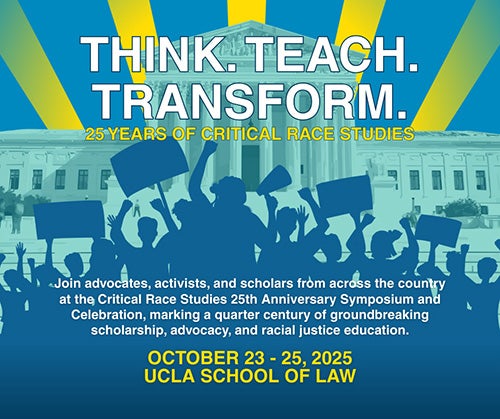 Think. Tech. Transform. 25 Years of Critical Race Studies
October 23-25, 2025 | UCLA School of Law
Celebrating the 25th anniversary of the Critical Race Studies Program at UCLA Law, this landmark symposium brought together leading scholars, students, advocates, and community members to honor CRS’s trailblazing contributions over the past quarter century—and to chart the future of racial justice in a moment of profound political and social challenge.
Symposium information and program
MAIN PANELS
See also Concurrent Sessions below Main Panels.
October 23, 2025
Plenary: From Theory to Program: The Establishment of Critical Race Studies
Welcome
- LaToya Baldwin Clark, Professor of Law and Faculty Director, Critical Race Studies, UCLA School of Law
Plenary: From Theory to Program: The Establishment of Critical Race Studies
Critical Race Theory emerged in the late 1980s as a revolutionary response to the limitations of traditional civil rights approaches. Legal scholars like Derrick Bell recognized that landmark 1960s civil rights legislation had failed to produce structural transformation, necessitating new theoretical frameworks for understanding persistent racial inequality. The movement crystallized through student activism at Harvard Law School in 1981, when Kimberlé Crenshaw organized an alternative race and law course following Bell’s departure, challenging both inadequate legal frameworks and institutional failures to address racial justice comprehensively.
UCLA’s Critical Race Studies program, established in 2000 by faculty including Crenshaw, Cheryl Harris, Laura Gómez, Devon Carbado, Mitu Gulati, and Jerry Kang, became the first law school program dedicated to Critical Race Theory. Its founding responded directly to California’s Proposition 209 (1996), which devastated the law school’s diversity—exemplified by one incoming class of 320 students that included only one African American male. Both foundational moments reflected sophisticated understandings of law’s dual role in enabling racial progress while maintaining hierarchical structures. This panel will highlight how the program’s establishment represented both a scholarly response to retrenchment and a commitment to training lawyers equipped with analytical tools for combating contemporary racial subordination.
- E. Tendayi Achiume, Professor of Law, Stanford Law School
- Cheryl I. Harris, Rosalinde and Arthur Gilbert Professor in Civil Rights and Civil Liberties, UCLA School of Law
- Emmanuel Mauleón, Associate Professor of Law, University of Minnesota Law School, UCLA Law JD ‘18
- K-Sue Park, Professor of Law, UCLA School of Law
- Moderator: LaToya Baldwin Clark, Professor of Law and Faculty Director, Critical Race Studies, UCLA School of Law
October 24, 2025
Plenary : Think Bold, New Ideas, and Dean Waterstone’s Remarks
Welcome
- Jasleen Kohli, Executive Director, Critical Race Studies, UCLA School of Law
Plenary: Think Bold, New Ideas
This panel assembles leading scholars whose work exemplifies Critical Race Theory’s evolution beyond its foundational frameworks. While honoring CRT’s origins, our panelists expand theoretical conversations through diverse methodological approaches: historical analysis of racial categories and comparative formations, sociological examination of Latino/Latina identity within racial hierarchies, international human rights and Third World legal perspectives, and empirical research on implicit bias intersecting race, gender, and sexuality.
The discussion will explore how interdisciplinary methodologies have enriched CRT’s analytical toolkit while generating productive theoretical tensions. How does historical methodology—straddling empirical social science and interpretive humanities—reshape understanding of racial formation? How does evidence of implicit bias complement or challenge CRT’s structural critique? What transformations occur when CRT travels transnationally, encountering different racial formations and legal systems? How do intersectional analyses of race, gender, sexuality, and class both fulfill and complicate CRT’s original vision?
By embracing both CRT’s expanding intellectual influence and its generative internal debates, this panel charts future directions for critical race scholarship across legal and interdisciplinary contexts, demonstrating the theory’s continued relevance and methodological sophistication.
- Aslı Ü. Bâli, Howard M. Holtzmann Professor of Law, Yale Law School
- Laura E. Gómez, Lee & Leon Karelitz Chair in Evidence & Procedure, The University of New Mexico School of Law and Rachel F. Moran Endowed Chair in Law Emerita, UCLA School of Law
- Ariela Gross, Distinguished Professor of Law and History, UCLA School of Law
- Russell K. Robinson, Walter Perry Johnson Professor of Law and Faculty Director, Center on Race, Sexuality, and Culture, UC Berkeley School of Law
- Moderator: Jerry Kang, Ralph and Shirley Shapiro Distinguished Professor of Law, UCLA School of Law; Distinguished Professor of Asian American Studies (by courtesy); Inaugural Korea Times – Hankook Ilbo Endowed Chair (2010-20); Founding Vice Chancellor for Equity, Diversity and Inclusion (2015-20), UCLA
Dean’s Remarks
- Michael Waterstone, Dean and Professor of Law, UCLA School of Law
Plenary: Teach Future Leaders and Scholars
Educational institutions serve as critical sites for shaping future leaders and fostering critical consciousness. Recent political developments, including systematic attacks on diversity, equity, and inclusion initiatives and the weaponization of anti-CRT rhetoric, have created unprecedented challenges for race-conscious pedagogy. These efforts continue reverberating across educational contexts, fueling censorship, silencing conversations about systemic inequality, and restricting institutional access. However, a Critical Race Studies lens offers potent strategies for resistance and institutional reimagination.
This panel brings together scholars and educators examining how legal education— and educational practice broadly—can foster critical consciousness while equipping future leaders to challenge oppressive systems and envision more equitable futures. Panelists will share concrete strategies for embedding CRS principles within curriculum, mentorship programs, and institutional reform initiatives, while addressing real-world barriers posed by political, legal, and institutional backlash. From community-engaged learning methodologies to radical reconceptualization of classroom dynamics, this conversation highlights teaching as both a site of resistance and a foundation for systemic transformation.
Together, participants will reflect on pedagogical approaches that cultivate responsibility, resilience, and imagination in emerging scholars and practitioners. This discussion invites students, faculty, and allies to collectively consider how educational practice can serve as both a foundation for collective liberation and a safeguard against civil rights retrenchment.
- Jonathan Feingold, Professor of Law, Boston University School of Law, UCLA Law JD ‘12
- Hiroshi Motomura, Susan Westerberg Prager Distinguished Professor of Law and Faculty Co-Director, Center for Immigration Law and Policy, UCLA School of Law
- Addie Rolnick, Yuhaaviatam of San Manuel Nation Professor of Law, Faculty Director, Indian Nations Gaming & Governance Program and Associate Director, Program on Race, Gender and Policing, University of Nevada, Las Vegas, William S. Boyd School of Law, UCLA Law JD ‘04
- Anna Spain Bradley, Professor of Law and Faculty Director, The Promise Institute for Human Rights at UCLA (with locations in Los Angeles and in Europe), UCLA School of Law
- Moderator: Fanna Gamal, Assistant Professor of Law, UCLA School of Law
Plenary: Transform Racial Justice Advocacy
This panel convenes distinguished alums, advocates, and scholars to examine innovative approaches for implementing critical race studies in professional practice. Panelists will analyze emerging and persistent challenges in translating theoretical frameworks into actionable strategies and highlight effective approaches to race-centered litigation, policy development, and movement-building initiatives. This discussion will illuminate how legal advocates are reimagining racial justice work in response to rising anti-CRT sentiment and increasing authoritarian tendencies within contemporary American political culture.
Panelists will address multifaceted challenges and evidence-based solutions operating at local, state, and national levels, offering concrete pathways for advancing social justice within the current political climate. The conversation will examine how practitioners navigate institutional and real-world constraints, exploring successful case studies and strategic innovations that demonstrate CRT’s practical applications. By connecting theoretical foundations with experience, this panel bridges academic scholarship and advocacy practice.
The discussion will emphasize collaborative approaches to systemic change, examining how legal professionals, community organizers, and policy advocates can leverage critical race theory insights to challenge structural inequities effectively. Speakers will demonstrate how CRT principles inform strategic decision-making, coalition-building, and long-term movement sustainability, providing attendees with actionable frameworks for translating critical race scholarship into meaningful social transformation across diverse professional contexts.- Ahilan Arulanantham, Professor from Practice and Faculty Co-Director, Center for Immigration Law & Policy, UCLA School of Law
- Kimberlé W. Crenshaw, Distinguished Professor of Law and Promise Institute Chair in Human Rights, UCLA School of Law
- Sandy Hudson, Writer, Producer, and Activist, Founder, Black Lives Matter-Canada, Co- Founder, Black Legal Action Centre, and Co-Owner, Above the Palace, UCLA Law JD ‘22
- Caleb Jackson, Judiciary Counsel, U.S. Senate, UCLA Law JD ‘18
- Saúl Sarabia, Founder and Director, Solidarity Consulting and Academic Coordinator, UCLA Institute for Research on Labor and Employment, UCLA Law JD ‘96
- Moderator: Sunita Patel, Professor of Law, Faculty Director, David J. Epstein Program in Public Interest Law and Policy, and Faculty Director, Veterans Legal Clinic, UCLA School of Law
CONCURRENT SESSIONS
See also Main Panels above Concurrent Sessions.
October 24, 2025
Algorithms, Authorship, and Empire: Critical Race Perspectives on Technology and Control
This panel interrogates how emerging technologies and intellectual property law reproduce racial hierarchies. Presenters analyze how structural bias in generative AI perpetuates racial inequality, how settler colonialism and global “chip wars” shape the cultural and geopolitical stakes of AI in Oceania, and how copyright law’s fixation on authorship has historically denied marginalized communities recognition for their creative labor. Drawing on Critical Race Theory, decolonial scholarship, and feminist critiques, the panel reveals how technological and legal regimes—often framed as neutral or progressive—can reinforce subjugating systems. Collectively, these papers offer accountable and justice-oriented alternatives to the ways knowledge, creativity, and data are owned and controlled in the era of generative AI.
- Chris Chambers Goodman, Professor of Law, Pepperdine Caruso School of Law, Critical Race Theory and Generative Artificial Intelligence: Understanding & Transforming Structural Bias in Subjugating Systems
- Dr. Melemaikalani Moniz, Postdoctoral Researcher, Abundant Intelligences, Toward A Decolonial Framework for Artificial Intelligence
- John Tehranian, Paul W. Wildman Chair and Professor of Law, Southwestern Law School, (C)aptured: Copyright Law’s Authorship Doctrine, the Body Politic and the Politics of the Body
- Moderator: Jerry Kang, Ralph and Shirley Shapiro Distinguished Professor of Law, UCLA School of Law
Citizenship, Territory, and the Constitutional Life of White Supremacy
This panel examines how constitutional law and legal structures have been central to producing and preserving racial hierarchy across different contexts and eras. These papers explore how caste supremacy aligned with whiteness in early naturalization law; parallels between fugitive slave laws and the contemporary rendition of migrants; the Insular Cases and white supremacy in U.S. territorial governance; and racial hierarchy in Redeemer constitutions and in the English-language requirement for naturalization. Together, these analyses reveal how legal frameworks have not merely reflected racial hierarchies but have actively constructed and reconstituted them across temporal and geographic boundaries.
- Sumit Baudh, Professor of Law, Jindal Global Law School, O.P. Jindal Global University, UCLA Law SJD ‘16, Citizenship and Equal Protection Laws in the U.S. and India: A South Asian Dalit Critique of Thind (1923)
- Emma Brush, Assistant Professor of Law, Jurisprudence and Social Thought, Amherst College, The Fugitivity the Law Creates
- Gabriel “Jack” Chin, Edward L. Barrett Jr. Distinguished Professor of Law, UC Davis School of Law and Paul Finkelman, Professor of Law, University of Toledo College of Law, White Supremacy in the Territories Marc E. Jácome, Immigration Attorney, Chicago Immigration Advocates, UCLA Law JD ‘19, White Naturalization: A Critique of the English Language Requirement in United States Naturalization Law
- Moderator & Panelist: Brian Highsmith, Assistant Professor of Law, UCLA School of Law, The Constitutional Entrenchment of Racial Hierarchy: Lessons from the “Redeemer” Constitutions
Families and the Construction of Racial Experience
As an area of scholarly and pedagogical interest, family law concerns adult intimate partnerships and parent-child relationships. Most of the laws and cases that comprise the current family law canon are race-neutral, leading to a centering of the white family in legal analysis. Family law in its current form is only conceptually coherent, however, if the experiences of non-white people are shunted into fields such as criminal, welfare, or immigration law. The family remains a site where racial meaning is created, and the law continues to play an active role in shaping those meanings, regulating who can partner together and reproduce. Family has also been a powerful metaphor for belonging in this country and thus a stage on which anxieties about citizenship have continued to play out, as evidenced by recent efforts to curtail birthright citizenship. Because marriage was, and continues to be, a sexual and economic relationship, the regulation of family inherently involves the policing of sexuality and gender roles: the study of race and family relationships is necessarily intersectional.
The papers in this panel all study the dialogical relationship between race and gender, as mediated through family relationships. They study how family choices and the laws available to certain families produce racial experiences, and how race affects family members along the lines of gender and sexuality. And they interrogate how individuals’ family formation choices reflect political calculations to maximize access to white privilege. These papers ultimately reveal underappreciated mechanisms by which the law perpetuates white supremacy.
- Robert Chang, Professor of Law and Sylvia Mendez Presidential Chair for Civil Rights, UC Irvine School of Law
- Rose Cuison-Villazor, Professor of Law and Chancellor’s Social Justice Scholar, Rutgers Law School
- Kaiponanea Matsumura, Professor of Law and William M. Rains Fellow, Loyola Law School, Los Angeles, UCLA Law JD ‘07
- Jessica Dixon Weaver, Professor of Law and Vinson & Elkins Faculty Fellow, SMU Dedman School of Law
Imprisoning Disability: Using CRT and DisCrit to Abolish the Carceral State
Critical Race Theory (CRT) has been a guiding principle in our work and how we think, teach, and transform communities. Alongside its intellectual sibling, DisCrit, we’ve deployed these frameworks in our scholarship, teaching, client advocacy, and policy work. The authors have worked for over thirty years as scholar-activists and advocates representing youth in delinquency and education proceedings. This panel will explore how CRT and DisCrit animate our advocacy, with concrete examples in the areas of dis/ability, education, and anti-racist, anti-prison work. Attendees will leave with practical tools and ideas for applying CRT and DisCrit in their studies, scholarship, and advocacy.
Subini Annamma will share how DisCrit was developed as a sibling to Critical Race Theory, similar to LatCrit and TribalCrit, and its unique affordances in advocacy, scholarship, policy, and teaching. She will share the findings of her most recent work with incarcerated youth across eight states. Jamelia Morgan will share how she has employed a DisCrit lens to examine the ways in which legal doctrine and everyday police practices work together to render disabled people— particularly those at the intersection of race and disability—uniquely vulnerable to police violence. Jyoti Nanda will describe how CRT and DisCrit shape her research on carceral spaces, including a current study of 200 closed case files to trace pathways for girls and gender-expansive pregnant youth into the youth carceral system. Vivian Wong will discuss how she reframes the school-to-prison-pipeline as a nexus of criminalization in schools, drawing from her youth client work, local policy efforts, and statewide legislative advocacy.
- Subini Ancy Annamma, Associate Professor, Stanford University
- Jamelia Morgan, Professor of Law, Northwestern Pritzker School of Law
- Jyoti Nanda, Professor of Law, Southwestern Law School
- Vivian Wong, Director and Visiting Associate Clinical Professor, Youth Justice Education Clinic at the Center for Juvenile Law and Policy, LMU Loyola Law School, UCLA Law JD ‘17
Critical Immigration Legal Theory
Critical immigration legal theory (CILT) contends with the ways in which U.S. immigration law constructs and perpetuates subclasses of people based on race, gender, class, and other historically oppressed identities. Informed and guided by critical race theory, CILT elucidates the interaction of immigration and criminal enforcement systems to reify white supremacy through carceral power. Colorblindness disguises state demarcations of immigrants, criminals, and criminal-immigrants as legitimate targets of containment and subordination. The U.S. immigration legal regime creates and sustains a hierarchical social order of insiders and outsiders based on race and capital. This regime is further justified by autocratic notions of national sovereignty and national security which are antithetical to a multiracial and multicultural democracy.
CILT’s praxis dimension embraces anti-subordination theory, intersectionality, and anti-essentialism to upend the existing immigration system. As many critical immigration legal scholars are engaged in the fight for immigrants’ rights, they have become intimately familiar with their clients’ interactions within the immigration law system. Bolstered by such experience, critical immigration legal scholarship provides space for responding to the structural determinism of the U.S. immigration system. By amplifying the work of critical immigration legal theorists, we hope to expose the existential threat of the current immigration and bordering regime and to replace it with an equitable and inclusive democracy that honors the lived experiences of all people within and beyond borders. This panel will examine and disrupt the reductive assumptions inherent in the U.S. immigration legal regime to highlight alternative paths towards freedom, equality, and justice.
- Ming H. Chen, Professor of Law, UC Law San Francisco
- Kathleen Kim, Professor of Law, LMU Loyola Law School
- Carrie Rosenbaum, Associate Professor, University of San Francisco School of Law
- Yolanda Vázquez, Professor of Law, University of Cincinnati College of Law
Critical Race Theory and Antisemitism
This roundtable will bring together scholars of Critical Race Theory, education law, Constitutional law, and antidiscrimination law, to discuss and explore a variety of interconnected questions, taking Critical Race Theory as both methodology and object.
These questions include:
- How can CRT help us understand the question of (Ashkenazic) Jewish “whiteness” and why it matters?
- How can we use CRT to understand strategic racialization by and of Diasporic North American Jews, as White/non- White in contexts such as citizenship and affirmative action?
- What larger political ends are served or frustrated by the deployment of the claim of “antisemitism” against CRT itself, as well as other efforts seen as aligned with it (such as affirmative action and DEI)?
- How can CRT be used by those genuinely seeking to combat antisemitism to help identify and combat the threat posed both to Jewish communities and communities of color by the rise of White Christian (ethno-) nationalism?
- How can CRT help us identify when anti-Zionism is and is not antisemitism, and is CRT more or less effective than other methodologies in this effort?
- Is CRT useful in understanding current deep divisions within the Diasporic North American Jewish community, about Zionism/anti-Zionism, particularly in the context of Israel/Palestine? Can CRT help North American Jews to better understand their own intersectional identities?
- Jonathan Feingold, Professor of Law, Boston University School of Law, UCLA Law JD ‘12
- David Schraub, Associate Professor of Law, Lewis & Clark Law School
- Moderator: Diane Klein Kemker, Clinical Assistant Professor of Law, Loyola University Chicago School of Law, UCLA Law JD ‘97
Critical Race Theory and Law Clinics: Where Theory Meets Practice
As the term critical race theory (“CRT”) is maligned in state legislatures, school board meetings, the media, and beyond, it is as essential a time as ever to consider how to reclaim the identity of CRT. Within the context of that inquiry, this panel proposes to engage with an important, broader epistemological conversation regarding the relationship between CRT and praxis. Beyond the interrogative ways that CRT is used to critique legal doctrines and mainstream legal thought, what else does CRT have to offer students who intend to practice law? In a moment wherein CRT (or racial justice projects broadly defined) is under attack, where is the best curricular site to address these questions?
In this panel, we will explore clinical legal education as a special (and underappreciated) place where theory and practice come together. Clinics are in position to off-road from classroom to practice, to push students to think about the transformative reaches and limits of both law and theory. The panel proposes to critically analyze the role of clinical legal education in making clearer the connections between CRT and praxis, and in reclaiming the identity of CRT as a capacious site of contesting the law.
We will consider topics such as:
- How to translate the tenets and methodology of CRT into tools that practitioners can draw upon to improve the conditions of marginalized individuals and communities.
- The efficacy of CRT to students in a climate in which racial justice generally and CRT specifically are under attack, the possibilities and limitations of incorporating CRT into clinical legal education.
- The usefulness of CRT as a prefigurative project that demonstrates what can be instead of what is for students.
- The role of CRT in defending and expanding rights-based claims.
- What might CRT offer in this moment of contestation and crisis that is different from other frameworks?
- Amber Baylor, Clinical Professor of Law, Columbia Law School
- Norrinda Brown, Associate Professor of Law, Fordham Law School
- Annie Lai, Clinical Professor of Law, UC Irvine School of Law
- Sunita Patel, Professor of Law, Faculty Director, David J. Epstein Program in Public Interest Law and Policy, and Faculty Director, Veterans Legal Clinic, UCLA School of Law
- Erika K. Wilson, Professor of Law, NYU School of Law, UCLA Law JD ‘03
Moral Panic and Moral Dilemma: CRT and the Reckoning of Our Democracy
While vilified and mischaracterized in the contemporary American imagination, Critical Race Theory (CRT) is the very analytical tool that can help America reckon with its unjust past and chart a racially just future. CRT recognizes that America’s past is not distant from its current reality. In the last text he wrote before his murder, Martin Luther King, Jr. observed that “[n]o society can fully repress an ugly past when the ravages persist into the present.” The Fugitive Slave Act of yesterday echoes in today’s anti-immigrant policies—fueled by racism and xenophobia. Slavery’s denial of education for enslaved (and some free) Black people reappears in the substandard opportunities still reserved for Black children in segregated, under-resourced schools.
CRT teaches that the past is prologue and that cycles of inequality perpetuate unless interrupted. At bottom, tactics of racial oppression—past and present—seek to erase the power, perseverance, and political participation of Black people and other communities of color. CRT not only exposes this agenda but also provides a blueprint for building a more racially just democracy. This is why CRT has long been both a target, as seen in the current moral panic about CRT, DEI, and other equity efforts, and an emancipatory tool.
This panel will bring together legal scholars and policy advocates who use CRT to expose the law’s complicity in racial inequality. Panelists will explore how CRT can help America confront its past and advance justice in democracy, immigration, and education.
- Janel George, Associate Professor of Law and Founding Director, Racial Equity in Education Law & Policy Clinic, Georgetown Law
- Cara McClellan, Founding Director and Practice Associate Professor of the Advocacy for Racial and Civil (ARC) Justice Clinic, University of Pennsylvania Carey Law School
- Karla McKanders, Director, Thurgood Marshall Institute, NAACP Legal Defense and Educational Fund, Inc.
- Jin Hee Lee, Director of Strategic Initiatives, NAACP Legal Defense and Educational Fund, Inc.
Policing, Punishment, and the Carceral State
This panel examines how racialized logics of punishment persist and adapt across different domains of the carceral state. One paper traces the evolution from broken windows policing to hot spots policing, revealing how new “evidence-based” approaches reproduce racial targeting. Another confronts the erasure of Asian Americans in death penalty challenges, showing how anti-Blackness and anti-Asian racism intertwine in capital prosecutions and urging advocates to recommit themselves to critical race theory’s focus on lived experience and storytelling to bolster effective advocacy. A third critiques the animal rights movement’s reliance on punitive logics, arguing for anti-carceral approaches that avoid replicating the failures of carceral feminism. Finally, a paper uses a firearms justice framework to examine how Second Amendment jurisprudence exploits Black communities to support a doctrinal trajectory that maintains racial and gender hierarchies continuing the historical practice of vilifying and criminalizing Black self-defense. Together, these contributions illuminate the durability of carceral frameworks while advancing critiques and strategies for dismantling them.
- Frank Rudy Cooper, Professor of Law and Director, Program on Race, Gender and Policing, William S. Boyd School of Law, UNLV, Policing Transformed, Racial Targeting Preserved: Hot Spots Policing as Successor to Broken Windows
- Raymond Magsaysay, Incoming Associate, Hueston Hennigan, Sentencing the Model Minority to Death: The Asian American Lacuna in the Fight Against California’s Death Penalty
- Nyala Tringali-Carbado, Incoming Associate, Gibson Dunn, & Crutcher, Anti-Carceral Animal Rights: Avoiding the Pitfalls of Carceral Feminism
- Michael R. Ulrich, Associate Professor, Boston University School of Public Health & School of Law, Arms, Race
- Moderator: Priscilla Ocen, Professor of Law, LMU Loyola Law School, UCLA Law JD ‘07
Reinscribing Whiteness: Law, Power, and the Evolution of White Supremacy
This panel examines the shifting strategies through which white supremacy adapts, sustains itself, and reasserts dominance in law, politics, and culture. Panelists bring comparative and interdisciplinary insights to trace how whiteness is preserved across contexts—from claims of white victimhood in U.S. and South African equal protection jurisprudence, to the commodification of identity on social media, to the deployment of religious liberty as a tool of racial retrenchment. Together, the papers interrogate how whiteness functions both as property and as ideology, co-opting even the language of Critical Race Theory to shore up white grievance. By analyzing these dynamics, the panel sheds light on the collective costs of white supremacy and highlights how legal discourse, constitutional principles, and public narratives continue to reinscribe whiteness as normative.
- Ohene Yaw Ampofo-Anti, Researcher, South African Institute for Advanced Constitutional, Public, Human Rights and International Law (SAIFAC), UCLA Law LLM ‘19, White Victimhood, Equal Opportunity and Colour-Blindness: The Right to Equal Protection of the Law in Comparative Context
- Ra’Shya Ghee, Visiting Assistant Professor, University of Minnesota Law School, White Supremacy as Property
- Brooke Girley, Assistant Professor of Law, Delaware Law School at Widener University, Sanctifying Whiteness: How The Legal Discourse Around Religious Liberty Reinscribes White Dominance
- Daniel Kiel, FedEx Professor of Law and Director of Faculty Development, The University of Memphis Cecil C. Humphreys School of Law, How Critical Race Theory Became White
- Moderator: Alanna C. Kane, Bernard A. and Lenore S. Greenberg Legal Scholar Fellow, UCLA School of Law, UCLA Law JD ‘22
October 25, 2025
After SFFA: Race, Admissions, and the Rhetoric of Colorblindness
This panel examines the legal, political, and rhetorical landscape of race in education following the Supreme Court’s decision in Students for Fair Admissions v. Harvard and UNC. The papers explore the narrowing pathways for diversity in higher education, the complexities of Asian American positioning and anti-Asian animus in admissions controversies, and the Court’s erasure of racial categories in its reasoning. Panelists also analyze how conservative advocates have hijacked terms like “diversity” and “equality” to recast racial justice as discrimination against whites. Together, the presentations reveal how SFFA reshapes the terrain of equal protection while offering strategies to resist reactionary narratives and to reimagine diversity doctrines and concepts as a tool for multiracial solidarity and racial justice.
- Ruben J. Garcia, Ralph Denton Professor of Law, William S. Boyd School of Law, UNLV, UCLA Law JD ‘96, Non-Racial Off-Ramps and Dead-Ends: Obstacle Narratives After SFFA
- Vinay Harpalani, Don L. & Mabel F. Dickason Endowed Chair in Law, the University of New Mexico School of Law, Anti-Asian Animus and Elite Admissions Controversies
- Rachel F. Moran, Professor of Law and Director of the Education Law Program, Texas A&M University School of Law, How Race Became Illegible
- Susan Tanner, Associate Professor of Law, University of Louisville, Brandeis School of Law, Hijacked Ideographs: Reclaiming “Diversity” and “Affirmative Action” from Reactionary Rhetoric
- Moderator: Cheryl I. Harris, Rosalinde and Arthur Gilbert Professor in Civil Rights and Civil Liberties, UCLA School of Law
Colonial Legacies, Corporate Power, and the Struggle for Self-Determination
This panel explores how colonialism—past and present—continues to shape law, democracy, and global power. These papers examine the constitutional contradictions in U.S. land and housing law, the suppression of Hawaiian and Japanese language rights as tools of empire, and the ways corporate structures perpetuate colonial hierarchies under the guise of globalization. A final paper traces how U.S. foreign policy enforces racialized loyalty tests, targeting communities of color to uphold imperial interests. Taken together, these contributions highlight how law both entrenches colonial domination and provides openings for struggles toward cultural survival, sovereignty, and multiracial democracy.
- Alvin Padilla-Babilonia, Assistant Professor of Law, Villanova University School of Law, The Constitutional Politics of Housing and Land Rights
- MJ Palau-McDonald, Assistant Professor of Law, University of Hawai’i at Mānoa William S. Richardson School of Law, Portraits of Sedition and Savagery
- Natasha Nandlal Varyani, Professor of Law, Roger Williams University School of Law, Corporate Colonialism: Public- Private Partnerships Perpetuating Existing Supremacist Hierarchies
- Leo Yu, Assistant Professor of Law, University of Massachusetts School of Law, Racialized Allegiances
- Moderator: Joseph Berra, Human Rights in the Americas Project Director, The Promise Institute for Human Rights at UCLA in Los Angeles, UCLA School of Law
Divergent Paths: Immigrant Belonging in Arizona & New Mexico
While close in proximity, the immigrants’ rights movements in Arizona and New Mexico have manifested wins in different arenas.
This panel will discuss the successful policies passed in New Mexico during the last 25 years that allow immigrant New Mexicans to pursue higher education and workforce training, obtain driver’s licenses, receive protection from wage theft and discrimination, and access state guaranteed-basic-income pilots. By contrast, Arizona has passed several anti-immigrant laws, including a ban on cities passing sanctuary policies, served as the center stage for racist policing as immigration enforcement, and is home to many localities that use immigration detention centers as a means for economic development. But Arizona has also served as an incubator for participatory defense community organizing led by directly impacted people, from Puente to Red De DefensAZ. This panel will explore the reasons behind these divergences and what they can teach us about non-carceral futures in the Southwest.
- Yvette Borja, Laura E. Gómez Latinx People and the Law Teaching Fellow, UCLA School of Law
- Mariel Alexandra Bustamante, PhD Student in Jurisprudence and Social Policy, UC Berkeley School of Law
- Gabriela Ibañez Guzmán, Staff Attorney, Somos un Pueblo Unido
- Emily Morel, Community Organizer, Red de DefensAZ
- Alejandra Pablos, Organizer, Red de DefensAZ
- Moderator: Laura E. Gómez, Lee & Leon Karelitz Chair in Evidence & Procedure, The University of New Mexico School of Law and Rachel F. Moran Endowed Chair in Law Emerita, UCLA School of Law
Justice on the Ground: Los Angeles as a Site of Struggle and Transformation
This panel highlights Los Angeles as a critical site where state violence and community resistance collide. One paper examines the limits of sanctuary and the potential of abolitionist federalism in defying the immigration machine. Another draws from the legacies of the Black Panther Party and Black Lives Matter-LA to reimagine Critical Race Theory as a living tradition rooted in local struggle. A third develops a reparations framework for communities harmed by LA Sheriff deputy gangs, centering survivor demands for accountability and repair. Together, these presentations underscore how Los Angeles reveals both the entrenched harms of carceral governance and the transformative possibilities of abolitionist and community-led visions of justice.
- Felipe De Jesús Hernández, Staff Attorney, National Prison Project, American Civil Liberties Union, Beyond Sanctuary: Abolitionist Federalism and Dismantling the Immigration Machine
- Adé T.W. Jackson, Resistance Attorney, The People, UCLA Law JD ‘19, Forecasting the Evolution of Critical Race Theory: Lessons from The Southern California Chapter of the Black Panther Party, Black Lives Matter-Los Angeles, and Local Activism
- Eric J. Miller, Professor of Law, LMU Loyola Law School, A Reparations Framework for Communities Impacted by Los Angeles Sheriff Deputy Gangs
- Moderator: Saúl Sarabia, Founder and Director, Solidarity Consulting and Academic Coordinator, UCLA Institute for Research on Labor and Employment, UCLA Law JD ‘96
Law, Power, and Resistance: Reframing Anti-Discrimination in Housing, Education, and Activism
This panel brings together critical interventions on how anti-discrimination law has been narrowed, weaponized, and resisted across multiple domains. One paper examines how Title VI enforcement has conflated antisemitism with criticism of Israel, subordinating Palestinian rights and chilling campus activism. Others trace the persistence of intersectional discrimination in housing, from the stigmatization of voucher holders to the exclusion of Black women through facially neutral screening practices. Another presentation looks back to Black Power lawyers of the 1960s and 70s as intellectual precursors to CRT, while a fourth unpacks the misuse of Section 1981—originally a Reconstruction-era civil rights safeguard—by anti-DEI advocates. Collectively, these papers reveal how law has been distorted to sustain hierarchies while also offering CRT-informed frameworks for reclaiming anti-discrimination principles in the struggle for racial justice.
- Sahar Aziz, Distinguished Professor of Law and Founding Director, Center for Security, Race and Rights, Rutgers University Law School, The Antisemitism of Essentializing Jews in Anti-Discrimination Enforcement
- Aissatou Barry, Assistant Professor of Law, Brooklyn Law School, Discrimination By Any Other Name
- Joyce M. Bell, Associate Professor in Race, Diaspora & Indigeneity and Sociology, University of Chicago, Black Power Law: How Radical Lawyering Informed Critical Race Theory
- Michael Z. Green, Professor of Law, Dean’s Research Chair, and Director, Workplace Law Program, Texas A&M University School of Law, Reversing Section 1981 Reversals
- Yvette N. A. Pappoe, Associate Professor of Law, University of the District of Columbia David A. Clarke School of Law, Closing the Gap: Leveraging Intersectionality to Combat Source of Income Discrimination Under the Fair Housing Act
- Moderator: Laboni Hoq, Civil Rights Attorney, Hoq Law
Praxis at the Table: Student-Led Critical Food Law Education
Education, immigration, civil rights, agriculture, social welfare, and nutrition: each of these arenas is being undermined by the current presidential administration. Despite these attacks, students are pushing back.
Through UCLA Law’s Food x Race Initiative, we explore how law students are using critical race studies and adjacent theories to retrench and build on advocacy in intersecting fields such as food law and policy. Through our initiative, we encourage students to educate themselves, publish scholarship, and play an active role in food law curriculum development. We will discuss how each of us came to this work and cover our own scholarship, including (a) connections between race, food systems, labor, and migration; (b) the importance of advancing perspectives from CRT and Third- World Approaches to International Law in advancing racial and social justice in food law and policy; and (c) food apartheid. We will then shift our discussion to how other legal professionals can use CRT to push boundaries, inform legal pedagogy and our work as practitioners, and promote a more racially just world. Finally, we will discuss our goals for the initiative and end with a call to action, encouraging student participation in the initiative and additional departmental integration.
- Heliya Izadpanah, Research Affiliate, Resnick Center for Food Law and Policy, UCLA School of Law, UCLA Law JD ‘25
- Lavanya Sathyamurthy, Research Affiliate, Resnick Center for Food Law and Policy, UCLA School of Law, UCLA Law JD ‘25
- Lucy Weiss, Research Associate, Resnick Center for Food Law and Policy, UCLA School of Law, UCLA Law JD ‘25
- Moderator: Andrea Freeman, Second Century Chair Professor of Law, Southwestern Law School
Race, Space, and Law: Perspectives from Asian American Critical Race Theory
Educational institutions and immigrant businesses are some of the physical and symbolic spaces associated with Asian Americans. This panel examines how American society and American laws have shaped, constrained, and policed these spaces, often through mechanisms of exclusion, neglect, or surveillance. Projecting these spaces into education access and COVID-inspired hate crimes, the panel explores today’s social debates and legal frameworks that govern Asian American presence and participation in public life. Building on the foundational insights of theorists such as Neil Gotanda, Frank Wu, Jerry Kang, Gabriel Chin, Claire Jean Kim and Robert Chang, the panelists apply these perspectives to contemporary legal controversies, illuminating the intersection of race, space, and law for Asian Americans.
- Elaine M. Chiu, Professor of Law, St. John’s University School of Law
- Chris M. Kwok, Community Organizer and Adjunct Professor, Hunter College (CUNY), UCLA Law JD ‘00
- Phil Lee, Professor of Law, St. John’s University School of Law
- Dr. Vivian Louie, Professor of Urban Policy & Planning, Hunter College (CUNY)
Beyond Resistance to the War on Higher Ed
In a 2021 speech entitled “The Universities are the Enemy,” Vice President JD Vance declared, “We have to honestly and aggressively attack the universities in this country.” Such attacks are part of the global authoritarian playbook to curtail universities’ independence and capacity to sustain democracy. In the U.S., however, the attack is perversely cloaked in civil rights discourse and tied to the persistent assault on racial justice efforts. As SFFA v. Harvard exemplifies, measures meant to address discrimination against marginalized communities are rebranded as racism against white people. Today this strategy manifests in right-wing campaigns against “critical race theory” and “DEI.”
A redefined notion of antisemitism marks the latest front. Here, conservative white elites and some Jewish communities are encouraged to band together to suppress critical thinking, progressive ideas, and supposedly “woke” faculty and students accused of antisemitism. This weaponization of “antisemitism” serves as a cloak for efforts to dismantle faculty self-governance and academic freedom. Universities are being pressured by donors and trustees as they struggle to balance student protest rights with claims of safety. Faculty governance norms are being upended as personnel are dismissed without due process. These crises collide with economic vulnerability after decades of neoliberal “corporatization.”
This panel draws on Critical Race Theory to examine how to act strategically and collaboratively within an individualist, careerist academic culture during this era of ideological conflict, with the goal of protecting and advancing higher education’s core mission: the pursuit of truth and knowledge for the common good.
- Mario L. Barnes, Chancellor’s Professor of Law, UC Irvine School of Law
- Steven W. Bender, Associate Dean for Planning and Strategic Initiatives and Professor of Law, Seattle University Law School
- Meera E. Deo, Professor of Law, Southwestern Law School
- Athena D. Mutua, Professor of Law and the Floyd H. & Hilda L. Hurst Faculty Scholar, University at Buffalo Law School
Critical Constitutional Realism: CRT, Fascism, and the Future of Racial Justice
Critical Race Theory (CRT) has reshaped how we understand democratic and legal institutions by placing race and racism at the center of inquiry. CRT is uniquely positioned to provide a framework for confronting the global resurgence of fascism.
Since the 2017 election of Donald Trump, America has witnessed a rise in authoritarian populism, political repression, and the erosion of democratic norms. These developments, paralleling global trends, reflect long-standing patterns in which fascist movements exploit racism, xenophobia, and social division to consolidate power. America’s own history—marked by slavery, economic exploitation, and systemic racial oppression—offers crucial context for understanding contemporary fascism and shaping effective responses.This panel will explore how CRT’s core tenets—recognition of structural racism, intersectionality, interest convergence, and racial realism—can guide strategies to resist and dismantle fascism. Discussion will center on questions such as:
- How can CRT illuminate the ties between America’s racial history and modern fascist strategies?
- In what ways can intersectionality inform coalition-building across marginalized communities?
- How might CRT approaches reshape advocacy and policymaking to counter authoritarianism?
- Can CRT’s critique of liberalism help construct resilient, community-driven models of democracy?
Panelists will draw on interdisciplinary insights and current movements to articulate a forward-looking CRT framework responsive to the urgency of today’s challenges. The session seeks not only to deepen theoretical discussions but also to identify actionable racial justice strategies, connecting CRT’s analyses of systemic racism and racial capitalism to fascism while empowering future generations to defend equity and democracy.
- Atiba R. Ellis, Associate Dean for Enrichment and Engagement and Professor of Law, Case Western Reserve University School of Law
- Areto Imoukhuede, Professor of Law, Florida A&M University College of Law
- Darrell D. Jackson, Winston Howard Distinguished Professor of Law, University of Wyoming College of Law
- Christian Sundquist, Professor of Law, University of Pittsburgh, School of Law
In 2026, Cambridge University Press will publish Critical Evidence, edited by Bennett Capers, Jasmine Harris, and Julia Simon-Kerr. This panel features six of its contributing authors, all scholars of evidence and race.
Critical Evidence shows that evidence law is fundamentally about power, setting the boundaries for whose voices will be heard and what types of knowledge will be cognizable in court. Building on critical race theory and other critical legal theories, Critical Evidence exposes the ways that the system of proof systematically privileges insiders while silencing or discrediting marginalized groups, in particular people of color, women, people with disabilities, LGBTQ+ people and those at the intersections of these marginalized identities. While this new scholarship is rich and varied, it is unified by its rejection of the view that evidence rules are neutral, trans-substantive, and non-partisan. Critical evidence theorists are also unified in exploring the ways the evidence system—the rules, the legal actors deploying them, and the gatekeepers interpreting them—is structured to perpetuate advantages for some and disadvantages for others; in short, subordination. This lens shows logic, knowledge, and determinations of truth cannot exist in a vacuum. The social context in which evidence questions are asked and answered will inform where we start and where logic takes us.
Each contributing author applies a critical lens to evidence law in its entirety or to a single evidentiary concept or rule, revealing evidentiary law’s inherent inequality or the asymmetry in how courts apply the rules, and suggesting reforms or transformation.
- Bennett Capers, Professor of Law, Fordham Law School, Critical Race Theory, Afrofuturism, and Reimagining the Rules of Evidence
- Montré Denise Carodine, Professor of Law, The University of Alabama School of Law, Race is Evidence/Evidence is Race: Flipping the Script on the “Racial Lens”
- Daniel Harawa, Professor of Law, NYU School of Law, Peña-Rodriguez v. Colorado, Jury Secrecy, and the Performance of Racial Justice
- Alexis Hoag-Fordjour, David Dinkins ‘56 Associate Professor of Law, Brooklyn Law School, Presumed Credible: Police Officer Testimony
- Ngozi Okidegbe, Associate Professor of Law and Assistant Professor of Computing & Data Sciences, Boston University School of Law, Democratic Evidence
- Anna Roberts, Dean’s Research Scholar and Professor of Law, Brooklyn Law School, Teaching Impeachment
Current Perspectives on Race and Law in Colombia
ILEX Acción Jurídica is an organization with more than seven years of experience, led by Afro-Colombian women lawyers committed to the fight for racial justice in Colombia. It was founded primarily by women lawyers who graduated from the UCLA Master’s program with a specialization in Critical Race Theory (CRT).
We believe that the CRT framework is both a theoretical and practical tool for confronting the multiple manifestations of white supremacy, not only in the United States but also in Latin America. This approach has been central to ILEX in designing strategic litigation and research initiatives that contribute to the advancement of Afro-Colombian communities.
Through a panel format, we will present how ILEX, through research and legal mobilization, addresses expressions of white supremacy in Latin America, with a particular focus on Colombia.
While the concept of “white supremacy” is politically and theoretically debated, we highlight parallels with the United States in areas such as mass incarceration and racist police violence. Our contribution compares these dynamics across both contexts, showing how law, viewed through a critical racial lens, can become an instrument to confront them.
- Dayana Blanco Acendra, Attorney, Ilex Acción Jurídica, UCLA Law LLM ‘18
- Maryluz Barragán Gonzalez, PhD Student, Human Rights Defender, University Carlos III de Madrid, UCLA Law LLM ‘18
- Daniel Gómez-Mazo, Co-Founder, Ilex Acción Jurídica, UCLA Law LLM ‘14
- Audrey Mena Mosquera, Academic Researcher, Ilex Acción Jurídica
City University of New York (CUNY) School of Law faculty offer a vision for mobilizing CRT that prepares CUNY’s diverse learning community for transformative practice in movement and abolitionist lawyering.
Since its inception in 1983, CUNY’s mission-driven program has centered social justice and engaged students who are historically underrepresented in the legal profession. CUNY’s curriculum comprehensively addresses the presence of racial hierarchies in law and their intersection with other forms of legal and social subordination. CUNY’s robust clinical program embeds CRT as an animating perspective, shaping students’ professional identities in areas of practice where the effects of racism are powerfully manifest.After George Floyd’s murder, CUNY added a mandatory CRT course to provide a shared, foundational framework for students to address how the ideology of white supremacy informs the substance of U.S. law and to identify effective responses. The panel will discuss a recent proposal to expand the requirement beyond a dedicated introductory course into a pervasive curricular approach that positions faculty from different doctrinal perspectives to further engage CRT in their classes and scholarship, and more fully reflect the conceptual, doctrinal, and lawyering dimensions of the CRT-practice continuum at CUNY.
- Chaumtoli Huq, Professor of Law, CUNY School of Law
- Donna H. Lee, Professor of Law, CUNY School of Law
- Jeena Shah, Professor of Law, CUNY School of Law
- Marbré Stahly-Butts, Associate Professor of Law, CUNY Law School
- Jared M. Trujillo, Associate Professor of Law, CUNY School of Law
- Moderator: Andrea McArdle, Professor of Law, CUNY School of Law
Sound as Legal Resistance: Hip-Hop’s Role in CRT’s Future
As Critical Race Theory (CRT) faces unprecedented attacks and misrepresentation in today’s political discourse, this panel explores how hip-hop—specifically Public Enemy’s revolutionary critique—offers vital methodological insights for CRT’s next twenty-five years. Both CRT and Public Enemy emerged in the 1980s as responses to the limits of civil rights era gains and the persistence of structural racism.
While CRT scholars developed theoretical frameworks in law schools, Public Enemy articulated parallel critiques through music, reaching audiences far beyond traditional scholarship. This synchronicity reflected the post–civil rights era’s racial dynamics, where colorblind liberalism masked inequality and mainstream institutions resisted radical critique.
We argue that hip-hop’s contributions to CRT extend beyond cultural commentary. Public Enemy’s music demonstrates how artistic expression can function as legal resistance—offering counter-narratives that challenge institutional frameworks, expose racial capitalism, and envision alternative futures. Their work embodies what CRT terms “oppositional cultural practice”: art that critiques existing power while imagining transformation.
The four presentations trace this methodological contribution across key domains:
- Theoretical foundations—how Public Enemy’s call for cultural resistance and racial agency parallels CRT’s centering of marginalized voices and critique of colorblindness.
- Economic justice—how the group’s critique of racial capitalism complements CRT’s analysis of race as property.
- Institutional critique—how Public Enemy’s challenges to exploitative power structures offer tools for today’s battles over DEI and corporate racial justice.
- Afrofuturism and digital activism—how their radical vision translates into contemporary cultural resistance across technological platforms.
- Jade A. Craig, Assistant Professor of Law, University of Mississippi School of Law
- Etienne Toussaint, Associate Professor of Law, University of South Carolina Joseph F. Rice School of Law
- Cheryl L. Wade, Harold McNiece Professor of Law, St. John’s University School of Law
- Moderator: Gregory Parks, Professor of Law, Wake Forest University School of Law
Subversive Social Work: Critical Race Theory in Social Welfare Policy, Pedagogy and Practice
This panel provides attendees with tools to “think, teach and transform” social welfare with CRT methodologies. CRT is an apt lens for the field, since, as a “helping” profession, social work is rife with problematic themes for those seeking a social justice lens. The development of the profession and of its academic literature shows a history that harkens liberal politics, the normalization of whiteness, the pathologization of individuals and communities of color, and a focus on the individual problems rather than systemic injustices. That being said, social work is also a value-laden profession, with its most passionate ambassadors insisting that social justice is at its core. Included in its code of ethics are concepts such as challenging social injustice, dignity and worth of a person, and the importance of human relationships.
Providing a comprehensive overview of subversive scholarship in social welfare, this panel details how CRT has impacted the field since 2002. The first paper describes the genealogy of CRT social work scholarship and its application in the profession. Second, a QuantCrit scholar with an eye towards racial wealth and health equity, examines structural mechanisms and presents theoretical and empirical examples that illustrate the racialized relationships among structural racism, wealth building, and health outcomes. Finally, the third paper describes a course situated at the intersection of social work and ethnic studies that positions counter-storytelling as both method and praxis: a means of thinking critically, teaching responsively, and transforming how knowledge and power operate in the classroom.
- Dr. Stacey Chimimba Ault, CEO, The RAGE Project
- Susan Lares-Nakaoka, Director of Practicum, Social Welfare, UCLA
- Larry Ortiz, Professor of Social Work, Loma Linda University
- Cindy C. Sangalang, Assistant Professor of Social Welfare and Asian American Studies, UCLA
- Sicong “Summer” Sun, Assistant Professor of Social Welfare, UCLA Luskin School of Public Affairs
- Nicole Vazquez, CEO, Armor Adelante LLC and Program Coordinator, My TRIBE Rise
-
.png) Celebrating the Career of Laura E. Gómez (View program here.)
Celebrating the Career of Laura E. Gómez (View program here.)March 15 | UCLA School of Law
A special symposium to celebrate Professor Gómez's retirement and honor her groundbreaking career and tremendous impact on Critical Race Studies, UCLA School of Law, and legal and academic communities at large.
Laura E. Gómez is UCLA's Rachel F. Moran Endowed Chair in Law and founding co-director of the Critical Race Studies program. She also is the esteemed author of Manifest Destinies: The Making of the Mexican American Race, and Inventing Latinos: A New Story of American Racism. Visit Professor Gómez's website here.
Remarks from
- Michael Waterstone, Dean of UCLA School of Law
- Cheryl I. Harris, Vice Dean for Community, Equality and Justice; Rosalinde and Arthur Gilbert Professor in Civil Rights and Civil Liberties
- Uriel Saldivar Esteban, J.D. Candidate '25 & Community Service Chair, UCLA Latinx Law Students Association
Manifest Destinies: The Making of the Mexican American Race
Panelists will discuss Professor Gómez's groundbreaking 2007 text, which has been established as an essential resource for understanding the complex history of Mexican Americans and racial classification in the United States.
- Moderator: Jerry Kang, Distinguished Professor of Law; Founding Vice Chancellor for Equity, Diversity and Inclusion (2015-20), UCLA School of Law
- Genevieve Carpio, Associate Professor, César E. Chávez Department of Chicana/o Studies, UCLA
- Nicholas Espíritu (Law '04), Deputy Director, Legal, National Immigration Law Center
- Casandra Salgado (Ph.D. Sociology '19), Assistant Professor, Sociology, Arizona State University
Inventing Latinos: A New Story of American Racism
Panelists will discuss Professor Gómez's most recent book exploring the impact of Latinos’ new collective racial identity on the way Americans understand race.
- Moderator: Aslı Ü. Bâli, Professor of Law, Yale Law School
- Walter Allen, Distinguished Professor of Education, Sociology, and African American Studies; Allan Murray Cartter Chair in Higher Education, UCLA School of Education & Information Studies
- Sherene H. Razack, Chair and Distinguished Professor, Gender Studies; Penny Kanner Endowed Chair in Women's Studies, UCLA
- Saúl Sarabia (Law '96), Founder and Director, Solidarity Consulting
Keynote by Laura E. Gómez, Rachel F. Moran Endowed Chair in Law
Introduction by Devon W. Carbado, The Honorable Harry Pregerson Professor of Law, UCLA School of Law (Read by Executive Director of the Critical Race Studies Program Jasleen Kohli, with additional remarks.)
Reception and Dinner in Shapiro Courtyard
Co-sponsored by
-
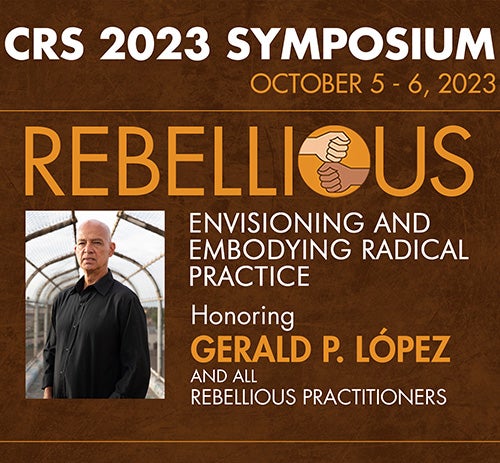
REBELLIOUS (view program here)
Envisioning And Embodying Radical Practice
Honoring All Rebellious Practitioners – Including Gerald P. López
October 5 & 6 | UCLA School of Law
Gerald P. López published Rebellious Lawyering: One Chicano’s Vision of Progressive Law Practice in 1992. The book brought to life how he and others had been practicing for decades. Through “fictional characters and settings as real as can be,” Rebellious Lawyering illuminated how people do what they do when collaborating with others as equals. To fight subordination of every sort. To transform institutions, systems, nations, and transnational life. To personify – and not just prefigure – the concrete utopias they seek. Militantly challenging subordination in all forms and transforming life as we know it are at the center of the rebellious vision, and UCLA Law’s Critical Race Studies program is honored to devote this symposium to looking at rebellious practice past, present, and future.
October 5
Welcome
- Michael Waterstone, Dean and Professor of Law, UCLA School of Law
- Laura E. Gόmez, Professor of Law and Co-Founder of Critical Race Studies Program, UCLA School of Law
Moderator:
- Shauna Marshall, Professor Emerita and Co-Director of the Center for Racial and Economic Justice, UC College of Law, San Francisco
Panelists:
- Martha L. Gómez, Deputy Attorney General, Department of Justice, UCLA Law ‘10
- Gina Hong, Attorney and Collective Member, LA Center for Community Law & Action, UCLA Law ‘18
- Dale Minami, Found & Senior Counsel, Minami Tamaki LLP and Co-Founder of the Asian Law Caucus and the Asian American Bar Association of the Greater Bay Area
- Sunita Patel, Assistant Professor of Law and Faculty Director, UCLA Veterans Legal Clinic, UCLA School of Law
What does toppling the status quo— people and personnel – require of radical practitioners? In how they do their work with others? In facing hostile enemies and squeamish “allies?” In dealing with disdainful and indifferent co-workers? What does it take to bluntly question, defy, and oppose people, institutions, and systems accustomed to crushing dissenters? What does it take to see a battle through? Especially when some take years and generations? Sometimes especially when victory – in the form, say, of a new law or a successful judgment – doesn’t mean much unless and until it’s implemented through on-the- ground practices? What must we bring each day to our work with others to force authoritarian governments to concede they have lied, cheated, stolen? To force ruthless employers and landlords to acknowledge their racism? To force arrogant educational institutions – individually and system-wide -- to admit they use “merit” to cover their consciously discriminatory choices?
Our moderator and panelists have founded and helped develop organizations, programs, and agencies that, working with individual clients and subordinated communities and diverse allies, challenged the racism, misogyny, classism, homophobia, xenophobia practiced by employers, landlords, local and state governments; that forced the United States to admit and to repair the generational damage it caused through the internment of Japanese Americans; that held universities accountable for illegal denials of tenure and for the neglect of low-income, of color, and immigrant communities surrounding campuses; that overturned school districts’ racist targeting of Latinx and Black students for suspension and expulsion and challenged governmental targeting of Muslims in the wake of 9/11. And they have called out everything from the failure of all government to provide robust support for unhoused and housing-insecure populations to the self-promoting regnant practices pursued by well-heeled public interest “impact organizations” and high volume “service work.”
Plenary Roundtable #2: Affirmative Action – The Real Deal and Not Just Harvard Admissions
Moderator:
- Gerald P. López, Professor of Law Emeritus, UCLA School of Law
Panelists:
- Eric Cohen, Executive Director, Immigrant Legal Resource Center (ILRC)
- Maisha Nelson, Director of Human Resources for the Immigrant Legal Resource Center (ILRC) in San Francisco and Founder & CEO of Partnerships with Purpose (P2)
- Mona Tawatao, Legal Director, Equal Justice Society
- Sherod Thaxton, Professor of Law and former Faculty Director of the David J. Epstein Program in Public Interest Law and Policy, UCLA School of Law
What must rebellious racial justice advocacy look like in a world without race-conscious affirmative action? The Supreme Court, diverse elites, and many others enthusiastically proclaim that banning race-conscious affirmative action now returns us to the merit-based systems central to all opportunities in the United States. Really? You do not need to be a student of history to understand that the ubiquitous White privilege we observe today was made possible by what we accurately can call affirmative action for Whites. Governmental programs – in coordination with networks of private institutions and people – have concentrated advantage in white communities and concentrated disadvantage in non-white communities. These racially discriminatory practices and policies created the White middle- and upper-middle class. And the same practices and policies have made it exceedingly difficult – sometimes impossible -- for most non-Whites to even have a fair chance at the American Dream. The kicker? Both the success (for Whites) and the suffering (for non-Whites) are passed down from generation to generation.
“Merit” (human capital) is the rhetoric among elites. But financial and social capital is the reality. This is why White kids born on third base can go through life thinking they’ve hit a triple. Meanwhile non-Whites -- especially Latinx, Blacks, Native Americans, Pacific Islanders and Filipinos -- are labeled dysfunctional and defective for their inability pull themselves up by their own bootstraps. But the world of powerful elites extends far beyond the swankiest schools and fanciest jobs. Across the country, there are always those who, in their own spheres of influence, wield an aggregate power far greater than The Ivy League, Capitol Hill, the Supreme Court Building, and Wall Street. These other elites, who remain overwhelmingly White, rule over state capitals, counties, cities, and rural areas and everything from education to housing to employment to banking to criminal justice to immigration to elections. And they rule through racism, cronyism, and crude proxies for merit that reinforce the status quo. If without race-conscious affirmative action we want our future not to look like our past, must rebellious practitioners abolish affirmative action for Whites?
October 6
Welcome
- Sherod Thaxton, Professor of Law and former Faculty Director of the David J. Epstein Program in Public Interest Law and Policy, UCLA School of Law
- Jasleen Kohli, Executive Director, Critical Race Studies Program, UCLA School of Law
Moderator:
- Colin Cloud Hampson, Partner, Sonosky, Chambers, Sachse, Endreson & Perry, LLP
Panelists:
- Alina Ball, Professor of Law, Bion M. Gregory Chair in Business Law, and Co-Director of the Center for Racial and Economic Justice, UC College of Law, San Francisco, UCLA Law ‘08
- Michelle Tseching Fei, Justice Liaison, UnitedHealthcare Community Plan of Hawai'i (Medicaid)
- Craig B. Futterman, Clinical Professor of Law, Director of Civil Rights and Police Accountability Project, University of Chicago Law School
- Yumari Martínez, Esq., Founding Executive Director, Catalyze Justice
Calls to abolish law enforcement have met with significant support and criticism, both within and outside of marginalized communities. None of this much surprised our boldly rebellious panelists. The wonder is quite the opposite. Once abolition became defined as fundamental transformation (as dismantling, redesigning, rebuilding), why haven’t far more people been calling for the abolition of a far wider set of institutions? If we’re talking transform, how about the Los Angeles Unified School District? The Bureau of Indian Affairs? Juvenile justice systems? The California Department of Motor Vehicles? Indian Health Services? The United States Department of Agriculture? Homeland Security? The Chicago Police Department? Universities? The Florida and Texas systems of governance? Nashville’s traditional country music scene? The political economy? And on and on.
The idea is as reasonable as reasonable can be: Shouldn’t all sensible folks come to understand that demanding fundamental transformation is a profoundly rational and sober response to institutions built and staffed to fail? To keep subordinated communities subordinated? A profoundly rational and sober response to institutions that can be described as “working” only if we assume they are designed and staffed not to work – not even for most in the middle class? Built and staffed to grotesquely betray their publicly professed missions? What explains why far more people don’t clamor for transforming a wide range of institutions? We certainly don’t need more “studies” and “pilot projects” that go nowhere and reinstate the status quo. We certainly don’t need to throw out “just a few bad apples.” Why don’t far more people — and all rebellious practitioners, really — demand fundamental transformation on a fast-track schedule? Fast-tracked transformation now?
Plenary Roundtable #4: Transforming the Education of Rebellious Practitioners
Moderator:
- Andrés Dae Keun Kwon, Senior Policy Counsel and Senior Organizer, ACLU Southern California, UCLA Law ‘16
Panelists:
- Jessica Cobb, Researcher and Advocate for Education Justice, former Policy Director, National Center for Youth Law, and former Director, Norco College Prison Education Program, UCLA Law ‘18
- Jullian Harris-Calvin, Director of Greater Justice New York at The Vera Institute, UCLA Law ‘13
- Ana Graciela Nájera Mendoza, Senior Staff Attorney, Educational Equity Team, ACLU Southern California and former associate at Alexander, Krakow and Glick a plaintiff civil rights firm, UCLA Law ‘14
- Ian Stringham, Attorney, Legal Aid Foundation of Los Angeles, UCLA Law ‘18
If you liberated your immigration, if you had available all the resources now found across a university and all the opportunities in communities beyond a university’s borders, how would you design the education of rebellious practitioners? And how would you continue this education into the future, over years of work, across a lifetime? Building upon and extending what ambitious and effective practitioners need to know? Or perhaps should want to know in the world they would come to see differently than most do now? How would you transform learning and teaching as the boundaries now separating universities and communities would grow more porous and perhaps disappear altogether?
Our moderator and panelists broke free of conventional wisdom. As students of the Rebellious Lawyering Clinic, the Legal Analysis Workshop, and graduates of UCLA Law’s Critical Race Studies Program, they rejected the bi-partisan way to “do law school.” Instead, looking across the university and out into communities and prisons and jails and detention centers, they packaged together an education more demanding, ingenious, and illuminating than tradition recommends. Then they threw themselves into the most demanding practices. Working with people charged with crimes and with immigration offenses. With employees battling wage theft, racial discrimination, sexual harassment. With K-12 students regarded by school districts as unworthy of ambitious and effective education. With incarcerated adults in need of well-run prison libraries and in-person education. They worked ambitiously within the very institutions and systems they aimed to fundamentally transform. If they were starting education from scratch, what would they envision? A collage of the best they found and helped to create? Something even more creative still? An education always in-the-making?
Plenary Roundtable #5: Rebellious Vocations, Rebellious Lives
Moderator:
- Tara Ford, Senior Counsel, Opportunity Under Law, Public Counsel & Co-Founder Pegasus Legal Services for Children
Panelists:
- Bill Ong Hing, Professor of Law and Migration Studies, Director of the Immigration and Deportation Defense Clinic, and Dean’s Circle Scholar, University of San Francisco School of Law and Founder of the Immigrant Legal Resource Center (ILRC)
- Brenda Montes, Immigration Attorney, Montes Law Firm, UCLA Law ‘11
- Gary Peck, former Executive Director, ACLU of Nevada
- Ascanio Piomelli, Professor of Law, UC College of Law, San Francisco
If being rebellious is a vocation, a calling, how can we be healthy when work and life can be so tough? Or does that pose the question in exactly the wrong way? Does health lie in embracing demanding ways of being? And being around others who do the same? Avoiding at all costs “parlor generals and field deserters,” as Marge Piercy urges, and seeking out those who “move in a common rhythm when food must come in or the fire be put out”? For the historically subordinated all this has always been a necessity, right? A necessity to survive and thrive? Surviving and thriving is, as Audre Lorde teaches, “the ability to change, to metabolize experience, good and ill, into something that is useful, lasting, effective.” Mustn’t we all, as Lorde says, “become fast learners”?
These panelists – among the most admired of radical practitioners – have done so much. Founded rebellious organizations, offices, and programs. Transformed others. Taken heavy hits. Lived with deep disappointments. Learned from mistakes and from successes. They’re not into martyrdom or sainthood. Not into “suffering as a badge of courage.” They do enjoy music, sports, yoga, art, dance, cooking, and poetry. Highs of many sorts. Yet they know there’s no “answer.” Work-life balance? Really, achieving and sustaining an equilibrium? When some people need to escape the horror of their lives far more than the demands of their jobs? When work is not “just a job” and life is “too much a bad job”? How then do they unflinchingly face realities and treat each day as a new opportunity? How do they learn from others? Across time, from afar, in our midst? Learn from all those they work with how to be healthy as together we transform our world? Learn how to be rebellious?
Plenary Roundtable #6: A Conversation and a Closing
Introduction:
- Sherod Thaxton, Professor of Law and former Faculty Director of the David J. Epstein Program in Public Interest Law and Policy, UCLA School of Law
Conversationalists:
- Stephen Carpenter, Deputy Director and Senior Staff Attorney, Farmers’ Legal Action Group
- Gerald P. Lόpez, Professor of Law Emeritus, UCLA School of Law
- Shauna Marshall, Professor Emerita and Co-Director of the Center for Racial and Economic Justice, UC College of Law, San Francisco
- Sherod Thaxton, Professor of Law and former Faculty Director of the David J. Epstein Program in Public Interest Law and Policy, UCLA School of Law
Closing:
- Gerald P. Lόpez, Professor of Law Emeritus, UCLA School of Law
In this final roundtable, we offer a conversation and then a closing.
The panelists’ conversation has not been scripted. Nothing’s been declared “off-limits.” Nothing has been declared “a necessity to talk about.” Instead, the conversation will draw upon all that has happened through October 6, 2023, including at this Symposia.
To evoke only a bit of the possible:
When elected Latinx City Council members spew hateful racist comments in their ignorant jokey-jokey fashion, we must immediately get rid of them. And their redistricting plans. And all those complicit in what they have done. And get rid of all those implicated in any “machine” these Latinx City Council members are part of. Drive them all out. Immediately. We can and must clean up our own houses. And, yes, we can without taking our eye off the pervasive practices and effects of White Supremacy. Hard stop.
On May 25, 2020, in the early morning hours, Amy Cooper called the police with a racist made-up story about Christian Cooper, a birdwatcher in Central Park. Later that same day, Derek Chauvin took George Floyd’s life in Minneapolis, with fellow police officers watching and doing nothing to stop the killing. Chauvin’s killing of George Floyd sparked a world-wide movement. Amy Cooper’s lies to the police about Christian Cooper drew much attention but only for a relatively short time. Never forget Derek Chauvin taking George Floyd’s life. Never forget Amy Cooper’s call to the police about Christian Cooper.
Why isn’t the rebellious practice of Farmers’ Legal Action Group (FLAG) talked about by every organization doing progressive and radical work? How they draw upon and collaborate with “farm advocates,” family farmers helping themselves, their neighbors, and others (regionally and even statewide) handle the problems they all regularly face. How they work with family-farm-accountable organizers and organizations. How they fight race and gender discrimination often ignored in talk of civil rights in part because the race and gender diversity among family farmers remains unappreciated. How they acknowledged publicly what’s particularly difficult and only partially successful in the work they do. How they always aim -- in fact and not just in principle – to get better still.
Why don’t we all already know about how the Winnebago Tribe of Nebraska took over its own health care system? How the Winnebago refused any longer to endure the horrible services provided by Indian Health Services? How they’ve built and staffed their own hospital, all within a comprehensive scheme? And why don’t we know about the many people involved? Including Colin Cloud Hampson? Including Danelle Smith? Who took years away from her Indian Law practice to serve as the CEO of Winnebago Healthcare System? If we’re looking in our midst for what many (probably most) would regard as impossible dreams of self-determination, why not learn about the Winnebago and their health care system?
Is the cure for Trumpism a renewed respect for the rule of law? The rule of law led to the Supreme Court’s decisions in the Chinese Exclusion Cases, Plessy v. Ferguson, Buck v. Bell, Pace v. Alabama, United States v. Brignoni-Ponce? That led to the Compromise of 1877, an informal agreement that made Rutherford Hayes president in exchange for ending and gutting Reconstruction, returning absolute power to the Southern states? That led Earl Warren to lie about the legal necessity to intern Japanese Americans? That led Colin Powell to lie to the UN Security Council about Iraq’s huge stash of weapons of mass destruction? That led Justices Kennedy, O’Connor, Rehnquist, Scalia, and Thomas to award the presidency to George Bush over Al Gore?
-
Critical Perspectives on Race and Human Rights: Transnational Re-Imaginings
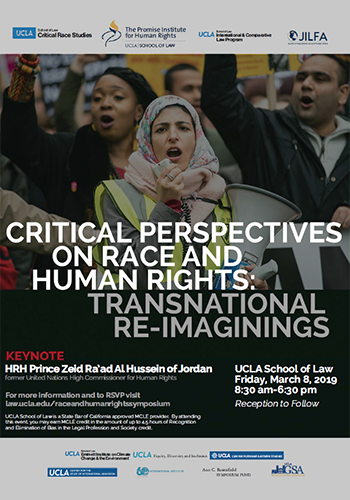
MARCH 8, 2019
UCLA's Critical Race Studies Program, Promise Institute for Human Rights, International and Comparative Law Program and Journal of International Law and Foreign Affairs hosted a one-day conference at the UCLA School of Law on Friday, March 8, 2019, exploring critical topics in contemporary international human rights law from the joint perspectives of Critical Race Theory (CRT) and Third World Approaches to International Law (TWAIL).
Videos:
-
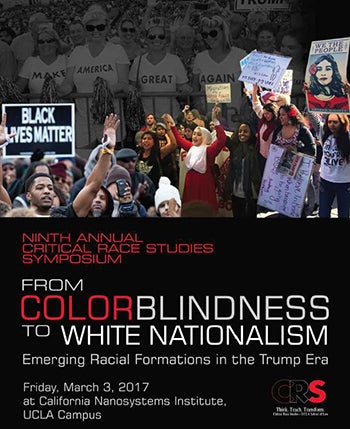
MARCH 3, 2017
Welcome Remarks
- Cheryl Harris, Rosalinde and Arthur Gilbert Professor in Civil Rights and Civil Liberties, Critical Race Studies Faculty Co-Director, UCLA School of Law
- Noah Zatz, Professor, Critical Race Studies Faculty Co-Director, UCLA School of Law
Panel 1: Restoring the White Nation: The Racialization of Immigrants
Videos: Intro | Abrego | Achiume | Q&A
Through the manipulation of borders, physical and conceptual, current expressions of white nationalism are deeply invested in configuring the immigrant as a racial subject whose presence, whether officially sanctioned by law or not, whether formal citizen or not, poses a threat to national identity and the political order. Thus, while domestic populations with non-European immigrant origins and transnational communities are embedded in the national fabric, they remain foreign in a racial sense to the white nation state. This panel will explore the various dimensions of this issue by considering how the expansion of markets and political instability create conditions for displacement and dislocation, how immigration law and policy intersects with gender, and further how the racial construction of domestic immigrant communities distorts and obscures realities.Leisy Abrego, Associate Professor, César E. Chávez Department of Chicana/o Studies, UCLA
- Tendayi Achiume, Assistant Professor, UCLA School of Law
- Gary Segura, Dean, UCLA Luskin School of Public Affairs
- Moderator: Joseph Berra, Clinical and Experiential Project Director, UCLA School of Law
Panel 2: Racialized State Violence
Videos: Intro | Ocen | Bâli | Roy | Q&A
Securing the nation as a racially vulnerable white subject requires the identification and monitoring of enemies who are defined in racial terms as threats to national security at home, agents of disorder globally, and disruptions of normative gender and sexuality. This panel will explore the continuities and distinctions between emergent and earlier forms of racialized state violence and surveillance, as legitimized and structured by law. While the historical origins of racialized state violence run deep and long, to what extent has the Trump era intensified and created new forms and logics to justify both overt and less direct technologies of state violence and social control? How do these systems interrelate and reinforce each other?
- Aslı Bâli, Professor, UCLA School of Law and Director, UCLA Center for Near Eastern Studies
- Priscilla Ocen, Associate Professor, Loyola Law School, UCLA School of Law '06
- Ananya Roy, Professor of Urban Planning and Social Welfare and Director of The Institute on Inequality and Democracy, UCLA Luskin School of Public Affairs
- Moderator: Sherod Thaxton, Assistant Professor, UCLA School of Law
Panel 3: Racial Neo-Liberalism and White Supremacy
Videos: Intro | Harris | Razack | Speed | Q&A
Nationalism routinely is figured in opposition to globalization, and in particular to the transnational practices of neoliberal economic policies. And yet a specifically white racial character has facilitated transnational identification and collaboration among nationalisms in the US, the UK, and Russia, to name a few. Meanwhile, nationalisms long have provided a basis for the economic projects of racial capitalism, as institutionalized in part through law, and whether pursued through transnational imperialism, settler colonialism, or racial caste. This panel will explore the ongoing reconfiguration of these relations among race, nation, and political economy.
- Cheryl Harris, Rosalinde and Arthur Gilbert Professor in Civil Rights and Civil Liberties, Critical Race Studies Faculty Co-Director, UCLA School of Law
- Sherene Razack, Distinguished Professor and Penny Kanner Endowed Chair in Women's Studies, UCLA Department of Gender Studies
- Shannon Speed, Associate Professor, UCLA Departments of Anthropology and Gender Studies, and Director, American Indian Studies Center
- Moderator: Noah Zatz, Professor, Critical Race Studies Faculty Co-Director, UCLA School of Law
Panel 4: Race and Resistance: Social Movements in the Post-Trump Era
Alongside the (re)emergence of a vocal white, masculinist nationalism, we are also witnessing the rise of widespread resistance to this articulation of the nation-state. Social movements that emerged in the wake of the 2016 election and those that have existed prior are reassessing strategies towards, and their conception of, racial and social justice. In this panel, we will explore the formation of new political configurations and the response of existing social movements. Is it necessary for social movements to reimagine themselves in light of emergent threats, or does this moment simply continue long-standing power structures, racial and otherwise? How do we conceptualize effective and inclusive resistance, with the simultaneous move towards a prioritization of intersectional analysis and the centering of the most vulnerable and marginalized populations as well as a backlash against “identity politics” and its perceived potential for divisiveness? What is the role of lawyers and the legal community in creating social change in this environment? What legal strategies need to be deployed considering the administration’s posturing vis-á-vis the judiciary? And given the multiple fronts on which resistance efforts are being fought, how can social movements remain sustainable and impactful over the long-term?
- Zakaria (Zack) Mohamed, Los Angeles Organizer, Black Alliance for Just Immigration
- Carmina Ocampo, Staff Attorney and Immigrants’ Rights Program Strategist, Lambda Legal
- Ameena Mirza Qazi, Executive Director, National Lawyers Guild Los Angeles
- Ignacia Rodriguez, Immigration Policy Advocate, National Immigration Law Center, UCLA School of Law '13
- Melanie Yazzie, Acting Assistant Professor, Gender & Sexuality Studies, UC Riverside
- Moderator: Jasleen Kohli, Director, Critical Race Studies Program, UCLA School of Law
Closing Remarks
- Jasleen Kohli, Director, Critical Race Studies Program, UCLA School of Law
-
OCTOBER 16-17, 2015
October 16
Welcome
- Gene Block, UCLA Chancellor
- Jerry Kang, Vice Chancellor for Equity, Diversity, and Inclusion, Professor of Law, Professor of Asian-American Studies (By Courtesy), Korea Times-Hankook Ilbo Chair in Korean American Studies, UCLA
- Hon. David S. Cunningham III, Los Angeles Superior Court
Opening Roundtable: Understanding Police Violence
Structured in the form of a roundtable, this opening plenary will lay the foundation for the rest of the conference. In addition to commenting on the causes of police violence and the role of law and civil rights organizing in solving the problem, panelists will discuss the ways in which police violence is implicated in immigration law, welfare policy, the school-to-prison pipeline, among other forms of state decision-making that, as a formal matter, sometimes occur outside of the criminal justice system. In the context of the foregoing engagements, the panel will take an intersectional approach, highlighting the impact of police and other forms of state violence on cis women and transgendered, queer, and gender-non-conforming people.
Moderator: Charles J. Ogletree Jr., Jesse Climenko Professor of Law, Harvard Law School; Director, Charles Hamilton Houston Institute for Race & Justice
- Congresswoman Karen Bass, 37th Congressional District, U.S. House of Representatives
- Povi-Tamu Bryant, Member, #BlackLivesMatter; Inter-Group Relations Coordinator, Asian Americans Advancing Justice-Los Angeles
- Jennifer Chacón, Professor of Law, University of California, Irvine School of Law
- Kimberlé Crenshaw, Distinguished Professor of Law, Columbia and UCLA School of Law
- Thomas Harvey, Executive Director and Co-Founder, Arch City Defenders
- Wesley Lowery, National Reporter, The Washington Post
- Jyoti Nanda, Lecturer in Law, UCLA School of Law
October 17
Welcome
- Jasleen Kohli, Director, Critical Race Studies Program
- Cheryl I. Harris, Rosalinde and Arthur Gilbert Professor in Civil Rights and Civil Liberties, Critical Race Studies Program Faculty Co-Director, UCLA School of Law
Plenary: Causes and Consequences of Police Misconduct
As recent events demonstrate, police violence and misconduct against people of color is systemic. For the families most immediately affected as well as the communities in which they reside, the consequences are traumatic and often lethal. Police misconduct is not isolated from broader social practices, policies and laws that implicate race, and indeed, in many ways, these practices arguably enable and incentivize misconduct. This panel will explore the underlying assumptions, causes, and conceptions that animate racial profiling, use of force, and everyday policing practices that literally and symbolically devalue communities of color.
Moderator: Devon Carbado, The Honorable Harry Pregerson Professor of Law, Critical Race Studies Program Faculty Co-Director, UCLA School of Law
- Amna Akbar, Assistant Professor of Law, Ohio State University Moritz College of Law
- Delroy Burton, Chairman, DC Police Union
- Phillip Atiba Goff, Associate Professor of Psychology, UCLA
- Senator Holly J. Mitchell, 30th District of California
- Angela R. Riley, Professor of Law, UCLA School of Law
- Andrea Ritchie, Soros Justice Fellow and Civil Rights Attorney
Keynote: Hon. Shira A. Scheindlin, United States District Judge for the Southern District of New York
Introduction: Adam Romero, Senior Counsel and Arnold D. Kassoy Scholar of Law, Williams Institute, UCLA School of Law
Plenary: Litigating Against Police Misconduct
A significant question with respect to ongoing incidences of police violence is whether law can solve the problem. To put the question directly: Can we litigate our way out of the problem of police violence? The answer, it turns out, is “no.” A complex set of legal doctrines—from different areas of law—converge to make it enormously difficulty to hold police officers criminally or civilly liable for their acts of violence. The purpose of this panel is to highlight this litigation difficulty and explore whether there are opportunities to overcome it.
Moderator: Beth Colgan, Assistant Professor of Law, UCLA School of Law
- Paul Butler, Professor of Law, Georgetown Law
- Cynthia Lee, Charles Kennedy Poe Research Professor of Law, George Washington University Law
- Sunita Patel, Practitioner-in-Residence, Civil Advocacy Clinic, American University Washington College of Law
- Joanna C. Schwartz, Professor of Law, UCLA School of Law
- Kenneth M. Trujillo-Jamison, Associate, Munger, Tolles & Olson
- Pete White, Founder and Co-Director, Los Angeles Community Action Network
Closing Roundtable: Identifying Solutions
While recognizing the longstanding and deeply embedded nature of the problem of police misconduct and violence, this panel takes up the difficult question of how to craft meaningful responses. In addition to legal reform, current debates around body cams and different models of civilian oversight are considered. However, because police violence is bound up with structural issues that include inequitable laws, economic inequality and racialized perceptions, to achieve lasting, sustainable change, the panel will consider some of the broader solutions and interventions.
Moderator: Cheryl I. Harris, Rosalinde and Arthur Gilbert Professor in Civil Rights and Civil Liberties, Critical Race Studies Program Faculty Co-Director, UCLA School of Law
- Peter Bibring, Director of Police Practices, ACLU of California
- Shiu-Ming Cheer, Immigration Attorney, National Immigration Law Center
- Nana Gyamfi, Attorney, Crenshaw Legal Clinic, Human Rights Advocacy
- Kathleen Kim, Professor of Law, Loyola Law School; Los Angeles Police Commissioner
- Kim McGill, Organizer, Youth Justice Coalition
- Isa Noyola, Program Manager, Transgender Law Center
Closing
- Jennifer Mnookin, Dean and David G. Price and Dallas P. Price Professor of Law, UCLA School of Law
-
OCTOBER 2-4, 2014
MAIN PANELS
See also Concurrent Sessions below Main Panels.
In 1993, the Harvard Law Review published Cheryl Harris's now seminal article, Whiteness as Property. Over the past two decades, the article has had tremendous impact inside and outside of legal academia, as well as within and beyond the borders of the United States. Broadly articulated, the purpose of this conference is to map and critically examine this impact. More precisely, the conference will explore the multiple trajectories along which Whiteness as Property has travelled and query whether and to what extent its conceptual framework has been re-constituted or re-articulated in the process. Over two and a half days, the conference will reflect on the political, legal, and intellectual context out of which Whiteness as Property emerged, explore how, if at all, its theoretical arguments have been revised, interrogate the impact of Whiteness as Property across academic disciplines, consider its relevance for a range of civil rights debates, as well as its implications globally, and examine the mobilization of the ideas in Whiteness as Property as pedagogy, legal practice, and social movement organizing. Our hope is to foster a conversation not only about where Whiteness as Property has gone but also about where it might have traction and still needs to go.
October 2, 2014
Welcome and Introduction to the Symposium
- Dean Rachel Moran, Dean and Michael J. Connell Distinguished Professor of Law, UCLA School of Law
- M. Belinda Tucker, Professor of Psychiatry and Biobehavioral Sciences, Center for Culture and Health, Semel Institute for Neuroscience and Human Behavior, David Geffen School of Medicine, Vice Provost, Institute of American Cultures, Faculty Associate, Bunche Center for African American Studies, UCLA
Whiteness As Property: Critical Foundations
Moderator:
- Devon W. Carbado, The Honorable Harry Pregerson Professor of Law, UCLA School of Law
Panelists:
- Kimberlé Williams Crenshaw, Distinguished Professor of Law, UCLA School of Law; Professor of Law, Columbia Law School
- Neil Gotanda, Professor of Law, Western State College of Law
- Robin D.G. Kelley, Distinguished Professor of History, Gary B. Nash Endowed Chair in United States History, UCLA
- Margaret Jane Radin, Henry King Ransom Professor of Law, The University of Michigan Law School
- Angela R. Riley, Professor of Law, Director, UCLA American Indian Studies Center, Director, MA/JD Joint Degree Program in Law and American Indian Studies, Co-director, Native Nations Law and Policy Center, UCLA School of Law
Panel Description:
When the Harvard Law Review published Whiteness as Property in 1993, Critical Race Theory was still in a formative moment, though already influencing and being influenced by other legal discourses, including feminist legal theory and critical legal studies. By this time, the Supreme Court had solidified its retreat from race conscious remedies, affirmed and undermined Native American sovereignty, and continued to normalize male and heterosexual baselines in adjudicating sex discrimination claims. The domain of ordinary politics was no less fraught. The very year Whiteness made its debut, Bill Clinton became the 42nd President of the United States, inaugurating a new kind of racial liberalism that sought to “mend but not end” affirmative action, “reform” (essentially gut) welfare, and facilitate legislative efforts to broaden law enforcement powers, furthering the “War on Drugs” and enabling the removal and deportation of undocumented persons from the United States. The foregoing developments were crucial predicates for the continued criminalization of poor communities and people of color, the expansion of the apparatus of incarceration, and the inauguration of the War on Terror in the aftermath of 9/11. On the other side of the globe, Africa’s newest democracy was emerging from apartheid oppression—a system that came into being alongside and in concert with its counterpart in the United States: Jim Crow. Understanding the apartheid/Jim Crow genesis and genealogies, including the extent to which their effects on both regimes transcend their formal demise, is crucial to understanding both the initial articulation of Whiteness as Property and the way in which the concept would travel.
October 3, 2014
Plenary: Whiteness as Property and Contemporary Civil Rights Debates
Moderator:
- Laura E. Gómez, Vice Dean and Professor of Law, UCLA School of Law
Panelists:
- Noura Erakat, Assistant Professor, George Mason University
- Russell Robinson, The Distinguished Haas Chair in LGBT Equity Professor of Law, UC Berkeley School of Law
- Rose Cuison Villazor, Professor of Law, UC Davis School of Law
- Robert St. Martin Westley, LOCHEF Professor of Legal Ethics & Professional Responsibility, Tulane University School of Law
- Noah D. Zatz, Professor of Law, UCLA School of Law
Panel Description:
Paradoxically, the fact that Barack Obama is the President of the United States has made the pursuit of racial justice harder than ever. His ascendance to the forefront of U.S. politics ushered in the rhetoric of “post-racialism” or, roughly, the idea that we have overcome the racial problems that once plagued our nation. Significantly, proponents of post-racialism do not deny that racial inequality persists; rather, they locate those inequalities in the choices, or “cultural pathologies,” particularly of Blacks and Latin@s. Other communities of color--Asian and Muslim specifically-- are differentially racialized, as “foreign” and “dangerous” respectively, similarly justifying discriminatory treatment as logical, necessary, and normatively legitimate. This framing of the racial landscape as one that occludes and normalizes racial inequality is precisely what Whiteness as Property sought to foreground—the subtle but significant ways in which legal regimes, political discourses, and cultural practices entrench and render invisible the cumulative advantages of whiteness. This panel considers how these advantages shape and affect a range of important contemporary civil rights debates in order to reveal and disrupt the instantiation of whiteness as the unarticulated racial default against which legal disputes are articulated, adjudicated, and culturally understood.
Plenary: Teaching Whiteness as Property: Pedagogical Implications of the Theory
Moderator:
- Jerry Kang, Professor of Law, Professor of Asian American Studies, Korea Times-Hankook Ilbo Chair in Korean American Studies, UCLA School of Law
Panelists:
- Sumi Cho, Professor of Law, DePaul University College of Law
- Lisa M. Fairfax, Leroy Sorenson Merrifield Research Professor of Law, Director of Conference Programs, C-LEAF, The George Washington University Law School
- Charles R. Lawrence, III, Professor of Law, University of Hawai'i at Mānoa Centennial Professor, University of Hawai'i at Mānoa William S. Richardson School of Law
- Daniel Solórzano, Professor of Education, Director, All Campus Consortium on Research for Diversity (UC/ACCORD), UCLA
- Valerie Purdie-Vaughns, Assistant Professor of Psychology, Columbia University
Panel Description:
Most law schools in the United States offer a basic course in Race and the Law and most universities offer at least one ethnic studies course or a course that engages race through a particular disciplinary frame. Yet, scholars who teach race in various disciplines have had few opportunities to engage each other about the substantive ways in which they teach racial inequality and the pedagogical challenges of doing so. This panel will explore the extent to which the ideas advanced by Whiteness as Property are useful frames for interrogating race in the classroom and for challenging the disciplinary conventions around which colleges and universities are organized. The panelists will also take up questions of institutional culture, with particular attention to how Whiteness as Property might be used to highlight the ways in which colleges and universities function as racialized spaces and institutions, as well as how the professions themselves reinforce exclusionary logics. This examination is necessary for developing interventions that disrupt these patterns and facilitate the elimination of racially-biased structures and practices.
Plenary: Global Engagements with Whiteness as Property
Moderator:
- Asli Ü. Bâli, Professor of Law, UCLA School of Law
Panelists:
- E. Tendayi Achiume, Assistant Professor of Law, UCLA School of Law
- George Bisharat, Professor of Law, University of California Hastings College of the Law
- Tanya Hernández, Professor of Law, Fordham University School of Law
- Aileen Moreton-Robinson, Professor of Indigenous Studies, Queensland University of Technology, Institute of Health and Biomedical Innovation Member
- Albie Sachs, Visiting Professor of Law and Gruber Global Constitutionalism Fellow, Yale Law School
Panel Description:
The problem of race and racial inequality transcends the United States. Across the globe, different nations have promulgated different legal regimes to combat the racial vulnerabilities of non-white populations. As in the United States, these efforts have met with various levels of success, but none has eliminated the operation of whiteness as a baseline that embeds racial hierarchy. In this respect, it is fair to say that the normalization and privileging of whiteness is a global phenomenon with which scholars and practitioners have had to contend. At the same time, there are distinctions between how whiteness is constituted in and across different contexts and how it intersects with broader contestations concerning human rights, indigeneity, national formations, and conflict. How they have done so is the subject of this panel. Close attention will be paid to whether there are lessons for the United States in the ways in how whiteness operates outside of its borders—and whether contestations of whiteness as property “at home” can be usefully redeployed to challenge legal and political regimes in other national contexts.
October 4, 2014
Plenary: Whiteness as Property and Legal Praxis
Moderator:
- Jyoti Nanda, Lecturer in Law, UCLA School of Law
Panelists:
- Margaret A. Burnham, Professor of Law, Northeastern University School of Law
- Mari J. Matsuda, Professor of Law, University of Hawai'i at Mānoa William S. Richardson School of Law
- Tracy L. McCurty, Executive Director, Black Belt Justice Center
- Hiroshi Motomura, Susan Westerberg Prager Professor of Law, UCLA School of Law
- Saúl Sarabia, Lecturer in Law, UCLA School of Law
Panel Description:
This panel explores how Whiteness as Property functions as praxis—that is, as an asset of ideas that shape legal practice, policy interventions, political and legal discourse, and community engagement. Through examining historical and contemporary contestations implicating race, the article identified an inherent tension between the continued valorization of whiteness as treasured property in law and the uneven and partial apparatus of law reform that both targeted and legitimated racial inequality. This panel seeks to broaden the lens to consider a range of other locations that manifest these themes, as well as possibilities for their disruption through theoretically informed action. Litigation, public policy debates, and social movements are all sites in which praxis is both possible and necessary. This panel considers how the themes explored in Whiteness as Property can shape both analysis and action in contemporary law and policy debates involving social justice issues such as immigration, affirmative action, restitution, and interracial community engagement and organizing.
Whiteness as Property Across the Disciplines
Moderator:
- Sherod Thaxton, Assistant Professor of Law, UCLA School of Law
Panelists:
- Eric Avila, Professor of Chicana/o Studies, UCLA
- George Lipsitz, Professor, UC Santa Barbara
- Michael Omi, Associate Professor, UC Berkeley
- Daria Roithmayr, George T. and Harriet E. Pfleger Chair in Law, USC Gould School of Law
- Leti Volpp, Robert D. and Leslie Kay Raven Professor of Law in Access to Justice, UC Berkeley School of Law
Panel Description:
Whiteness as Property argued that the ruthless enforcement of racial boundaries via law and legal institutions featured as an essential aspect of racial subordination. This central claim, though fundamentally grounded in law and legal doctrine, had implications for the study of racial inequality more generally. In particular, the argument that whiteness was a rigorously policed resource from which people could derive material benefits proved crucial to broadening the study of race from the question of what racism takes away to the question of what it confers. This panel considers how the ideas Whiteness as Property advanced have circulated and shaped the framing of racial inequality across disciplines. This engagement will include a discussion of whether the way in which Whiteness as Property has travelled outside of the law can shape how we understand subordination, power, and identities in the context of law.
Closing: Jasleen Kohli, Director, Critical Race Studies Program, UCLA School of Law
CONCURRENT SESSIONS
See also Main Panels above Concurrent Sessions.
October 3
1. Whiteness as Property in Practice: Attorneys of Color in White Spaces
Moderator:
- Angela Onwuachi-Willig, Charles M. and Marion J. Kierscht Professor of Law, University of Iowa College of Law
Panelists:
- Meera Deo, Associate Professor, Thomas Jefferson School of Law; Discrimination in Hiring and Promoting Law Faculty of Color
- Bryant Garth, Chancellor’s Professor of Law, UC Irvine School of Law; Race and Ethnicity through the Lens of the After the J.D. Project
- Luz Herrera, Assistant Dean of Clinical Education, Experiential Learning, and Public Service, UCLA School of Law; Whiteness as Property in Public Interest Lawyering
Panel description:
Historically, the practice of law has been an elite endeavor. The profession privileged those who asserted a property interest in being white and male, relegating others to non‐participatory positions. In one instance, the court upheld a law specifying that non‐whites could not even testify against whites. In another, judges opined that the “natural and proper timidity and delicacy” of women deemed them unfit for legal practice. More commonly, and more recently, regulation of the white‐normative aspects of the legal profession has tracked the shift in racism generally, becoming more “subtle though no less damaging.” Thus, the culture of the legal profession remains overwhelmingly white and xenophobic. In legal academia, whiteness is maintained both through implicit bias and direct discrimination against entry‐level candidates, while senior scholars of color may be reluctant to assume leadership roles based on the race‐based challenges they anticipate. Practicing attorneys of color may face fewer initial hurdles, at least in the corporate sector. Yet, few lawyers of color successfully climb the corporate law firm ladder to partnership and leadership positions. Even in public interest settings, which many expect are flooded with attorneys of color committed to social justice, the environment is often unfriendly to people of color who seek to change the traditional white paradigm. This panel will explore white spaces in the legal profession, focusing explicitly on the ways in which a vested property interest in whiteness continues to exclude and isolate attorneys of color. The discussion will include both challenges facing legal academics, corporate attorneys, and public interest lawyers of color, and strategies for combatting ongoing discrimination in order to achieve professional success.
2. Beyond Whiteness: Exploring Property Interests in Racial and Sexual Identities
Moderator:
- Sheldon Bernard Lyke, Assistant Professor of Law, Whittier Law School
Panelists:
- Nicole Guidotti-Hernandez, Associate Professor, American Studies, University of Texas at Austin; Whiteness as a Sexual and Racial Modality of Property Relations in the Nineteenth Century Arizona-Sonora Borderlands
- Osamudia James, Professor of Law, University of Miami School of Law; Identity Politics as Resilience
- Stewart Chang, Assistant Professor of Law, Whittier Law School; Racial Capitalism and Jeremy Lin: Deconstructing the 'Merits' of the NBA Contract
- Ainsley LeSure, Lecturer, Center for Gender & Sexuality Studies, University of Chicago; Interrogating the Interrelationship Between Identity Politics and the Concept of Property
- Sheldon Bernard Lyke, Assistant Professor of Law, Whittier Law School; Social Identity as Commons
Panel description:
This panel explores the scholarly extension of Cheryl Harris’s argument in Whiteness as Property. The papers discuss the property interests present in identities other than whiteness and examine how identity generally, but racial and sexual identities specifically, operates as property in society. The papers also explore how minority identity responds under the weight and shadow of power and in the margins of whiteness (and other dominant identities) as property. This panel expands the concept of whiteness as property, and applies the conceptualization outside of whiteness. The goal is to demonstrate the concept’s utility for understanding identity, property relations, social interaction, and politics amongst a variety of social groups.
This diverse, multi-disciplinary panel examines Harris’s argument from a variety of disciplinary backgrounds (i.e., American Studies, Cultural Studies, English, History, Law, Political Theory, and Sociology), interdisciplinary theoretical perspectives, and empirical examples. The panel examines race and sexuality both generally, and specifically, from blackness in entertainment, through heterosexual brownness on the U.S. Mexico border, to the commodification of commercial sex work in yellowface.
3. Colonialism as Property,Whiteness as Colonialism
Moderator:
- Robin D.G. Kelley, Gary B. Nash Professor of American History UCLA
Panelists:
- Nina Farnia, Ph.D. Candidate, Department of History, UC Davis; Colonialism Without Colonies: Palestine, Iran, and Resistance to American Empire
- Justin Leroy, Post-Doctoral Fellow, Charles Warren Center for American History, Harvard University; Slavery, Settler Colonialism, and the History of Black Anti-Imperialism
- Manijeh Nasrabadi, UC President’s Post-Doctoral Fellow, Asian American Studies UC Davis; Imperial Model Minorities Gone Rogue: Iranian Foreign Students in the Revolutionary Convergence
- Magid Shihade, Professor, Institute of International Studies, Birzeit University; Israel in Asia, Israel in the Globe: Mobility, Settler Colonialism, and Rupture
Panel description:
This panel seeks to explicate the relationship between white supremacy and colonialism in the age of American empire. Panelists will focus on the manifestations of white supremacy and colonialism both in the United States and in West Asia, the region commonly called “the Middle East.” The panelists will evaluate the repression of different racial communities in the United States and their resistance both to that repression and to the emerging American empire, arguing that colonialism is a constitutive factor in the making of American racial groups, domestic civil rights and immigration policies, and U.S.-based social movements. Thus, colonialism emerges as an organizing force not merely in the distribution of land and resources in the U.S., but throughout the uneven and contested terrains of American law and politics, as Cheryl Harris argues in Whiteness as Property.
Globally, American-style white supremacy continues to manifest itself throughout the region of West Asia. Panelists will consider the role of Israel as a U.S. proxy in the region, which is both governed by and espouses an explicit white supremacist politic. Iran continues to be the only major state actor in the region challenging both Israeli and American power, while also attempting to expand its own influence. Panelists will argue that the relations between Israel, the U.S. and Iran obscure a complicated, uneven web of colonial and neo-colonial relations that facilitate the expansion of U.S. empire throughout much of the Arab world, Central Asia and parts of Africa.
4. Food, Health, and Whiteness as Property
Moderator:
- Margot J. Pollans, Teaching Fellow, Resnick Program for Food Law and Policy, UCLA School of Law
Panelists:
- Ernesto Hernández-López, Professor of Law, Dale E. Fowler School of Law; Banning Sriracha: Municipal Authority and Racial Exclusion as Property
- Andrea Freeman, Assistant Professor, University of Hawai'i William S. Richardson School of Law; Whiteness as Property and Food Oppression
- Erin Kerrison, Postdoctoral Research Fellow, Department of Criminology and the Population Studies Center, University of Pennsylvania; “Things Just Got Outta Hand”: White Ownership of Victimhood and the Race- Based Medicalization of Addiction
Panel description:
Ernesto Hernández-López unravels the “Srirachaapocalypse,” involving legal controversies around the possible halt of production of the hot sauce Sriracha in the Los Angeles suburb of Irwindale in 2013, after concerns that its production emitted odors, causing a public nuisance. These controversies offer lessons on how insider-outsider dynamics are enflamed by municipal legal power and spatial exclusion. Andrea Freeman explores how food policy, created through the cooperation of the government and the food industry, results in food oppression - institutional, systemic, food-related action or policy that physically debilitates a socially subordinated group. An analysis of the role that whiteness plays in common health narratives is necessary to shed light on what drives food policy. Erin Kerrison draws upon empirical research that examines qualitative interviews conducted with approximately 300 drug-involved individuals released from prison in the 1990s, examining how drug-involved former prisoners conceive of their addiction and the extent to which race modifies ownership of a deviant status. Analyses are disaggregated by race and gender to identify whether patterns of meaning construction differ with inherited intersectional privilege.
5. Whiteness as Property: Broadening the Framework
Moderator:
- Sumit Baudh, UCLA School of Law, Doctor of Juridical Science (S.J.D.) Candidate 2016
Panelists:
- Timothy Golden, Associate Professor of Philosophy and Director of the Frederick Douglass Institute, West Chester University of Pennsylvania; Cruel Irony: Legally Securing the Christian Dimension of Whiteness as Property
- Brant T. Lee, Professor of Law, The University of Akron School of Law; From Self-Interest to Conscience
- Nicholás Espíritu, Staff Attorney, National Immigration Law Center, Los Angeles office; J.D. UCLA School of Law ’02; Citizenship as Property
- Amanda Werner, Legal Fellow, Office of US Senator Elizabeth Warren; J.D. UCLA School of Law ’14; Corporations are (White) People: How Corporate Privilege Reifies Whiteness as Property
Panel description:
Timothy Golden analyzes the recent Supreme Court decision in Burwell v. Hobby Lobby, Inc., 573 U.S. _______ (2014), and its relationship to Employment Division of Human Resources v. Smith, 494 U.S. 872 (1990). Through this analysis, Golden attempts to answer these questions: Does a relationship exist between whiteness as a property right and religion? If so, then what is it? Does religion facilitate the enshrinement of whiteness as a property right in American legal traditions? Does the Religious Freedom Restoration Act (RFRA) fulfill its intended purpose? Does RFRA protect religious liberty at the expense of racial justice? Brant T. Lee utilizes insights from cognitive and behavioral psychology to establish that modern race discrimination is carried out through autonomic, affective dispositions, rather than through conscious intent; thus, no racist intent or conspiracy is required in order to maintain systems of racial inequality. He then asks the question whether there is any moral obligation to address or correct racial inequality that is unfair, for which nobody in particular is to blame, since it is not the product of intentional malice. Nicholás Espíritu investigates wht the growth of populations with disaggregated citizenship – such as the Deferred Action for Childhood Arrivals (DACA) – means for efforts to achieve social justice and democratic legitimation. Amanda Werner suggests that the rise of corporate privilege has played a major role in enabling ongoing racial inequities, evolving and expanding with modern “colorblind” jurisprudence to reify white domination through an ostensibly race-neutral mechanism.
6. Whiteness as Property: Appropriation and Intellectual Property (no video available)
Moderator:
- Kelly Orians, UCLA School of Law J.D. Candidate 2015
Panelists:
- Deidre Keller, Associate Professor of Law, The Ohio Northern University Pettit College of Law and Anjali Vats, Assistant Professor of Communication and African and African Diaspora Studies, Boston College and Assistant Professor of Law, Boston College Law School; Whiteness as (Intellectual) Property: Authorship and Transformativeness as Possession
- Eunsong Kim, Ph.D. Candidate in Literature, U.C. San Diego; Interrogating Fountain: Whiteness & the Properties of Found
- Shun-Ling Chen, Assistant Research Professor, Institutum Iurisprudentiae, Academia Sinica; Whiteness as Property in Copyright – The Case of Cultural Appropriation in the Contemporary Western Music Industry
Panel description:
Through the lens of intellectual property, Deidre Keller and Anjali Vats examine copyright’s central trope for evaluating the existence of fair use, namely that of “transformativeness,” as the concept is used to protect the economic, social, and political benefits associated with whiteness. Eunsong Kim examines how the Western processes and rationale that lead to the normalization of found/appropriation, found-object art, found literature and the concept of the readymade—are foundationally dependent on whiteness. Shun-Ling Chen argues that the copyright system appears to be neutral but is in fact a product of chirographic society. It disadvantages musicians from communities with strong oral traditions, including black and indigenous musicians.
7. Whiteness as Property: Lessons on Property and Racial Privilege
Moderator:
- Jassmin Poyaoan, UCLA School of Law J.D. Candidate 2015
Panelists:
- Tom Romero, Professor of Law and History University of Denver; Teaching Whiteness as (the) Property Curriculum
- Aleatra Williams, Associate Professor, Charleston School of Law; Lending Discrimination, the Foreclosure Crisis and the Perpetuation of Racial and Ethnic Disparities in Homeownership in the U.S.
- Priya Gupta, Associate Professor, Southwestern Law School; Governing the Single Family House: A (Brief) Legal History
- Shirley Thompson, Associate Professor, American Studies, University of Texas at Austin; Playing the Numbers: Quantitative Analysis and the Effort to Establish Property in Blackness
Panel description:
Based upon his experiences of teaching first-year Property every year since 2004, Tom Romero explores the pedagogical challenges and rewards of teaching and learning property law through the lens of race within a predominantly white institution. Aleatra Williams draws attention to the role of lending discrimination in the housing crisis. The concomitant consequences of lending discrimination during this crisis are greater wealth loss for minorities, furthered racial segregation and widened gaps in home ownership in the U.S. Priya Gupta investigates connections between the extensive New Deal law and regulation that led to the proliferation of single family detached houses and the continuing racial and gender disparities in housing security and ownership in the U.S. Drawing on the work of urban historians, architects, and geographers as its foundation, Gupta excavates the often overlooked histories of the law, zoning, and federal regulation that built America’s housing. Shirley Thompson focuses on the critical period of the late nineteenth and early twentieth centuries and builds on the work of Avery Gordon, W.E.B. Du Bois, Toni Morrison, and others to theorize persistent anxieties over property rights in persons and the quantitative methods that make such rights visible, actionable, and exclusive.
October 4
1. Whiteness’s Aesthetic Properties
Moderator:
- andré douglas pond cummings, Interim Dean and Professor of Law, Indiana Tech Law School
Panelists:
- andré douglas pond cummings, Interim Dean and Professor of Law, Indiana Tech Law School; The Appearance of Diversity: Corporate Boardrooms, the Black Body, and the Property of a Good Photo-Op
- Donald F. Tibbs, Associate Professor of Law, Drexel University Law School; The Crime(s) of the Ear: Hip Hop Lyrics Aesthetic Properties in the Courtroom
- Nick J. Sciullo, Ph.D. candidate, Department of Communication, Georgia State University; Who’s Afraid of the Boogeyman? The Racialization of Richard Sherman(‘s Dreadlocks)
- Kim D. Chanbonpin, Associate Professor of Law, The John Marshall Law School; Black, White, or Other: Colorism in the Asian American Community
Panel description:
This panel considers the aesthetic dimensions of whiteness as property by considering hip-hop lyrics, dress, hair styles, the black body, photography, and other aestheticized markers of otherness. Often the whiteness as property idea is crudely reduced to economic interests, taking Peggy MacIntosh’s “knapsack” analogy too literally. This panel blends the aesthetic with the material, offering suggestions for ways to resist aesthetic whiteness in a multiracial world. This discussion entails a reflection on both legal and political, to the extent those realms can be divorced from each other anymore, considerations in modern day diversity policy, criminal law, and media representations of people of color. Without an appreciation for whiteness’s aesthetic property, critical race scholars risk an overly narrow legal, political, or sociological analysis of whiteness that ignores its less concrete dimensions. To recast Justice Potter Stewart, “I know whiteness when I see it.” The visual metaphor presents a new way to consider whiteness beyond economic interests and static notions of critical legal analysis.
2. But What About Me? Entitlement and Racial Identity
Moderator:
- Tristin Green, Professor of Law, University of San Francisco School of Law
Panelists:
- Tristin Green, Professor of Law, University of San Francisco School of Law; Personal Space and Racial Entitlement
- Osamudia James, Professor, University of Miami School of Law; Diversity and White Racial Identity
- Nancy Leong, Assistant Professor, University of Denver Sturm College of Law; Identity Entrepreneurs
- Camille Gear Rich, Associate Professor of Law, University of Southern California Gould School of Law; Marginal Whiteness Revisited
- Leticia Saucedo, Professor of Law, University of California, Davis School of Law; Whiteness as Property and the Criminalization of “Wrongly Documented” Work
Panel description:
Entitlement is the latest buzzword. It is pervasive in the news media (e.g., used to explain the motivations of the white-biracial man behind the Santa Barbara massacre) and prominent in popular literature (e.g. used to characterize the “give me attitude” of citizens demanding government benefits in the book A Nation of Takers: America’s Entitlement Epidemic). Perhaps the most interesting aspect of Americans’ preoccupation with entitlement is that the word has a radically unstable meaning, shifting reference in different public debates. It is used to describe everything from the basis for white, middle class rage about “entitlement- based” diversity programs such as affirmative action or public benefits to the attitudes of the white middle class itself, as it perceives certain social, cultural, and economic losses associated with the so-called browning of America.
This panel uses Cheryl Harris’s seminal article Whiteness as Property as an opportunity to interrogate racial “entitlement” in American society. Despite CRT’s role in establishing the cultural relevance of the term, we believe that it remains under-theorized both in CRT and in the academic literature more generally. Therefore, the purpose of this panel is to probe various meanings of entitlement and the ties of entitlement to racial identity as well as to consider ways in which the law shapes and reinforces racial dimensions of entitlement. The panel extends entitlement as a useful concept beyond the macro, societal (usually associated with provision of governmental services) to the micro, interpersonal expectations in relations and within institutions. It seeks to explore questions like the following: What is entitlement and how is it linked to racial identities? What does entitlement look like as it plays out in social interactions? How is entitlement distinct from and/or related to concepts like racism and in-group favoritism or egalitarianism and tolerance? What happens or might happen when micro-social-racial entitlement is disrupted? In what ways do organizational and/or institutional structures and narratives shape entitlement frames? In what ways does (or should) the law reinforce and/or disrupt racial entitlement?
The panel seeks to learn from the social science on the psychology of entitlement, racial identities, and prejudice. However, its goal is more theoretical and conceptual: to ask questions and generate theories about racial identity and entitlement in light of Harris’s insights from two decades ago and to consider the law’s role in reinforcing or disrupting entitlement in various contexts, such as schools and workplaces.
3. Whiteness as Property and Multiracial Identity
Moderator:
- Kevin Noble Maillard, Professor of Law, Syracuse University
Panelists:
- Kevin Noble Maillard, Professor of Law, Syracuse University
- Rose Villazor, Professor of Law, University of California, Davis School of Law
- Carla Pratt, Associate Dean for Academic Affairs and Professor of Law, The Dickinson School of Law, Penn State
- Addie C. Rolnick, Associate Professor, William S. Boyd School of Law, University of Nevada
Panel description:
Scholar-Activist Gloria Anzaldúa once questioned the existence of true racial borders in the United States, and this issue becomes more pertinent as the nation grows more cognitively multiracial. But will statistical change be met by a substantive transformation of longstanding racial paradigms, or retrench whiteness as property?
The U.S. Census reports that whites will become a minority in 2043. At the same time, interracial intimacy and reproduction will continue to increase. This was famously chronicled on the cover of Time Magazine in 1993, which featured a computer generated face of demographically proportional multiracial woman, titled “The New Face of America.”
This roundtable will assess the reality, resistance, and realization of that vision and the diverse group of discussants will approach this issue informed by their own research and personal backgrounds. Rose Villazor will talk about the impact of immigration on the “browning” of America; Carla Pratt will discuss the difficult issue of race, identity, and finite ethnic resources in Native American tribes; Kevin Noble Maillard will discuss Loving v. Virginia and the lingering taboo of black-white intimacy; and Addie C. Rolnick will present ideas on inter-racial histories generally, on theorizing anti-Black and anti-Indian racism and on teaching inter-racial histories.
If the “New Face of America” will one day be nonwhite and heterogeneous, will it break the mold of a collective vision of race as separate, bordered phyla? How would multiraciality as a collective norm challenge the idea of Whiteness as Property? With these predicted demographic changes before us, will we view race differently in the 21st Century?
4. Expectation and the Propertied Regimes of Race, Gender and Security
Moderator:
- Pui-Yee Yu, UCLA School of Law J.D. Candidate 2015
Panelists:
- Sarah Haley, Assistant Professor of Gender Studies, UCLA; Expectation, Exclusion, and Enjoyment: A Carceral History of Gender Normativity as Property
- Jasmine Syedullah, UC President’s Postdoctoral Fellow, Department of English, UC Riverside; A Claim on her Future: A Criminalized Woman’s Right to Self-Defense
- Dylan Rodriguez, Professor of Ethnic Studies, UC Riverside; A Logic of Evisceration: Gendered Racial and Racial-Colonial Genocide in the Policing-Carceral State
- Erica Edwards, Associate Professor of English, UC Riverside; Blackness as Security: Race, Counterterror, and the Expectations of Safety
Panel description:
This panel brings together four scholars of policing and abolition to discuss the relationship between race, gender, and security in U.S. history and legal discourse. Drawing on Cheryl Harris’s paradigm-shifting analysis of whiteness as property, we examine how the discourses and practices of punishment and counterterrorism protect the propertied status of whiteness, even in an era defined by public discussions of the post-racial. We foreground the interdisciplinary methodologies of gender studies, cultural studies, ethnic studies, and abolition studies to extend Professor Harris’s important work, especially its claim that “whiteness was an ‘object’ over which continued control was—and is—expected,” to query how the expectations of privilege map differently onto varied, but related, racial gendered regimes of modern U.S. containment: the Georgia penal system, post-9/11 counterterrorism discourse, and self-defense. Altogether, these papers offer an interdisciplinary framework for critical race studies scholarship on policing and freedom that seeks to answer the conference organizers’ call to unmask subordination and provoke social change.
5. Whiteness as Property and Immigration
Moderator:
- Kat Choi, UCLA School of Law, J.D. Candidate 2015
Panelists:
- Beth Caldwell, Associate Professor of Legal Analysis, Writing & Skills, Southwestern Law School and Ellen Caldwell, Art Historian and Writer; Images, Immigration & Whiteness
- Angelica Chazaro, Visiting Assistant Professor, University of Washington School of Law; Illegality and Harm
- Raquel Gonzalez-Madrigal, Ph.D. Candidate, University of New Mexico, Albuquerque; Discourses of Property in Arizona’s SB1070 Law and the Struggle of Undocumented Immigrant Youth
- Nayla Wren, Associate at Holguin, Garfield, Martinez & Quinonez; Trafficking as Discrimination: Title VII as Victim-Centered Remedy for Forced Labor
Panel description:
This session focuses on immigration. In their interdisciplinary talk entitled, Images, Immigration & Whiteness, Beth Caldwell and Ellen Caldwell incorporate images presented by an art historian with a legal analysis by a law professor in order to highlight the relationships between whiteness and immigration law. Their talk will focus on the law’s work to preserve white privilege and will incorporate images that serve to reinforce or challenge the law. Angelica Chazaro draws attention to the 11 million undocumented people in the United States on the ‘path to citizenship.’ This push for legalization has led mainstream immigrant rights groups to deploy imagery of the undocumented as non-criminal, hard-working, and family-oriented – the ideal candidates to be invited into the spheres of the protections of whiteness. Chazaro argues that instead of centering citizenship, pro-immigrant advocacy should be guided by the question, “Will this intervention increase or decrease the harms related to living without lawful status?” Raquel Gonzalez-Madrigal unravels discourses of property in Arizona’s SB1070 Law and the struggle of undocumented immigrant youth. She asks the following questions: How are legal notions of property rooted in anti-immigration legislation? How does the 2010 Arizona bill use notions of property to uphold ideas of American citizenship and nationalism? Nayla Wren examines the utility of Title VII as a remedy for human trafficking. She provides a case study of a paradigmatic labor trafficking case involving Thai workers brought to the US under H2 visas. Wren argues that Title VII is a viable, victim-centered remedy for trafficking.
6. Whiteness as Property: Conceptual Origins and Disruptions
Moderator:
- Jasmine Phillips, UCLA School of Law J.D. Candidate 2015
Panelists:
- Don Anque, Emerging Scholar, Syracuse University College of Law; There and Back Again: Native American Tribal Disenrollment and Heritage
- Khaled Beydoun, Assistant Professor of Law, Dwayne O. Andreas School of Law, Barry University; Antebellum Islam
- Natsu Taylor Saito, Professor of Law Georgia State University College of Law; “The Unconstrained Right to Exclude”: Whiteness as Property in the American Settler Colonial Project
- Howard Winant, Professor of Sociology, UC Santa Barbara; Whiteness: On the Meaning of Progress
Panel description:
Don Anque examines, based on group paper with Christopher Doval and Elin Cortijo-Doval, the legal basis of tribal disenrollment and its entangled relationship with racial subordination and Native American heritage. Many disenrolled Native Americans question the validity of their ousting, which also calls into question the governing powers of Native American tribes and their basis for determining property rights and identity. Khaled Beydoun brings attention to the conflation of Muslim-American identity with Arab-American identity. This conflation perpetuates stereotypes within legal scholarship, government agencies, and civil rights interventions seeking to combat the marginalization of Muslim Americans – victims of post-9/11 profiling and new, local policing surveillance programs. Beydoun examines the legal seeds of this conflation, and the consequent erasure of Black Muslim identity that still prevails today. Natsu Taylor Saito assesses racial hierarchy in the United States as a function of ongoing settler colonial relations, and draws attention to the limitations of the equal protection framework (typically employed to analyze racial inequalities) and points to the liberatory potential of the right to self-determination as it applies not only to Indigenous peoples but all those deemed “Other”. Howard Winant reflects on the possibility of “white anti-racism” and suggests that it is not the repudiation or abolition of whiteness, but its reinvention that would provide the key to “white redemption”.
7. Whiteness and Criminal Justice
Moderator:
- Maya Garza, UCLA School of Law J.D. Candidate 2015
Panelists:
- Jay Borchert, PhD Candidate University of Michigan Department of Sociology; Epistemological Ownership of the Punishment State in the Era of Mass Incarceration
- Jamila Jefferson-Jones, Associate Professor Barry University Dwayne O. Andreas School of Law; Using Whiteness as Property to Promote Social Justice for Ex-Offenders
- Andrea Roth, Assistant Professor of Law, UC Berkeley School of Law; Race Against the Machine: Mechanization of Criminal Justice and Replication of Social Privilege
- Priscilla Ocen, Associate Professor of Law, Loyola Law School, Los Angeles; Prison & Gender
Panel description:
Through interviews with twenty-five state correctional department directors nationwide, Jay Borchert demonstrates linkages between the overwhelmingly white, male power structures that own our jurisprudence and correctional epistemology to reveal how vast social distance may work to conceal the social damages our punishment apparatus perpetrates upon citizen prisoners. Jamila Jefferson-Jones concludes that reputation bears the same characteristics as whiteness; therefore, it qualifies as “status property.” Once reputation is established as property, then government conduct is identified as the continued assault on reputation by the ongoing attachment of stigma, even after one’s sentence has been served. Andrea Roth shows how mechanical forms of proof replicate existing inequities, such as through selective positioning of red light cameras and contextual bias in DNA allele-calling. Priscilla Ocen will discuss the interface of law with prisons and gender.
8. Whiteness as Property and the Construction of Identities
Moderator:
- Lisa Pruitt, Professor of Law, UC Davis
Panelists:
- Sonia Katyal, Associate Dean for Research and Joseph M. McLaughlin Professor of Law, Fordham Law School, New York; The Intellectual Properties of Gender
- Nancy López, Associate Professor of Sociology, University of New Mexico; Colorblind & Neoliberal Racial Projects in Federal Data Collection: Why we Need Two Questions on Hispanic Origin & Race in the U.S. Census & Beyond
- Lisa Pruitt, Professor of Law, UC Davis; (Re)Assessing the Value of Whiteness as Property: Lessons from Winter’s Bone
- Karen Gaffney, English Professor, Raritan Valley Community College, NJ; Whiteness as Trespassed Property: Uniting Cheryl Harris and Novelist Joyce Carol Oates in Challenging the Status Quo
Panel description:
Sonia Katyal argues that in order to reimagine the regulation of sex and gender, it might be helpful to explore a parallel type of affiliation between property and intellectual property. Katyal presents a reconceptualization of gender, both descriptively and normatively, through the lens of property and intellectual property theory. Nancy López examines the politics of racial and ethnic guidelines and measurements in the Office of Management & Budget (OMB) and the Census as sites of macro-level racial formations. She argues that abstract liberal discourses that conflate race (master social status) with ethnicity (cultural background), national origin (nationality), or ancestry (distant lineage) contribute to hegemonic colorblind and neoliberal racial projects that undermine Civil Rights monitoring, enforcement and equity-based policy-making across a variety of policy arenas including housing, education, criminal justice and employment. López provides conceptual models and use-inspired questionnaire formats for racial and ethnic measurements that are anchored in the need to contextualize data collection for equity-based policy making. Lisa Pruitt analyzes whiteness as historical and contemporary property in Debra Granik’s 2010 award winning film, Winter’s Bone (based on Daniel Woodrell’s 2007 novel). Pruitt seeks to move beyond abstract discussion of whiteness by referencing the lived realities of socioeconomically disadvantaged whites and to ground and situate whiteness in ways that ultimately complicate its meaning within critical race theory. Karen Gaffney unites the works of Cheryl Harris and Joyce Carol Oates, a literary writer so that we can better understand the way whiteness has been socially constructed and re-constructed throughout American history, how its borders are vigilantly patrolled, and what happens when the property of whiteness becomes haunted.
9. Whiteness as Property: Racializing Childhood and Parenthood
Moderator:
- Juliet Williams, Associate Professor of Gender Studies and Associate Dean of the Division of Social Sciences at UCLA
Panelists:
- Bela August Walker, Associate Professor, Roger Williams University School of Law; Whiteness and Parenthood: Parental Status from Property Rights to Fundamental Rights
- Isy India Geronimo Thusi, Ph.D. Candidate, University of Witwatersrand; Whiteness as Property and the Criminalization of Minority Schoolchildren
- Juliet Williams, Associate Professor of Gender Studies and Associate Dean of the Division of Social Sciences at UCLA; White Privilege and ‘Boy Crisis’ Discourse
Panel description:
Bela August Walker argues that the rhetoric of rights is doing the work of property law. Today, these property rights determine who becomes a (legal) parent, the scope of that parenthood, and the extent to which the state comes to interfere with parenting. Those who once held greater property entitlements—because of whiteness, wealth or gender—continue to have greater protections of their “fundamental rights.” Isy India Geronimo (Thusi) argues that the over-criminalization of students of color highlights the power “nonracial” policies have in maintaining white superiority and maintaining the property interests whites have in their whiteness. Existing policies that are facially race-neutral exacerbate pre-existing advantages that promote white superiority. Juliet Williams focuses on K-12 public education reform debates and presents an analysis of the way claims about gender-based disadvantage have been deployed to retrench white privilege in U.S. public schools. With attention to the role that antidiscrimination law plays, Williams shows how white boys have come to achieve the status of a disadvantaged class in education reform circles.
-

March 7 & 8, 2013
Welcome & Opening Roundtable Plenary:
- Devon Carbado - Professor of Law, UCLA School of Law
- Kimberlé Crenshaw - Distinguished Professor of Law, UCLA School of Law
- Laura E. Gómez - Professor of Law, UCLA School of Law
- Cheryl I. Harris - CRS Faculty Co-Director; Rosalind and Arthur Gilbert Professor of Civil Liberties and Civil Rights, UCLA School of Law
- Jerry Kang - Chair in Korean American Studies, Korea Times-Hankook Ilbo; Professor of Law, UCLA School of Law
- Jasleen Kohli - Program Director, Critical Race Studies Program at the UCLA School of Law
- Gerald López - Professor of Law, UCLA School of Law
- Jyoti Nanda - CRS Faculty Co-Director; Lecturer in Law, UCLA School of Law
- Cheryl I. Harris - CRS Faculty Co-Director; Rosalind and Arthur Gilbert Professor of Civil Liberties and Civil Rights, UCLA School of Law
- Sharon Hing - Law Student '13, UCLA School of Law
- Emily M.S. Houh - Associate Dean of Faculty and Gustavus Henry Wald Professor of Law and Contracts, University of Cincinnati College of Law; Co-Director, Center for the Study of Race, Gender and Social Justice
- Carmina Ocampo - Staff Attorney, Impact Litigation Unit at the Asian Pacific Legal Center; UCLA Law '08
- Saúl Sarabia - Founder, Solidarity-Solidaridad; Program Director, Critical Race Studies Program at the UCLA School of Law 2005-2001; UCLA Law '96
- Maisie Chin - Executive Director and Co-Founder, Community Asset Development Re-defining Education (CADRE)
Race and Local Government Law:
- Nicholás Espíritu - National Staff Attorney, Mexican Amerian Legal Defense and Educational Fund; UCLA Law '04
- Kathay Feng - Executive Director, California Common Cause; UCLA Law '96
- Jasleen Kohli - Program Director, Critical Race Studies Program at the UCLA School of Law
- Beatriz Maria Solís, Ph.D., MPH - Program Director, Healthy Communities Southern Region
- David Dante Troutt - Professor of Law and Justice John J. Francis Scholar, Rutgers School of Law, Newark
- Asli Ü. Bâli - Assistant Professor of Law, UCLA School of Law
- Priscilla Ocen - Associate Professor of Law, Loyola Law School
- Angela Riley - Professor of Law, UCLA School of Law; Director, UCLA American Indian Studies Center; Director, MA/JD Joint Degree Program in Law and American Indian Studies; Co-Director, Native Nations Law and Policy Center
- Latonya Slack - Principal and Founder, Slack Global Consulting
-
March 31 – April 2, 2011
CRS Welcome and Opening Roundtable:
- Angela Riley
- Saul Sarabia
- Addie Rolnick
- Stacy Leeds
- Kendra Taira-Field
- Devon Carbado (moderator)
Screening of Hearing Radmilla: A Documentary by Angela Webb and discussion with Radmilla Cody
Plenary I: Settler Colonialism and Racial Management
- Chris Anderson
- Aziz Rana
- Audra Simpson
- Laura Gomez
- Jessica Cattelino (moderator)
Plenary II: Sovereigns and Subjects
- Leti Volpp
- Maylei Blackwell
- David Theo Goldberg
- Gil Gott
- Maivan Lam
- Asli Bâli (moderator)
Plenary III: Defensive Sovereignty: Property, Race, Resistance
- Rose Cuison Villazor
- Rebecca Tsosie
- Catherine Iorns
- Julian Aguon
- Sarah Krakoff
- Angela Riley (moderator)
Friday Evening Keynote (April 1, 2011)
- Mishuana Goeman
- Aileen Moreton-Robinson
Plenary IV: The Politics of Recognition
- Sumi Cho
- Keith Camacho
- Adjoa Aiyetoro
- Melinda Lowery
- Joanna Barker
- Kimberle Crenshaw (moderator)
Plenary V: Enforced Belonging and Exclusion
- Robin D.G. Kelley
- Bethany Berger
- Carlos Soltero
- Hiroshi Motomura
- Gerald Torres
- Carole Goldberg (moderator)
- Patrick Wolfe
- Antony Anghie
- J. Kehaulani Kauani
- Cheryl Harris (moderator)
-
March 11-13, 2010
March 11, 2010
Speakers:
- Ayanna London
- Russell Robinson
- Saul Sarabia
- Kaimi Wenger
Speakers:
- Mimi Kim
- Soniya Munshi
- Lee Ann Wang
3. Intersectionality and the Courts, co-sponsored by the American Constitution Society
Speakers:
- Paul Butler
- Cheryl Harris
- Julie Su
- Camille Gear-Rich
4. Applied Intersectionality: Community Accountability of Violence in Communities of Color
Speakers:
- Mimi Kim
- Clarisse Rojas
- Andrea Smith
- Katherine Ojeda Stewart
Speakers:
- Susan Burton
- Kim Carter
- Marilyn Montenegro
- Monica Stel
- Marta Lopez-Garza
6. Reading and Teaching Intersectionality
Moderator:
- Christine Littleton - UCLA, Women's Studies & Law
Speakers:
- Anna Carastathis - California State University, Los Angeles, Philosophy
- Barbara Tomlinson - UC Santa Barbara, Feminist Studies
- Noah Zatz - UCLA School of Law
7. Intersectional Research and Practice
Moderator:
- Beth Ribet - Burton Blatt Institute, Syracuse University Law, and UCLA Center for the Study of Women
Speakers:
- Elizabeth Cole - University of Michigan, Psychology
- Priscilla Ocen - Lawyers Committee on Civil Rights of the San Francisco Bay Area
- Ange-Marie Hancock - University of Southern California, Political Science
Moderator:
- Cheryl Harris - UCLA School of Law
Speakers:
- Stephen Yeazell - UCLA School of Law
- Devon Carbado - UCLA School of Law
- Sumi Cho - DePaul University College of Law
- Luke Harris - Vassar College, Department of Political Science
- Catharine MacKinnon - University of Michigan Law School
- Mari Matsuda - Georgetown University School of Law
March 12, 2010
1. Intersectionality and State Power
Moderator:
- Aldon Morris - Northwestern University
Speakers:
- Geneva Brown
- Joseph Yi
- Shaun Ossei-Owusu
- Courney Marshall
2. Domestic Violence: Unpacking the Dynamics and Consequences of Intersectional Subordination
Moderator:
- Beth Richie - University of Illinois at Chicago
Speakers:
- Omolara Akinpelu
- Kimberly Robertson
- Elizabeth MacDowell
3. Intersectional Stratification: Structure, Violence, and Cross Movement Politics
Moderator:
- Carole Goldberg - UCLA School of Law
Speakers:
- Sarah Deer - William Mitchell College of Law
- Tanya Hernandez - Fordham University School of Law
- Lenora Lapidus - ACLU Women's Rights Project
- Beth Richie - University of Illinois at Chicago, Criminal Justice & African-American Studies
- Mieke Verloo - Institute for Gender Studies, Netherlands
4. Intersectionality and Violence: Critiques of State-Driven Responses to Violence
Speakers:
- Andrea Smith
- Sora Han
- Denise DaSilva
5. Representational Intersectionality: Community, Culture, and Power
Moderator:
- Russell Robinson - UCLA School of Law
Speakers:
- Phil Goff - UCLA Department of Psychology
- Angela P. Harris - University of California, Berkeley - Boalt School of Law
- Beverly Guy-Sheftall - Spelman College, Women's Research and Resource Center
- Nagwa Ibrahim - Los Angeles Muslim Bar Association
- Tricia Rose - Brown University, Africana Studies
March 13, 2010
1. The Intersectionality of the Body
Moderator:
- Dean Spade - Seattle University
Speakers:
- Julie Greenberg
- Erin Ranft
- Marcia Dawkins
- Sheri Faulkner
2. Intersectional Analysis of Gender-Based Violence
Moderator:
- Lenora Lapidus - ACLU Women's Rights Project
Speakers:
- Vek Lewis
- Jacqueline Dan
- Elizabeth Philipose
3. Intersectionality by Design: Epistemologies, Disciplines, and Discourse
Moderator:
- Vickie Mays - UCLA, Psychology & Health Services
Speakers:
- Leslie McCall - Northwestern University, Department of Sociology
- Charles Mills - Northwestern University, Department of Philosophy
- Dean Spade - Seattle University School of Law
- Francisco Valdes - University of Miami School of Law
4. Punishment: Perspectives on Territory, Citizenship and State Violence
Moderator:
- Nikhil Singh - NYU
Speakers:
- Tryon Woods
- Tarecq Amer
- Ofelia Cuevas
Speakers:
- Kolleen Duley
- Priscilla Ocen
Speakers:
- Kimberle Crenshaw
7. Realizing and Revising Intersectionality Across Space and Place: Local and Global Narratives
Moderator:
- Asli Bâli - UCLA School of Law
Speakers:
- Eudine Barriteau - Centre for Gender & Developmental Studies, University of West Indies, Barbados
- Sibongile Ndashe - The International Centre for the Legal Protection of Human Rights
- Manjula Pradeep - Navsarjan, Gujarat, India
- Nikhil Singh - New York University, Social & Cultural Analysis & History
Moderator:
- Jerry Kang - UCLA School of Law
Speakers:
- Melissa Harris-Lacewell - Princeton University, Politics & African-American Studies
- George Lipsitz - UC Santa Barbara, History & Black Studies
- Dorothy Roberts - Northwestern University Law School
- Alvin Starks - National Association for the Advancement of Colored People (NAACP)
- Miguel Unzueta - UCLA Anderson School of Management
-
March 6 & 7, 2009
March 6, 2009
Moderated by Devon Carbado - Professor of Law, UCLA
2. 20th Anniversary of the CRT Workshop
Speakers:
- Kimberle Crenshaw - Professor of Law, UCLA School of Law
Moderated by Cheryl Harris - Professor of Law, UCLA School of Law
Speakers:
- Neil Gotanda - Professor of Law, Western State University, College of Law
- Kevin Reed - Vice Chancellor-Legal Affairs, UCLA
- Evan Apfelbaum - Professor of Psychology, Tufts University
- Denise Sekaquaptewa - Associate Professor of Psychology, University of Michigan
- Gary Blasi - Professor of Law, UCLA School of Law
Moderated by Devon Carbado - Professor of Law, UCLA School of Law
Speakers:
- Philip Atiba Goff - Professor of Psychology, UCLA
- Victoria Plaut - Professor of Psychology, University of Georgia
- Deirdre Bowen - Professor of Law, Seattle University School of Law
- Miguel Unzueta - Assistant Professor, UCLA Anderson School of Management
- Howard Winant - Professor of Sociology, UC Santa Barbara
March 7, 2009
1. Student/Practitioner Roundtable: How Race Funtions in Colorblind Law Schools and Legal Workspaces
Moderated by Jerry Kang - Professor of Law, UCLA School of Law
Speakers:
- Eduardo Bonilla-Silva - Professor of Sociology, Duke University
- Daria Roithmayr - Professor of Law, USC Gould School of Law
- Stephanie Fryberg - Assistant Professor of Psychology, University of Arizona
- Tristin Green - Professor of Law, Seton Hall Law School
- Sam Bagenstos - Professor of Law, Washington University Law, St. Louis
3. Colorblindness and Social Science: Are we relevant to the law?
Valerie Purdie-Vaughns - Assistant Professor of Psychology, Yale UniversityModerated by Russell Robinson - Acting Professor of Law, UCLA School of Law
Speakers:
- Kimberly West-Faulcon - Associate Professor of Law, Loyola Law School, Los Angeles
- Margaret Shih - Associate Professor, UCLA Anderson School of Management
- Richard Brooks - Professor of Law, Yale Law School
- Michele Landis Dauber - Professor of Law, Stanford Law School
- Eric Knowles - Assistant Professor, School of Social Ecology, UC Irvine
- Brian Lowrey - Associate Professor, Stanford Graduate School of Business
-
1. Welcome by Jerry Kang; Student Panel
Speakers:
- Leah Goodridge
- Amanda Simpson
- Regina Du
- Shayla Myers
- Yvonne My
2. Marketplaces and Desires: the economics of racial and homoerotic representation
Moderated by Devon W. Carbado - Professor of Law, UCLA School of Law
Speakers:
- David L. Eng - Professor of English and Comparative Literature, Program in Asian American Studies, University of Pennsylvania
- Phillip A. Goff - Assistant Professor of Psychology, Pennsylvania State University
- Cheryl l. Harris - Professor of Law, UCLA School of Law
- Cleo Manago - Founder and CEO of Amassi Wellness and Cultural Centers; Founder of Black Men's Xchange
- Jahan Sagafi - Partner, Lieff, Cabraser, Heimann & Bernstein, LLP
3. Misrepresentation and Misogyny: intersections of gender, culture, and media
Moderated by Kimberle W. Crenshaw - Professor of Law, UCLA School of Law
Speakers:
- Mary Anne Case - Arnold I. Shure Professor of Law, University of Chicago Law School
- Sonia Katyal - Associate Professor of Law, Fordham University School of Law
- Mignon R. Moore - Assistant Professor of Sociology, UCLA
- Horacio N. Roque Ramirez - Assistant Professor, Chicana/o Studies, UC Santa Barbara
- Dean Spade - Law Teaching Fellow, UCLA School of Law, Williams Institute
Dr. Dwight McBride - Dean, College of Liberal Arts and Sciences, Professor of African-American Studies, English, and Gender & Women's Studies, University of Illinois at Chicago
-
Inaugural Symposium
1. 2007 Keynote Address: "Guantanamo is Here: Race Rights and Citizenship"
Professor Muneer Ahmad - American University
2. "Construction of Racial Identities"
Moderated by Devon W. Carbado - Associate Dean and Professor of Law, UCLA School of Law
Speakers:
- Dr. Howard Winant - Professor of Sociology, UC Santa Barbara
- Daria Roithmayr - Professor of Law, USC Gould School of Law
- Mari Matsuda - Professor of Law, Georgetown University Law Center
3. "Intersectionality and Interdisciplinarity"
Moderated by Kimberle W. Crenshaw - Professor of Law, UCLA School of Law, Columbia Law School
Speakers:
- Dr. George Lipsitz - Professor of Sociology and Black Studies, UC Santa Barbara
- Alexandra Oprea - School of International and Public Affairs, Columbia University
- Russell Robinson - Professor of Law, UCLA School of Law
- Sumi Cho - Professor of Law, DePaul University College of Law
4. "Structural and Institutional Racism"
Moderated by Cheryl l. Harris - CRS Faculty Director; Professor of Law, UCLA School of Law
Speakers:
- Sohail Daulatzai - Assistant Professor, African American Studies, Film and Media Studies, University of California, Irvine
- Carole E. Goldberg - Professor of Law, UCLA School of Law
- Tanya Hernandez - Professor of Law and Justice, Frederick W. Hall Scholar, Rutgers School of Law
- Dr. Melvin L. Oliver - Professor and Dean of Social Sciences Division, UC Santa Barbara, College of Letters and Sciences
5. "CRT Perspectives on Race and Hurricane Katrina"
Moderated by Dr. Vickie Mays - Professor of Psychology and Health Services, UCLA School of Public Health and UCLA Dept. of Psychology; Director, UCLA Center for Research, Education, Training, and Strategic Communication on Minority Health Disparities
Speakers:
- Dr. Oscar H. Gandy - Professor Emeritus, Annenberg School of Communication at the University of Pennsylvania
- Cheryl l. Harris - Professor of Law, UCLA School of Law
- David Dante Troutt - Professor of Law; Justice John J. Francis Scholar, Rutgers School of Law
6. "Unconscious Racism and Implicit Bias"
Moderated by Jerry Kang - Professor of Law, UCLA School of Law
Speakers:
- Charles R. Lawrence III - Professor of Law, Georgetown University Law Center
- Gerald Lopez - Visiting Professor of Law, UCLA School of Law
- Linda Hamilton Krieger - Professor of Law, UC Berkeley School of Law - Boalt Hall
- Dr. Kristin Lane - Derek Bok Center for Teaching and Learning, Harvard University, Department of Psychology
7. "Integrating Academic Excellence and Social Change"
8. Roundtable – "Student/Practitioner Roundtable" – Audio Recording Only
9. "The Global Affirmative Action Praxis Project"
10. "Are Our Brains Conditioned Towards Bias?"