Heading home: UCLA Law clinic wins the release of a man from immigration detention
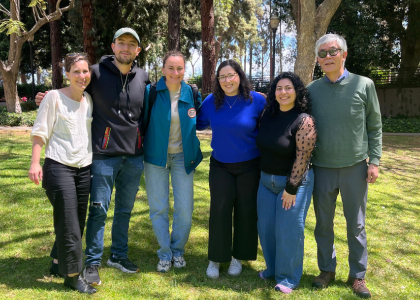
Students in UCLA School of Law’s Immigrants’ Rights Policy Clinic secured a major legal victory in April when they helped free a man from ICE detention. It was a success that put a human face on their legal studies and sharpened their focus on the real difference that lawyers can make.
During the Spring 2026 semester, students in the clinic – which is the teaching arm of the law school’s UCLA Miñana Family Center for Immigration Law and Policy (CILP) – jumped into the knotty fray that has been caused by ICE’s recent detention practices. In Los Angeles, where immigrants make up a significant amount of the population, the need was especially acute: as Talia Inlender, CILP’s deputy director, puts it plainly, ICE’s actions “are tearing families apart.”
Inlender teaches the clinic with Distinguished Professor Hiroshi Motomura, who is CILP’s faculty co-director. Sofía López Franco, CILP’s staff attorney, also worked with students on the case.
It was a prime opportunity for them to play out UCLA Law’s founding mission and serve their neighbors. They immersed themselves in the fast-evolving law of habeas corpus as it applies to immigrants in detention. Key to their work was an ambitious project where they developed practice templates that they shared with hundreds of Southern California attorneys, who could then rapidly challenge ICE’s re-detention of people in ongoing removal proceedings at their ICE check-ins by using federal court petitions for habeas relief. It is an issue that CILP and its partners at the Center for Human Rights and Constitutional Law are now litigating in the class action lawsuit Fanfan v. Mullin, which challenges this practice.
But the even greater impact came when they used those resources, including preparing and submitting an extensive habeas petition of their own, to secure the release of their client, JB. The father of an eight-year-old boy, JB had been detained while complying with ICE’s request that he appear at a check-in in Los Angeles, only to be arrested without process and held at the Otay Mesa Detention Center in San Diego for more than seven months. Thanks to a pilot program that allows law students to represent clients in the U.S. District Court for the Southern District of California – and UCLA Law dean Michael Waterstone’s certification of their readiness to do so – the students saw the case through, at every step, to its conclusion.
“The students showed extraordinary commitment,” Inlender marvels. “They traveled to Otay Mesa over spring break to meet with their client, worked over nights and weekends to prepare pleadings, and finally welcomed him back home to Los Angeles.”
Within hours of JB’s release, he got off a bus in downtown Los Angeles at 1:30 a.m. The clinic team greeted him there, decked out in UCLA Law hoodies, early on that weekend morning, with gifts for him and his son. It was a moment that brought some of them to tears of joy.
“At a time where the need for habeas representation is greater than ever, the clinic team was able to step in, secure the release of our client, and reunite him with his family,” Inlender says. “While they awaited a decision in the case, the students traveled to Sacramento, where they shared their client’s story with state legislators. It highlighted the important role that law students can play in changing the lives of their individual clients through pro bono representation and in contributing to broader efforts involving strategic litigation and policy advocacy to push back against the targeting of immigrant communities.”
“Being part of the team that helped someone regain his freedom was one of the most meaningful experiences I have had in law school – and in my whole life.”
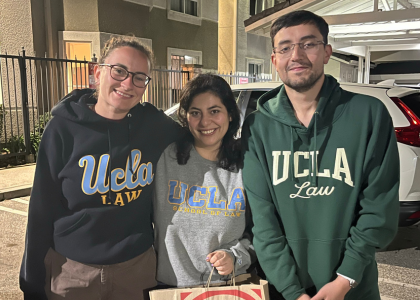
For several of the students, the work felt particularly personal.
“Being part of the team that helped someone regain his freedom was one of the most meaningful experiences I have had in law school – and in my whole life,” says Camilo Suárez LL.M. ’26, who became a lawyer in his native Colombia and then immigrated to the United States. He recently completed his LL.M. degree at the law school – he was a featured speaker at UCLA Law’s 75th commencement ceremony in May – and he plans to take the California bar exam, with an eye toward serving immigrant communities in his legal practice.
“Professor Inlender was actually the first person I connected with at UCLA Law, even before the semester started, and that early connection with her and her work made me interested in the clinic,” he says. “Before coming to UCLA, I had already worked closely with immigrant communities and had seen how difficult it can be for people to navigate the immigration system, especially when they do not have meaningful access to counsel or do not feel heard. The clinic helped me understand that advocacy can happen at many levels: with an individual client, through litigation, through policy work, and through efforts that change the conditions affecting entire communities. After this experience, I am even more certain that I want to continue working with immigrant communities, fighting for access to justice, and helping ensure that the rule of law protects people who are often ignored or silenced.”
Jessie Rich ’27 just finished her 2L year at UCLA Law and is working at the civil rights and criminal defense firm of McLane, Bednarski & Litt in Pasadena this summer. Preparing for a career in public interest lawyering, she participated in the clinic because it piqued her concern for immigration law and tapped into her connection with clients like JB.
“Given the current political climate, I felt a pressing need to be involved in immigrants’ rights advocacy in some form, and the clinic seemed like a great fit,” she says. “Issues of immigration affect all other areas – criminal defense, housing, employment, et cetera. But throughout my career prior to and during law school, I felt that when I had clients facing immigration issues, it was a total blind spot for me. I didn’t want to have this blind spot anymore.”
For Alexandra Sarkis ’26, the experience is one that she will build on as she embarks on her career as an Equal Justice Works fellow at the Immigrant Defenders Law Center, where she will prepare habeas petitions.
“This helped tremendously prepare me for my fellowship, as it is exactly the kind of work I’ll be doing very soon,” she says. “The experience was great because I got to work with the best mentors and team – such dedicated advocates who were not only committed to our client but also supportive of each other, personally and professionally.”
And she, adds, she will never forget this case. “Finding out that my client was released was incredible! It reminded me that the rule of law does still exist,” she says. “It reminded me that attorneys are very powerful and can use that power to do good in this world.”