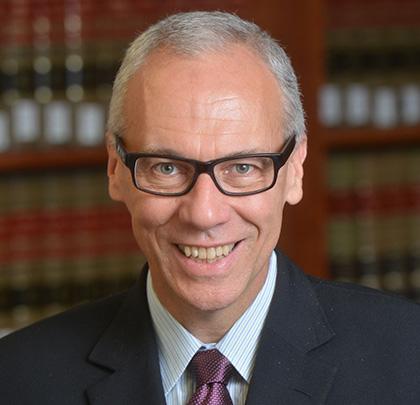
UCLA School of Law Professor Edward Parson has published an editorial in Science, the world’s leading scientific journal, calling for more research on solar geoengineering.
Solar geoengineering is a potential way to complement deep emissions cuts and adaptation measures in an integrated response to climate change. It would help make the Earth a little more reflective to incoming sunlight, most likely by spraying a fine mist of reflective aerosols in the upper atmosphere.
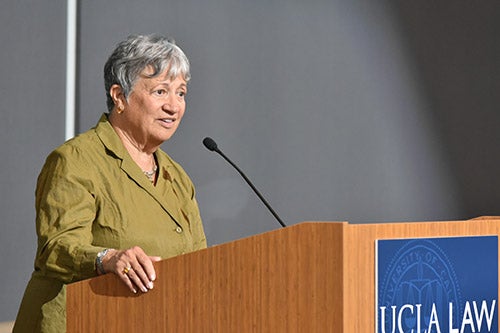 Mary Nichols, one of the country’s foremost environmental attorneys, has joined UCLA School of Law and the Emmett Institute on Climate Change and the Environment as distinguished
The California Environmental Legislation & Policy Clinic gives students a unique opportunity to experience the legislative process in California through direct work with legislative staffers and engagement with advocates and stakeholders. Students work on cutting-edge environmental issues, contributing to innovative legislative solutions, and gain a nuanced understanding of what it takes to make law in California.
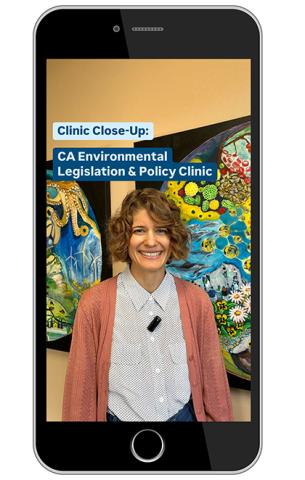
Clinic Close-up: California Environmental Legislation & Policy
The Emmett Institute on Climate Change & the Environment's California Environmental Legislation & Policy Clinic provides students a hands-on experience in California's legislative process, working directly with legislative staffers on cutting-edge environmental issues.
-
Clinic Faculty
Julia Stein is the Deputy Director for the Emmett Institute on Climate Change and the Environment at UCLA School of Lawand Supervising Attorney for the Frank G. Wells Environmental Law Clinic. Prior to coming to UCLA, she practiced at large private firms in Los Angeles, focusing on environmental litigation, regulatory compliance, and land use practice, including litigating complex environmental cases in state and federal court, advising clients on compliance with state and federal environmental regulations, and assisting clients through land use entitlement and development processes. She also has experience lobbying, drafting legislation, and orchestrating research and comments on significant regulations.
Stein earned her B.A. cum laude from Georgetown University, and her J.D. from Georgetown University Law Center. During law school, she was a Global Law School and Teaching Fellow, and Senior Editor of the Georgetown International Environmental Law Review. Full bio.
-
Selected Student Work
Research, support and testimony on behalf of AB 779, introduced by Assemblymember Lori D. Willson. During the 2022-2023 legislative session, students helped write this bill, which focused on improving the legal process when disputes over groundwater land in court. Read the Legal Planet blog post by students and the UCLA Newsroom article about the bill.
Research support for major legislation to cut single-use plastics. In 2022, the governor signed SB 54, the comprehensive legislation introduced by Senator Allen to significantly reduce single-use waste over the next decade.
Research support for AB 2243. Developed through a collaboration between the students and Assemblymember Garcia’s office this, 2022 bill pushed CalOSHA to strengthen air quality standards for farmworkers.
Research support for SB 63, a bill by Senator Stern to help local communities strengthen wildfire prevention efforts and also provide state funding to diminish the damage caused by fires. Read a Legal Planet blog post by the students on their project and a UCLA Newsroom article about their research.
Research support for a legislative proposal to create a state-level revolving loan fund enabling local governments to purchase and lease back property at eventual risk of sea-level rise impacts, which passed the Legislature twice (SB 83 (2021) and SB 1079 (2022)) but was ultimately vetoed both times. This novel approach to sea-level rise would have been the first state-level program of its kind in the nation. Read an NPR story with Deputy Director Julia Stein about the policy.
-
Student Experiences
"I've always been fascinated by the workings of the California Legislature. The clinic showed me what it means to be a legislative lawyer and how exciting that work can be. While law school often requires students to explore the interrelationship between the law and public policy goals, the clinic gave us the chance to design public policy from the ground up. We thought it would be difficult to contribute in an area that has received so much expert attention. This assumption proved untrue. By bringing together ideas from different fields, exploring initiatives in other states, and prioritizing community-based programs, we were able to reimagine how resources might be allocated to prevent wildfire in Southern California."
-- Michael Cohen ’21
"Working on the wildfire research project was incredibly rewarding because we were trying to think of solutions to a real and immediate problem. Whereas a lot of law school entails working on abstract academic exercises or hypotheticals, through the clinic we were able to use our legal research, writing, and analysis skills to produce a work product that would be used to make actual policy changes. It was surreal to be doing research or meeting with my team members while the sky outside was dark orange and the air filled with smoke. Tackling this project during such a bad fire season really brought a sense of purpose to our work. Through the clinic, I had to identify a problem, conduct extensive research about why it exists, and write a well-reasoned and structured proposal about how to fix it. I think this is what I’ll often be asked to do as a lawyer. At the end of the day, lawyers are problem solvers, and the clinic allowed me to wrestle with one very complicated problem over the course of a semester."
-- Leeza Arbatman ’22
"It was an exciting challenge to gather up such a large volume of information and translate it into effective policy. We spoke with a variety of experts from many different fields, and many of them had opposing views on what effective wildfire management should entail. These contradictions highlighted the importance of gathering information from a wide variety of sources with different perspectives, values, and priorities when developing effective policy. It has been incredibly rewarding to see that our hard work translated into real, tangible change, and I hope these measures help to protect Californians from the threat of wildfires."
-- Shawna Strecker ’22
"It felt extremely rewarding to work on live issues with a live client-- legislation amendments for committee consultants that may actually be implemented. This clinic helped me develop and refine a legislative skill set that's a great tool in the larger advocacy toolbox."
-- Amanda Dworkin ’20
"The clinic was the perfect way to familiarize myself with the complexities of legislative advocacy, policy making, and bill drafting. A lot of the post-graduate jobs I have been applying for are policy oriented. Being able to talk confidently during interviews about my work for the CA legislature has been really helpful."
-- Matthew Simmons ’20
"My favorite part of the clinic was having substantial freedom and independence with amazing guidance from Professor Stein. I got to craft legislation from whole cloth, and while this was inherently challenging and overwhelming, the sky was the limit. It was a lot of on-the-fly learning, and every time something came up, it was on me to figure out how to solve the problem. I had the freedom to be creative and institute patchwork solutions drawing upon a multiplicity of laws. I would recommend the clinic to any and everyone. It doesn't matter if you're not focused on environmental [law] or not aiming to be a legislator or policy person. The problem solving and out of the box thinking skills are transferable and fungible, and the experience was rewarding beyond my expectations."
-- Emme Tyler ’21
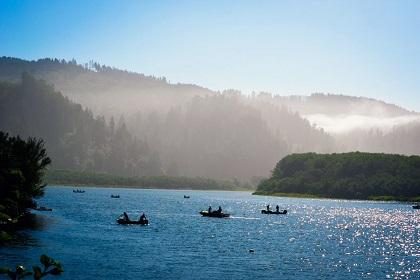
For thousands of years, the Yurok people have looked to the Klamath River Basin close to California’s northern border for a rich variety of nutritional and cultural sustenance: salmon from the river, elk and berries from the forests, and mussels and clams along the coast, among other culturally significant species. But the arrival of European settlers in the 19th century brought changes that impeded tribal members’ ability to harvest on their ancestral territories.
On July 19, 2021, Cara Horowitz, Co-Director of the Frank G. Wells Environmental Law Clinic, wrote to staff of the Los Angeles County Board of Supervisors to share information relevant to the potential phase-out of oil and gas production activities in the Inglewood Oil Field, the largest urban oil field in the U.S., and to provide an assessment of how to accomplish such a phase-out. The letter was researched and drafted by Clinic students Madison Dipman ‘22 and Reilly Nelson ‘22 and was submitted on behalf of Clinic client the Natural Resources Defense Council.
Scholars from UCLA School of Law’s Promise Institute for Human Rights played a key part in defining the new crime of ecocide, which could have significant implications for battling climate destruction.
-
J.D Environmental Law
-
J.D. International and Comparative Law
On June 10, 2021, ten Emmett Institute faculty members submitted comments to EPA supporting the Corporate Average Fuel Economy Preemption rule, which would repeal the Safer Affordable Fuel-Efficient Vehicles Rule Part One: One National Program rule (2019 Rule). The comment letter argues the 2019 Rule contravened Congress’ intent in enacting the Energy Policy and Conservation Act and its subsequent amendments, relied on dubious legal authority to adopt a preemption determination, and failed to adhere to bedrock principles of administrative procedure.