25 Years After 9/11: Reimagining Freedom, Justice, and Security

Event registration is now closed. Limited in-person, day-of event registration will available for current students and faculty with a Bruin Card. All such registrants will be directed to the over-flow room as the main room is already at capacity.
Twenty-five years after the attacks of September 11, 2001, the legal, political, social, and technological transformations initiated in response to the attacks continue to profoundly shape law and society. The attacks killed nearly 3,000 people, forever altering the lives of their families, communities, and the nation. In response, the government declared a global “War on Terror” and vowed to enhance the nation’s security. The post-9/11 era ushered in sweeping expansions of state power with which we all live to this day. These developments transformed domestic and international law while reshaping the lives of people both in the U.S. and abroad who were targeted by racialized national security policies, immigration enforcement, policing, and war.
Over the past quarter century, many of the state responses forged during the “War on Terror” within the U.S. have expanded. From border militarization and mass industrialized surveillance to the normalization of endless war, suppression of dissent, intensified policing and more, the infrastructures of the post-9/11 security state continue to reverberate across political and legal life. Over time, the boundaries between foreign war, domestic policing, and state and corporate actors have increasingly collapsed; the distinction between emergency national security measures and routine domestic governance has become blurred; and surveillance infrastructures, counterterrorism frameworks, and militarized tactics now circulate across borders, shaping the government’s responses to domestic protest movements, migration, and routine criminal activity alike.
The frameworks created by the state response to 9/11 were no less significant overseas. Contemporary conflicts and crises, including the ongoing genocide in Gaza, renewed war across the Middle East, the global rise of authoritarianism, and attacks on protest movements around the world continue to be shaped by the legal frameworks and practices arising from the “War on Terror.”
Twenty-five years later, the post-9/11 legal order raises urgent questions about how “security” has been mobilized to justify state violence, exclusion, surveillance, and the erosion of freedom. At stake are fundamental questions about the future of the rule of law, human rights, and democratic life in an era defined by securitization and permanent emergency.
This symposium brings together legal scholars, practitioners, and others from across various disciplines to examine the enduring legacies of 9/11; the ways the legal and political architecture of the post-9/11 era continues to shape contemporary debates about race, migration, surveillance, war, technology, policing, and international law; and think collectively about how to chart a better path forward.
Sponsored by the UCLA School of Law’s Critical Race Studies Program, International & Comparative Law Program, Institute for Technology, Law & Policy, Miñana Family Center for Immigration Law & Policy, and The Promise Institute for Human Rights.
This symposium is free and open to the public. Those who wish to help support the costs of the symposium may make a contribution here.
NOTE: UCLA School of Law is a State Bar of California approved MCLE provider. This symposium is approved for MCLE credit.
For any questions, please contact crs@law.ucla.edu.
Symposium Program
-
5:00 – 5:30 PM: Registration
5:30 – 5:45 PM: Welcome
- James Park, Vice Dean for Community, Equality and Justice, Professor of Law, UCLA School of Law
- Jasleen Kohli, Executive Director, Critical Race Studies Program, UCLA School of Law
5:45 – 7:15 PM: From Crisis to Legacy: 25 Years of the War on Terror and the Struggle to Reimagine Freedom, Justice, and Security
Twenty-five years after September 11, 2001, the legal, political, and social transformations set in motion in its aftermath continue to shape governance, conflict, and everyday life. This opening plenary brings together three distinguished leaders whose scholarship, advocacy, and organizing have been central to understanding and challenging the enduring legacies of the post 9/11 era.
Drawing on perspectives from international law, constitutional law, civil rights advocacy, and community organizing, the panel will examine how responses to 9/11 reconfigured the relationship between security and liberty. The conversation will explore the evolution of the legal frameworks that have governed armed conflict, detention, surveillance, targeted killing, and other areas that have seen dramatic expansions of executive power, alongside the expansion of domestic security institutions and the profound consequences of racialized national security policies for Muslim, Arab, and South Asian communities in the United States.
The discussion will also consider how these developments have reshaped democratic institutions, normalized exceptional forms of state power, and influenced broader debates about immigration, policing, and civil rights. Looking ahead, the panelists will reflect on the future of the legal and political architectures built in the name of national security, asking what has been entrenched, what may be changing, and what alternative visions of freedom, justice, and collective security are possible.
As the opening conversation for the symposium, this plenary will set the stage for a critical reassessment of the post-9/11 era and invite participants to imagine futures beyond the frameworks of fear, exclusion, and militarization that have defined the past quarter century.
Panelists:
- Hussam Ayloush, Chief Executive Officer, Council on American-Islamic Relations, CA
- Aslı Ü. Bâli, Howard M. Holtzmann Professor of Law, Yale Law School
- Mohammad Tajsar, Director of Immigrants’ Rights, American Civil Liberties Union of Southern California
- Moderator: Ahilan Arulanantham, Professor from Practice and Faculty Co-Director, Miñana Family Center for Immigration Law and Policy, UCLA School of Law
UCLA School of Law is a State Bar of California approved MCLE provider. This session is approved for 1.5 hours of MCLE credit.
7:15 – 9:00 PM: Dinner
-
8:00 – 8:45 AM: Registration
8:45 – 9:00 AM: Moment of Remembrance and Opening Remarks
- Ahilan Arulanantham, Professor from Practice and Faculty Co-Director, Miñana Family Center for Immigration Law and Policy, UCLA School of Law
9:00 – 10:00 AM: 9/11 and the Transformation of the Jus ad Bellum: Twenty-Five Years Later
This panel will examine how responses to the September 11, 2001, terrorist attacks transformed the international law governing the use of force and continues to shape contemporary conflicts. In the aftermath of 9/11, the United States and its allies advanced an expanded understanding of non-international armed conflict that enabled the “global war on terror” to transcend traditional geographic and temporal limits. The attacks also prompted significant developments in the law of self-defense under Article 51 of the UN Charter, including the claim that large-scale attacks by non-state actors may trigger the right to use force even absent direct state attribution. Related doctrines, including the controversial “unwilling or unable” test, further expanded claims regarding when and where force may be used against non-state actors operating within the territory of another state.
The panel will explore the evolving role of the UN Security Council in legitimizing counterterrorism operations, NATO’s unprecedented invocation of Article 5 following 9/11, and the long-term implications of these developments for collective security. Drawing on contemporary conflicts, panelists will assess whether post-9/11 legal paradigms have normalized increasingly expansive claims of wartime authority and weakened the prohibition on the use of force. The discussion will consider whether—and under what conditions—states can renew their commitment to the Charter framework and strengthen legal constraints on the resort to force in pursuit of a more peaceful international order.
Panelists:
- Tom Dannenbaum, Professor of Law, Stanford Law School
- David Glazier, Professor of Law, LMU Loyola Law School
- Saira Mohamed, Agnes Roddy Robb Chair in Jurisprudence, Ethics, and Social Responsibility and Professor of Law, UC Berkeley School of Law
- Rachel E. VanLandingham, Professor of Law and Lt Col, USAF (ret.), Southwestern Law School
- Moderator: Jessica Peake, Professor of Law and Director, International & Comparative Law Program, UCLA School of Law
This panel is led by the UCLA International & Comparative Law Program. UCLA School of Law is a State Bar of California approved MCLE provider. This session is approved for 1 hour of MCLE credit.
10:00 – 10:15 AM: Break
10:15 – 11:30 AM: Torture, Rendition, and Detention: The Erosion of the Rights Regime post 9/11
This panel will examine what happened after 9/11 and how US law and international human rights regimes have responded to (and have changed due to) the increased counterterrorism authority that the US executive, and executives around the world, have claimed post 9/11. The focus will be on torture, rendition (including both extraordinary rendition and rendition to 3rd country detention in the immigration context today), and changes in detention regimes (both Guantanamo and immigration detention expansion).
Panelists:
- Amanda M. Klasing, National Director of Government Relations and Advocacy, Amnesty International USA
- Melanie Partow, Trial Attorney, Military Commissions Defense Organization
- Steven M. Watt, Senior Counsel, Human Rights Program, American Civil Liberties Union
- Moderator: Richard L. Abel, Michael J. Connell Distinguished Professor of Law Emeritus and Distinguished Research Professor, UCLA School of Law
This panel is led by The Promise Institute for Human Rights. UCLA School of Law is a State Bar of California approved MCLE provider. This session is approved for 1.25 hours of MCLE credit.
11:30 AM – 12:30 PM: Lunch
1:00 – 2:15 PM: Borders, Migration, and National Security
The Department of Homeland Security (DHS) was created in 2002 to address national security concerns in the aftermath of the September 11 attacks. Over the last 25 years, however, DHS has expanded its reach to become the largest law enforcement agency in the U.S. And in recent years, much of that growth has focused on restricting immigration and eroding longstanding protections for all immigrants, from asylum seekers at the U.S. border to people who have lived in the country for decades. A panel of experts will discuss how the fight against terrorism has been weaponized in the immigration context, and what the future may hold for immigrants, now 25 years after the 9/11 attacks.
Panelists:
- Hiroshi Motomura, Susan Westerberg Prager Distinguished Professor of Law and Faculty Co-Director, Miñana Family Center for Immigration Law and Policy, UCLA School of Law
- Jennie Pasquarella, Interim Executive Director, the Seattle Clemency Project
- Silky Shah, Executive Director, Detention Watch Network
- Moderator: Julia Preston, Journalist and Author, Preston Report
This panel is led by the UCLA Miñana Family Center for Immigration Law and Policy. UCLA School of Law is a State Bar of California approved MCLE provider. This session is approved for 1.25 hours of MCLE credit.
2:15 – 2:30 PM: Break
2:30 – 3:45 PM: The Racialization of the War on Terror
The “Global War on Terror” declared by the United States government after 9/11 created new forms of and expanded existing state power, ostensibly race-neutral but racialized in enforcement. Concepts such as “radical Islam,” “political Islamist,” and “terrorist activity” criminalized religious identity, beliefs, and practices the U.S. government determined were threats to Western state hegemony in Muslim majority countries and White Christian nationalism in the homeland. The deeply racialized terms granted the state and private actors license to target Muslims and other racialized groups. Once normalized, the rights infringing practices expanded to a broad range of political activity challenging the status quo.
Panelists will discuss how “terrorism” and “material support” as concepts were deployed in racial terms; racial surveillance in mosques and later of “Black identity extremists”; contemporary anti-immigrant state action against racialized subjugated people under the guise of combatting “terrorism”; and the various black-listing and designation schemes, including the Department of Homeland Security’s “Designated Terrorist Organization” list, the “No-Fly” list, the Office of Foreign Assets Control’s “Specially Designated Nationals” list, and others. The panel will also discuss how these concepts have been weaponized to punish certain forms of dissent and protest in the United States, including political opposition to the genocide in Gaza.Panelists:
- Amna A. Akbar, Benjamin N. Berger Professor in Criminal Law and Professor of Law, University of Minnesota Law
- Sunita Patel, Professor of Law and Faculty Director of the UCLA Veterans Legal Clinic, UCLA School of Law
- Wadie Said, Professor of Law, University of Colorado Law School
- Moderator: Sahar Aziz, Distinguished Professor of Law and Chancellor's Social Justice Scholar, Rutgers Law School
This panel is led by the UCLA Critical Race Studies Program. UCLA School of Law is a State Bar of California approved MCLE provider. This session is approved for 1.25 hours of MCLE credit.
3:45 – 4:00 PM: Break
4:00 – 5:00 PM: Security, Surveillance, and the Quest for Total Information
The establishment of the Department of Homeland Security, created as a response to 9/11, gathered 22 different government agencies under the banner of security. Agencies with functions as disparate as immigration enforcement, disaster response, biological warfare defense, and infrastructure protection were united under a single umbrella. More than bureaucratic reshuffling, the establishment of DHS inaugurated a new way of thinking about risk, uncertainty, and the future.
Security is an ever-moving target, one that is productive in its indeterminacy. In the 25 years since 9/11, the logic of security has been used to justify mass surveillance, wiretapping, searches of electronic devices at the border, and other incursions into civil liberties. Fear of the unknown has driven the development and adoption of data-driven, black box systems that purport to predict the future, while anxieties over “strangers at the gates” have spurred the creation of terrorist watchlists and biometric identification at every border checkpoint.
This panel will explore the technologies and forms of data collection that have been pursued in the name of national security. Panelists will discuss how the focus on national security has produced new forms of insecurity and reflect on which groups have been most affected by these developments. Drawing on examples from grassroots organizing in Southern California, panelists will also share how communities have fought against the encroachment of surveillance technology in their cities and neighborhoods.
Panelists:
- Lilly Irani, Professor of Communication & Science Studies and Faculty Director, UCSD Labor Center, UC San Diego; Community organizer, TRUST SD Coalition
- Shakeer Rahman, Attorney, Stop LAPD Spying Coalition
- Nina Toft Djanegara, Fellow, UCLA Institute for Technology, Law & Policy, UCLA School of Law and Samueli School of Engineering
- Moderator: Ameena Mirza Qazi, Attorney, Mirza Law Office and Consulting, PC
This panel is led by the UCLA Institute for Technology, Law & Policy. UCLA School of Law is a State Bar of California approved MCLE provider. This session is approved for 1 hour of MCLE credit.
- Ahilan Arulanantham, Professor from Practice and Faculty Co-Director, Miñana Family Center for Immigration Law and Policy, UCLA School of Law
Frequently Asked Questions
-
Date and Time of Symposium
The symposium is an in-person event and will not be streamed live or recorded.
Thursday, September 10, 2026
- 5:00–5:30 PM – Registration
- 5:30–7:00 PM – Opening Plenary
- 7:00–9:00 PM – Dinner Reception
Friday, September 11, 2026
- 8:00–8:45 AM – Registration & Breakfast
- 8:45 AM–5:00 PM – Symposium
Cost
The symposium is free and open to the public, but registration is required.
This event is made possible through the support of the sponsoring UCLA Law programs listed above. If you would like to help defray the costs of the symposium and support our ability to offer programs like this free of charge, we welcome contributions of any amount.
Donations may be made through the Critical Race Studies Program Fund and will be used to support the costs of the symposium.
Parking at UCLA
There are several bike parking stations near the law school where you can park your bike/scooter. You may find a map of the biking parking areas here.
Lots 2 and 3 are the closest lots to the law school, and a map is attached showing their location.
Map of the Campus with Labels for the Law School, Lot 2 and Lot 3It is a 10-15 minute walk from the parking lots to the law school.
Parking costs range from $5 per hour to $33 for an all-day pass. Average day pass is $18. More information here.
Disability Parking Options
Dickson Court: Disabled parking is available directly in front of the law school on Dickson Court.
If you’re entering campus from Hilgard Avenue, make a left onto Charles E. Young Drive East. Continue down the road until you reach Dickson Court- please note, you’ll be required to make a right turn at this point.
You’ll find designated disabled parking spots on both sides of Dickson Court. Signage will be posted with instructions on how to pay for parking.
Lot 2 (Alternate Option): If disabled parking spots are not available on Dickson Court, please proceed to Parking Lot 2, where you may park in any of the "pay-by-space" disabled parking stalls.
How to Pay for Parking
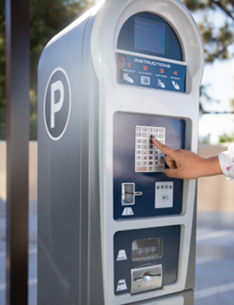
- Park in any unreserved stall in a Pay-by-Plate area.
- Visit the nearest pay station machine.
- Enter your license plate number using the number pad.
- Keep your printed permit as a receipt.
If your vehicle does not have a visible license plate, enter the last six digits of your VIN and display the permit on the driver’s side dashboard.
Transportation to UCLA
There are several public transportation options available to get to UCLA, read more here.
Several bus lines travel along Hilgard Ave. from Sunset Blvd. with stops within a short walk to the law school (located at Hilgard & Wyton Ave).
The closest and most convenient stop is at Hilgard & Westholme Ave — about a 5-minute walk.
Due to traffic congestion, we recommend allowing extra time and consulting your bus provider's trip planner.
Rideshare
Use this address when calling a rideshare:
385 Charles E. Young Dr. East, Los Angeles, CA 90095
Hotels & Lodging
The below hotel offers special discounts for booking your stay with them for the Symposium, subject to room availability:
Hotel Angeleno - Symposium Discount Available
Distance: 3.1 miles from UCLA Law
Rate: $169/night + tax for King size rooms and $189/night for Double size rooms
Taxes: 16.2% (not included in the rates above)
Valet Parking: $25/day (discounted)
Booking Reservation Link (please be sure to book through this link): UCLA School of Law Booking Link
Address: 170 N. Church Lane, Los Angeles, CA 90049
Phone: (310) 476-6411The following hotels are all located within 5 miles of the UCLA School of Law, and though they do not currently offer any special discounts for Symposium guests, they are recommended by our staff. Please find the contact information for these local lodging options below:
The Inn at UCLA (conveniently located across from the UCLA campus)
Distance from UCLA School of Law: 0.1 miles
Phone Number: (310) 825-2923
330 Charles E. Young Drive East
Los Angeles, CA 90095UCLA Tiverton House (located across from the UCLA campus)
Distance from UCLA School of Law: 1 mile
Phone Number: (310) 794-0151
900 Tiverton Avenue
Los Angeles, CA 90024The Luxe Hotel – Sunset (located across the street from the Hotel Angeleno)
Distance from UCLA School of Law: 3.1 miles
Phone Number: (310) 476-6571
Luxe Hotel – Sunset
11461 Sunset Blvd.
Los Angeles, CA 90049
Other Questions/Assistance
If you have other questions or require any accommodations at the symposium, please contact us at crs@law.ucla.edu.

Post-Symposium Response
-
We write as Co-Chairs of the Symposium at UCLA School of Law, 25 Years After 9/11: Reimagining Freedom, Justice, and Security. We are enormously proud of the symposium we organized, and UCLA should be too. We showcased a nuanced and sophisticated set of conversations among more than twenty leading experts who discussed both the successes and failures of state responses in the years since 9/11.
We are disappointed by the media coverage which has grossly distorted the nature of our symposium. It was open to the public, but so far as we can tell, none of the people who have criticized it actually attended, even in part. Had they done so, they would have heard Professor Ahilan Arulanantham, who was in Manhattan on 9/11, memorialize those killed in the attacks and share his recollection of the months that followed. They also would have heard Jasleen Kohli, Executive Director of the Critical Race Studies program, describe how her mother nearly boarded one of the flights that was hijacked and reflect on the devastation for the families for whom that nightmare became real. They and other speakers at the symposium addressed the dual realities we must hold at once: the horror and profound loss of 9/11 itself, including the thousands of lives taken that day and in the years since; and millions of lives lost and devastated by what followed—war, displacement, detention, torture, surveillance, racial and religious targeting, and other forms of violence carried out in the name of the War on Terror.
We are deeply grateful to all of the panelists who shared their expertise throughout the symposium. The University should value the speech of experts who both condemn the 9/11 attacks and object to the grave human rights abuses carried out in response.
Some have criticized our decision to invite a federal employee representing detainees held at Guantánamo Bay, Cuba. The Department of Defense long ago recognized that people facing trial by military commission at Guantánamo are entitled to legal representation. As law faculty, we believe it fundamental that the rule of law requires the service of attorneys willing to represent unpopular clients, particularly in death penalty cases. We value the public servants who undertake such important work.
– Symposium Co-Chairs, writing as independent members of the faculty of UCLA School of Law
Ahilan Arulanantham, LaToya Baldwin Clark, Jasleen Kohli, Jessica Peake, Julia Powles, and Catherine Sweetser
MCLE Information
-
We will be offering CLE credits for each of our sessions. For those seeking CLE credit, please make sure to check in at registration, as this will serve as confirmation of your attendance. Please note that CLE processing will not take place at the registration desk. We will send out follow-up instructions and forms after the symposium.
Panel: From Crisis to Legacy: 25 Years of the War on Terror and the Struggle to Reimagine Freedom, Justice, and Security
- Stretching the Limits of International Law: The Challenge of Terrorism by Aslı Ü. Bâli
- Changes in Immigration Law and Practice After September 11: A Practitioner's Perspective by Aslı Ü. Bâli
- Vasquez Perdomo Supreme Court Stay Order & Dissent
Panel: 9/11 and the Transformation of the Jus ad Bellum: Twenty-Five Years Later
- United States v Najibullah Symposium - Bad Apples Are Still Apples by Rachel VanLandingham
- Has the United States Violated the Law of Armed Conflict in the Iran War? (Podcast) by Tom Dannenbaum, Margaret Donovan, Todd Huntley and Ryan Goodman
- Over 100 International Law Experts Warn U.S. Strikes on Iran Violate UN Charter and May Be War Crimes by Tom Dannenbaum, Rebecca Hamilton, Adil Ahmad Haque, Oona A. Hathaway and Gabor Rona
- Collection: U.S. Lethal Strikes on Suspected Drug Traffickers, Operation Southern Spear, Operation Absolute Resolve by Just Security
Panel: Torture, Rendition, and Detention: The Erosion of the Rights Regime post 9/11
- No Guns, No Drugs—Why Did We Blow Up These Boats? by Amanda Klasing
- Trial Guide: The Sept. 11 Case at Guantánamo Bay by Carol Rosenberg
Panel: Borders, Migration, and National Security
- Borders and Belonging: Toward a Fair Immigration Policy by Hiroshi Motomura
Panel: The Racialization of the War on Terror
- A Muslim Registry: Precursor to Internment? by Sahar F. Aziz
- Race, Entrapment and the Manufacturing of 'Homegrown Terrorism' by Sahar F. Aziz
- State Sponsored Radicalization by Sahar F. Aziz
- Orientalism, Empire and the Racial Muslim by Sahar F. Aziz
Panel: Security, Surveillance, and the Quest for Total Information